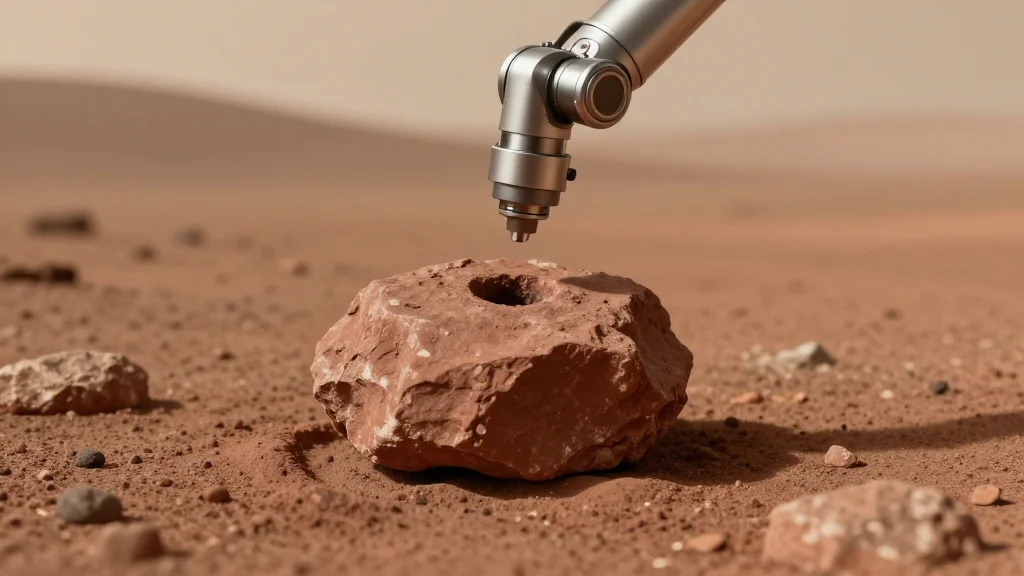
Curiosity Shakes Loose a Pesky Rock
Why It Matters
The episode showcases Curiosity’s mechanical resilience and yields a high‑resolution view of Martian surface material, informing future drilling strategies and geological analysis.
Key Takeaways
- •Atacama rock stuck in Curiosity’s drill on April 25, 2026
- •Engineers used arm repositioning and drill vibration to release it
- •Rock broke into pieces after detaching on May 1, 2026
- •Mastcam image shows 1.5‑ft diameter, 6‑in thick rock with drill hole
- •Sample offers valuable data for Martian geology and future missions
Pulse Analysis
Since its 2012 landing, NASA’s Curiosity rover has become the workhorse of Mars surface exploration, routinely drilling into rocks to collect powdered samples for onboard analysis. The rover’s drill, a 2‑inch rotary‑percussive tool, is designed to penetrate a wide range of lithologies, yet the Atacama rock presented an unexpected challenge. Its dense, cohesive composition caused the drill bit to seize, prompting mission controllers to halt sampling and assess the mechanical fault. This incident underscores the inherent risks of autonomous planetary drilling and highlights the importance of real‑time engineering interventions on distant missions.
The team’s response combined precise arm articulation with controlled vibration of the drill shaft, a technique refined during earlier Mars missions but rarely employed in situ. By incrementally adjusting the arm’s angle and applying low‑frequency oscillations, engineers gradually loosened the rock’s grip, ultimately allowing the rover to extract the specimen on May 1. The successful recovery not only prevented a potentially costly loss of drilling capability but also provided valuable data on the performance limits of Curiosity’s hardware under Martian gravity and temperature extremes. Lessons learned are already feeding into design tweaks for upcoming rovers, ensuring greater resilience against similar entrapments.
Beyond engineering triumphs, the Atacama rock offers a rare geological snapshot. Its reddish‑brown hue, thin stratification, and intact drill hole give scientists a direct view of sedimentary processes that may have occurred billions of years ago. Analyzing the rock’s mineralogy could refine models of past water activity on Mars, complementing findings from Perseverance and the Mars Sample Return campaign. As NASA prepares for more ambitious surface operations, each recovered sample like Atacama strengthens the scientific case for in‑situ resource utilization and informs the selection of future drilling sites, ultimately advancing humanity’s quest to understand the Red Planet’s habitability.
Curiosity Shakes Loose a Pesky Rock
Comments
Want to join the conversation?
Loading comments...