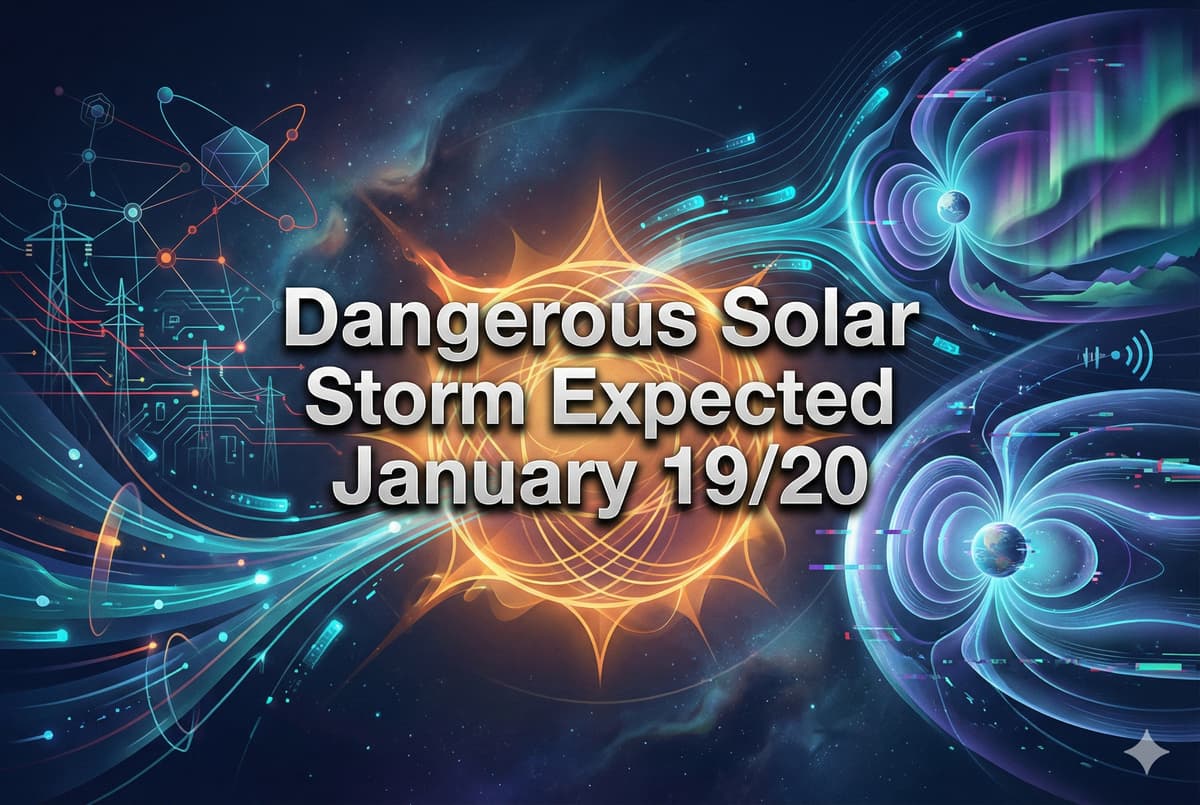
Dangerous Solar Storm Expected January 19/20
•January 19, 2026
0
Why It Matters
The storm could induce geomagnetically‑induced currents that stress electrical infrastructure while also offering rare low‑latitude aurora displays, making timely alerts critical for utilities and aerospace operators.
Key Takeaways
- •X1.9 flare from AR4341 produced full‑halo CME.
- •CME arrival expected Jan 19‑20, possibly G3‑G4 storm.
- •Potential impacts: auroras, power grid currents, satellite drag.
- •Solar Cycle 25 near maximum, increasing X‑class events.
- •Operators advised to monitor NOAA SWPC alerts.
Pulse Analysis
The January 18 solar eruption arrives at a pivotal moment in Solar Cycle 25, when the Sun’s magnetic dynamo is delivering more frequent high‑energy events. While X‑class flares are statistically rare, the combination of a central‑disk flare and a full‑halo CME creates a near‑perfect alignment for Earth impact. Space‑weather models now incorporate real‑time solar wind measurements, allowing forecasters to narrow the arrival window to a few hours and to estimate the likely geomagnetic storm class with greater confidence than in past cycles.
From a technical perspective, the CME’s speed—exceeding 1,000 km s⁻¹—means it will compress the magnetosphere rapidly, driving a shock that can re‑orient the interplanetary magnetic field southward. This orientation is the primary driver of geomagnetically‑induced currents (GICs) that can overload transformers and disrupt high‑frequency radio links. Satellite operators also face heightened drag and surface charging, prompting temporary adjustments to orbital maintenance plans. The storm’s predicted G3‑G4 intensity places it above the threshold where most power‑grid operators activate mitigation protocols, such as load redistribution and transformer monitoring.
For industry stakeholders, the event illustrates the growing economic relevance of space‑weather forecasting. Utilities, aviation firms, and GPS‑dependent logistics companies are increasingly integrating NOAA SWPC alerts into their risk‑management workflows. As the solar maximum progresses, investment in resilient grid designs, hardened satellite components, and automated alert dissemination will become standard practice. Continued research into CME propagation and magnetospheric coupling will improve predictive accuracy, reducing both the financial cost and the public safety risks associated with severe geomagnetic storms.
Dangerous Solar Storm Expected January 19/20
0
Comments
Want to join the conversation?
Loading comments...