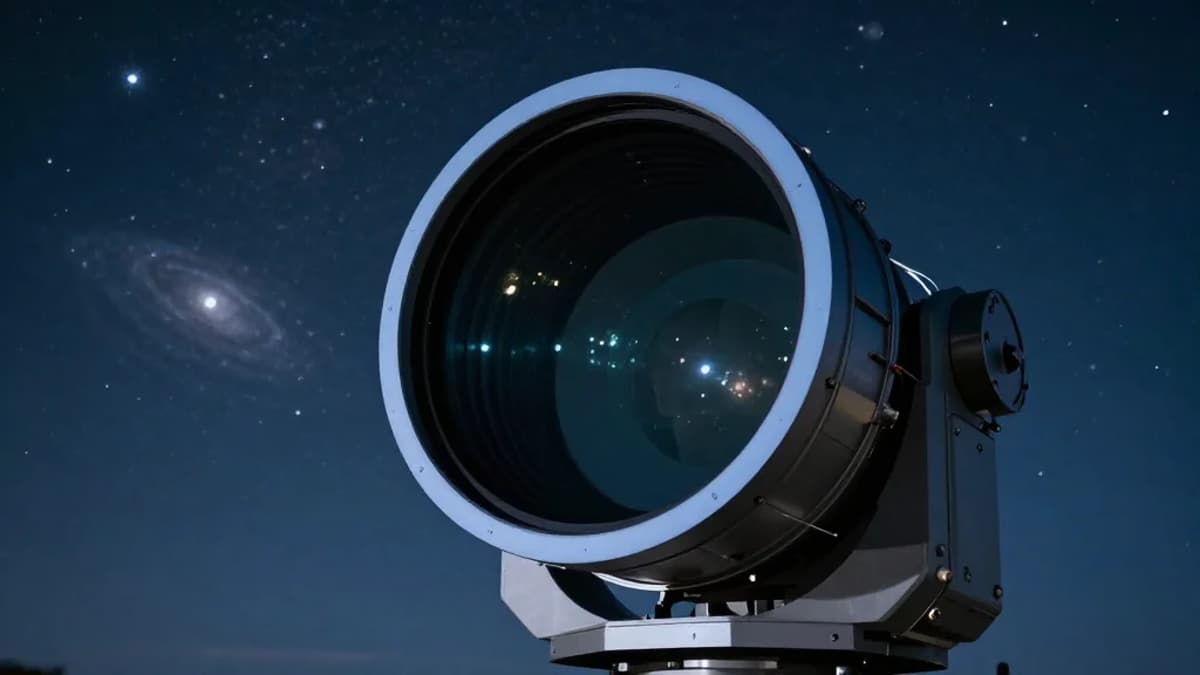
Dark Energy Survey Scientists Release Analysis of All Six Years of Survey Data
•January 22, 2026
0
Why It Matters
Tighter constraints sharpen our picture of dark energy and test the foundations of cosmology, influencing future survey designs and theoretical models. The findings also set a benchmark for upcoming projects like the Rubin Observatory’s LSST.
Key Takeaways
- •All six DES years combined for first comprehensive analysis
- •Cosmological constraints now twice as tight as earlier DES results
- •Data align with standard ΛCDM model, wCDM not favored
- •Persistent tension in galaxy clustering versus early‑universe predictions
- •Findings pave way for Rubin LSST integration and deeper tests
Pulse Analysis
The Dark Energy Survey’s Year‑6 release marks a milestone in observational cosmology, uniting six years of DECam imaging into a single, high‑precision data set. By integrating four independent probes—weak gravitational lensing, galaxy clustering, baryon acoustic oscillations, and Type‑Ia supernovae—the collaboration achieves parameter uncertainties roughly half those of earlier analyses. This methodological synthesis not only maximizes the scientific return on the substantial investment in DECam and the Blanco telescope but also demonstrates the power of multi‑probe strategies for disentangling dark‑energy signatures.
From a theoretical standpoint, the new constraints reinforce the ΛCDM paradigm, confirming a constant dark‑energy density across cosmic time. While the extended wCDM model, which allows a varying equation‑of‑state, fits the data, it offers no statistical advantage, suggesting that any evolution in dark‑energy properties must be subtle. However, the analysis also highlights a persistent tension: the observed clustering of galaxies deviates from predictions based on early‑universe measurements, a discrepancy that survives even when DES data are combined with external surveys. This tension fuels ongoing debates about possible new physics, such as modified gravity or exotic dark‑energy interactions.
Looking ahead, the DES results lay essential groundwork for the Vera C. Rubin Observatory’s Legacy Survey of Space and Time (LSST). LSST will map billions of galaxies with unprecedented depth, and the methodological advances pioneered by DES—especially in weak‑lensing calibration and joint‑probe analysis—will be directly applicable. The synergy between DES’s legacy data and LSST’s forthcoming observations promises to tighten cosmological parameter bounds further, probe the nature of dark energy with greater fidelity, and potentially resolve existing anomalies in large‑scale structure measurements.
Dark energy survey scientists release analysis of all six years of survey data
0
Comments
Want to join the conversation?
Loading comments...