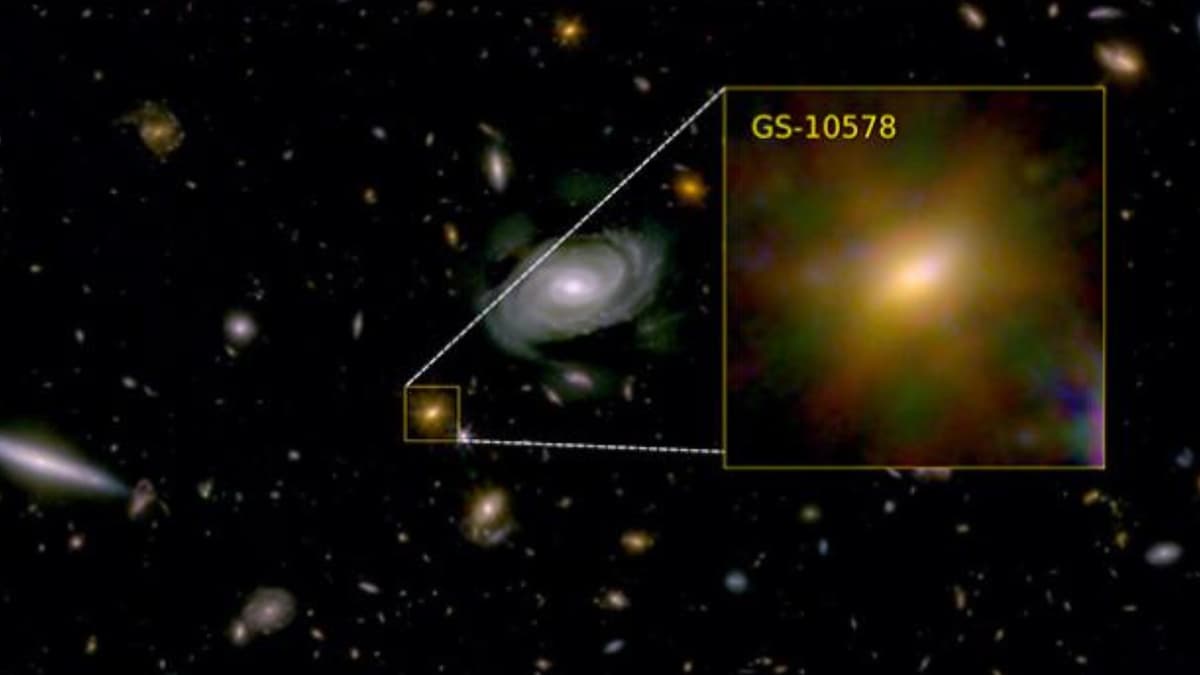
'Death by a Thousand Cuts': James Webb Space Telescope Figures Out How Black Hole Murdered Pablo's Galaxy
•January 13, 2026
0
Why It Matters
Understanding black‑hole‑driven starvation reshapes models of early galaxy evolution and informs predictions of star‑formation shutdown across cosmic time.
Key Takeaways
- •JWST+ALMA reveal black hole starving early massive galaxy
- •No cold gas detected; star formation halted
- •Outflows eject 60 solar masses of gas annually
- •Gas depletion timescale: 16‑220 million years
- •Findings challenge violent quenching assumptions
Pulse Analysis
The discovery of a starving supermassive black hole in a young, massive galaxy underscores the power of next‑generation observatories. JWST’s infrared sensitivity captures the stellar structure of galaxies formed only a few billion years after the Big Bang, while ALMA’s millimeter capabilities trace the cold molecular reservoirs that fuel star formation. By combining these instruments, researchers can probe both the luminous core and the hidden gas supply, revealing a complete picture of how early galaxies acquire and lose their material.
Traditional models of galaxy quenching often invoke dramatic, high‑velocity outflows that blow gas out of the host in a single event. The Pablo’s Galaxy case, however, points to a slower, sustained process where the central black hole continuously ejects gas at speeds of over two million miles per hour, gradually starving the galaxy of the cold hydrogen needed for new stars. This “starvation” mode aligns with theoretical predictions of kinetic feedback but provides the first direct observational evidence at such an early epoch, prompting a reevaluation of the relative importance of gentle versus violent feedback in shaping the galaxy population.
Looking ahead, the findings will inform cosmological simulations that aim to reproduce the observed distribution of star‑forming and quiescent galaxies across time. Incorporating gradual black‑hole‑driven gas depletion could improve predictions of galaxy mass functions and the timing of the cosmic star‑formation peak. Moreover, the methodology—deep, coordinated JWST and ALMA observations—sets a new standard for studying distant systems, suggesting that many more “quietly dying” galaxies may be uncovered as the James Webb mission continues its survey of the early universe.
'Death by a thousand cuts': James Webb Space Telescope figures out how black hole murdered Pablo's Galaxy
0
Comments
Want to join the conversation?
Loading comments...