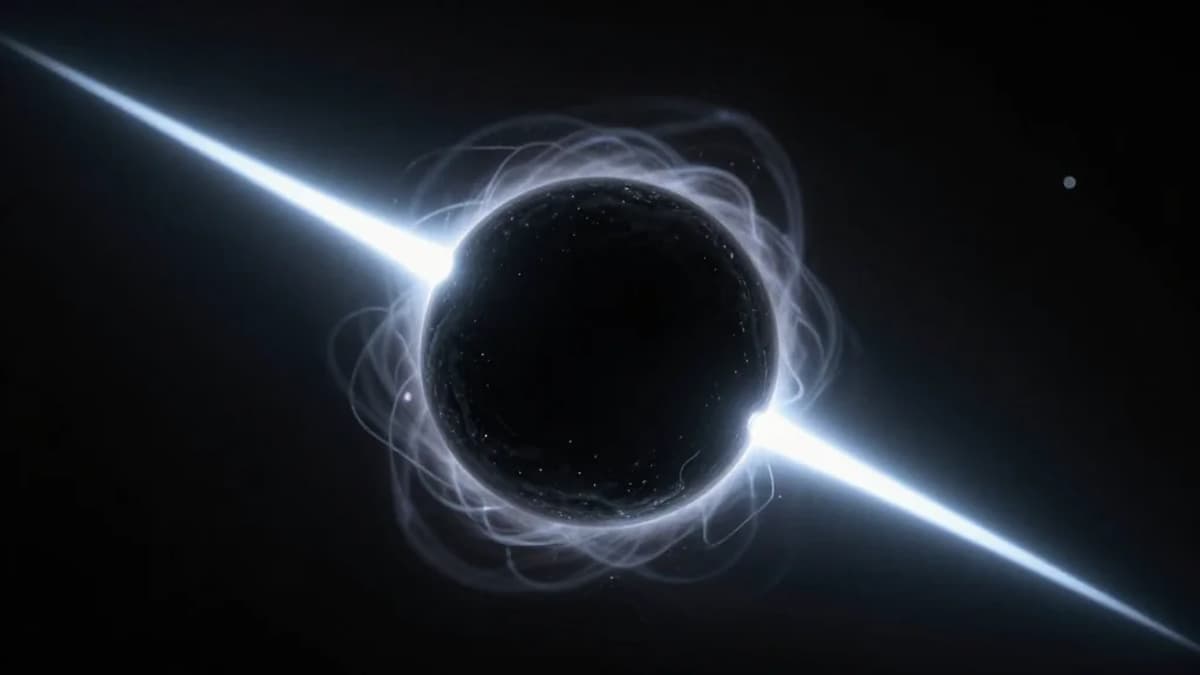
Did We Just See a Black Hole Explode? Physicists Think So—And It Could Explain (Almost) Everything
•February 3, 2026
0
Why It Matters
The hypothesis offers a unified explanation for an otherwise impossible neutrino event and provides a testable pathway to detect primordial black holes, Hawking radiation, and dark‑matter signatures, reshaping fundamental physics and cosmology.
Key Takeaways
- •Quasi‑extremal PBH explosion could emit PeV neutrinos.
- •KM3NeT recorded a 100,000× LHC‑energy neutrino event.
- •Dark charge model links PBHs to dark matter candidates.
- •Explosions predicted roughly every decade, observable with current telescopes.
- •Confirmation would validate Hawking radiation experimentally.
Pulse Analysis
Primordial black holes, first theorized by Stephen Hawking, differ from stellar remnants by forming in the universe’s earliest moments. Their tiny masses make them hot enough to radiate particles via Hawking radiation, a process that accelerates as they lose mass. While the concept has remained largely speculative, recent advances in high‑energy astrophysics have opened a window to detect the final, explosive phase of these objects, offering a rare laboratory for quantum‑gravity phenomena.
The UMass Amherst team’s paper connects this theory to a concrete observation: a PeV‑scale neutrino captured by the KM3NeT detector. Standard astrophysical sources cannot generate such energy, but a quasi‑extremal PBH with a novel dark charge could. This dark charge mimics electric charge but involves a heavy “dark electron,” allowing the black hole to retain charge while evaporating, ultimately triggering an explosive outburst. The model not only reproduces the neutrino’s energy spectrum but also explains why IceCube, with a different detection geometry, missed the event, highlighting the importance of detector orientation and sensitivity.
If future observations confirm these explosions, the implications ripple across multiple sectors. Verifying Hawking radiation would cement a bridge between general relativity and quantum mechanics, while identifying PBHs as dark‑matter constituents could resolve one of cosmology’s longest‑standing puzzles. For the particle‑physics industry, this opens avenues for new detector technologies and data‑analysis frameworks aimed at capturing transient, ultra‑high‑energy signatures. Investors and policymakers should watch for funding opportunities in multi‑messenger astronomy, as the convergence of neutrino, gamma‑ray, and gravitational‑wave observatories promises a transformative era for fundamental science.
Did we just see a black hole explode? Physicists think so—and it could explain (almost) everything
0
Comments
Want to join the conversation?
Loading comments...