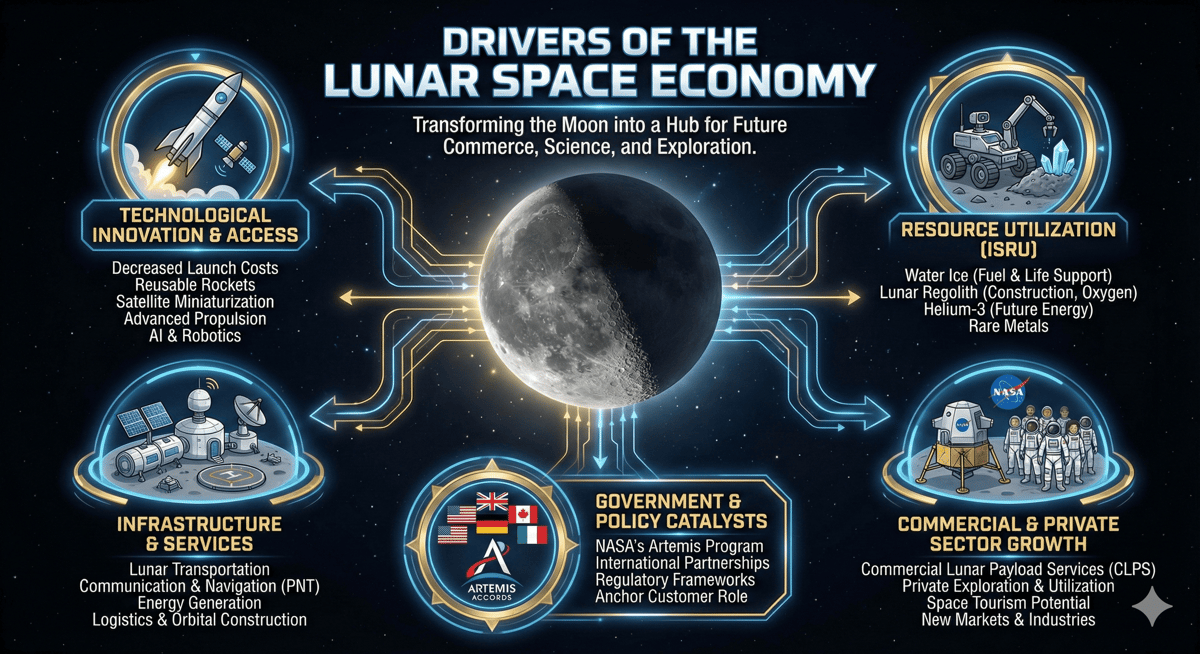
Drivers of the Lunar Space Economy: Demand, Activities, and Future Growth
Companies Mentioned

Why It Matters
A viable lunar economy reshapes aerospace economics, creates new revenue streams, and accelerates technology transfer to Earth, making space a regular commercial frontier.
Key Takeaways
- •Reusable launch vehicles cut payload cost dramatically
- •Lunar water ice enables on‑site propellant production
- •South‑pole solar sites become high‑value real estate
- •ISRU shifts cost structure from Earth‑launch to local manufacturing
- •Public‑private partnerships accelerate lunar infrastructure deployment
Pulse Analysis
The lunar economy’s momentum stems from three interlocking pillars: permanent human habitats, continuous power, and local resources. Sustained presence drives a recurring logistics market, demanding life‑support, food, and equipment resupply—similar to the ISS but on a harsher surface. Energy availability, especially at the south‑pole’s Peaks of Eternal Light, dictates where infrastructure can thrive, while nuclear micro‑reactors promise baseload power for mining and manufacturing. Together, these factors create a demand curve that justifies the massive capital outlays of both governments and private firms.
Commercial launch providers are the linchpin that transforms demand into supply. Reusable heavy‑lift vehicles such as SpaceX’s Starship and Blue Origin’s New Glenn are slashing the cost per kilogram, opening lunar access to research institutions, startups, and eventually tourism operators. The rise of cislunar logistics—orbital tugs, fuel depots, and the Lunar Gateway—decouples launch schedules from surface operations, adding flexibility and fostering a marketplace for payload‑as‑a‑service. Public‑private initiatives like NASA’s CLPS program provide guaranteed revenue streams, encouraging rapid development of landers, rovers, and habitat modules.
In‑situ resource utilization (ISRU) is the economic disruptor that could make the Moon self‑sustaining. Extracting water ice for life‑support and propellant, processing regolith into construction materials, and exploring helium‑3 for future fusion all shift cost structures from Earth‑launch‑heavy to locally sourced production. This not only reduces launch mass but also spawns ancillary markets—space‑based insurance, legal frameworks, and data services. Geopolitical competition intensifies investment, ensuring steady funding while fostering international standards. As the lunar supply chain matures, spillover technologies—advanced solar panels, closed‑loop water systems, and autonomous robotics—will find terrestrial applications, cementing the Moon’s role as both a commercial hub and a catalyst for broader economic growth.
Drivers of the Lunar Space Economy: Demand, Activities, and Future Growth
Comments
Want to join the conversation?
Loading comments...