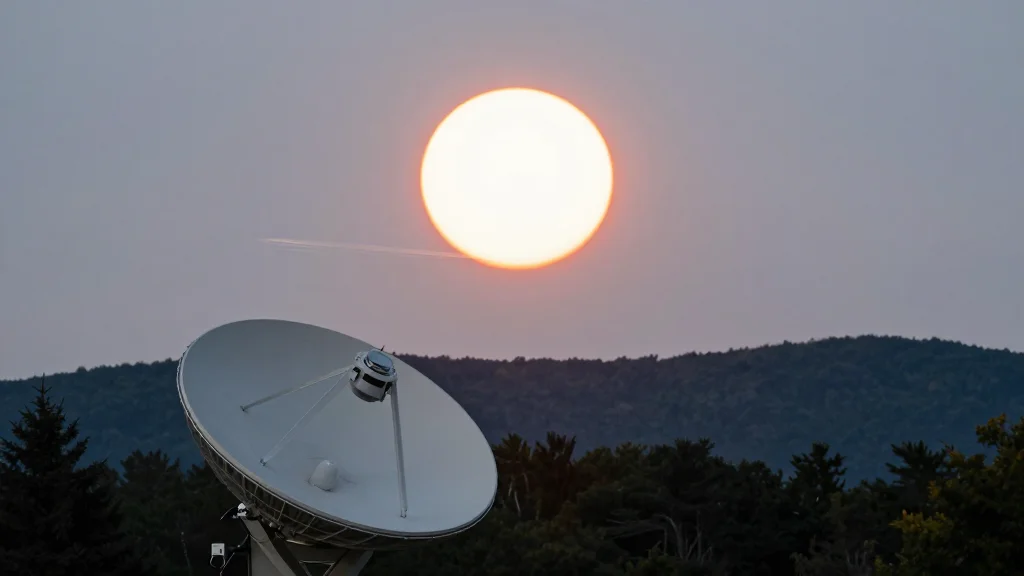
Elephant‑Sized Meteor Rocks New England, NASA Confirms Natural Space Object

Why It Matters
The New England meteor highlights both the scientific intrigue and the practical urgency of planetary‑defense work. While the explosion caused no damage, its energy release—equivalent to 300 tons of TNT—demonstrates that even modestly sized NEOs can generate shockwaves felt over hundreds of miles. The event reinforces the need for continuous, high‑resolution sky surveys and rapid‑response coordination among agencies, private firms, and international partners. Moreover, the public’s immediate reaction—social‑media reports, news coverage, and community curiosity—offers a rare chance to educate citizens about space hazards. By linking the spectacle to concrete defense initiatives, NASA and its partners can build broader support for funding advanced detection systems, potentially accelerating the deployment of next‑generation infrared telescopes and ground‑based radar arrays that could spot similar threats years in advance.
Key Takeaways
- •NASA confirmed a natural meteor, ~3 ft wide and elephant‑weight, exploded 40 mi above New England on May 30
- •Energy release estimated at ~300 tons of TNT, producing a sonic boom heard from Delaware to Montreal
- •Object traveled at ~75,000 mph before fragmenting, detected by NOAA’s GOES‑19 satellite and NASA’s Space Alerts
- •NASA deputy news chief Jennifer Dooren emphasized the event was not space debris or a re‑entry
- •The blast underscores the importance of planetary‑defense monitoring and may spur new funding for NEO detection
Pulse Analysis
The meteor’s sudden appearance over a densely populated region serves as a vivid reminder that space is not an abstract frontier but a tangible risk factor for everyday life. Historically, high‑profile bolides have catalyzed policy shifts—Chelyabinsk spurred renewed interest in the European Space Agency’s Flyeye telescope, and Tunguska remains a benchmark for worst‑case scenarios. This event, though far smaller, arrives at a moment when the commercial space sector is expanding launch cadence and satellite constellations, increasing the volume of objects that must be tracked and de‑conflicted.
From a market perspective, the incident could accelerate investment in next‑generation detection platforms. Venture capital has already flowed into firms developing space‑based infrared sensors capable of spotting NEOs days before impact. The public’s reaction—viral videos, trending hashtags, and a surge in local news coverage—creates a narrative hook that investors and policymakers can leverage to justify budget allocations. In the longer term, the meteor may influence insurance underwriting for aerospace assets, as insurers factor in the probability of atmospheric explosions that could affect ground‑based infrastructure.
Strategically, the event reinforces the value of international data sharing. NOAA’s GOES‑19, NASA’s Space Alerts, and the American Meteor Society’s crowd‑sourced reports together painted a comprehensive picture within minutes. As the planetary‑defense community pushes for a global early‑warning network, this coordinated response could become a template for future incidents, ensuring that the next time a bolide threatens a major metropolitan area, authorities will have both the data and the public awareness needed to respond swiftly and effectively.
Elephant‑Sized Meteor Rocks New England, NASA Confirms Natural Space Object
Comments
Want to join the conversation?
Loading comments...