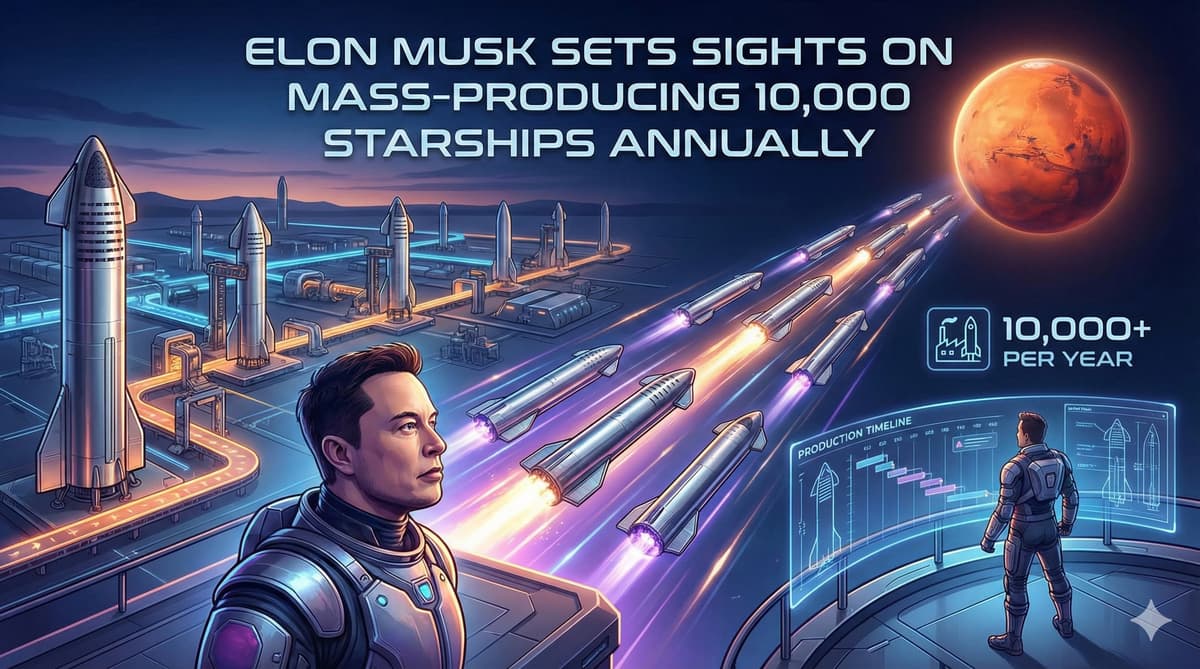
Elon Musk Sets Sights on Mass-Producing 10,000 Starships Annually: A Leap Toward Multiplanetary Life
•January 6, 2026
0
Companies Mentioned


Why It Matters
A 10,000‑ship annual rate would slash launch costs, making space access routine and accelerating humanity’s multiplanetary ambitions.
Key Takeaways
- •SpaceX aims for 10,000 Starships per year
- •Gigabay facility designed for 1,000 ships annually
- •Reusability could cut launch costs dramatically
- •Scaling requires automotive‑style assembly and robotics
- •Regulatory and supply‑chain hurdles remain significant
Pulse Analysis
SpaceX’s push toward producing 10,000 Starships annually marks a paradigm shift in aerospace manufacturing. By treating rockets more like commercial aircraft or automobiles, the company hopes to transition from bespoke, hand‑built vehicles to high‑throughput assembly lines. The Gigabay complex in Texas, already sized for 1,000 units, serves as a testbed for robotics, including Tesla’s Optimus humanoid, that could automate welding, panel installation, and engine integration. This scale mirrors the production cadence of major airlines, promising economies of scale that could drive per‑launch costs down to a fraction of today’s prices.
If realized, such volume would transform the economics of space travel. Fully reusable Starships capable of delivering 100‑200 tons to orbit could support frequent cargo flights, satellite constellations, and tourism, while also enabling the massive lift capability required for Mars settlement. With launch windows to the Red Planet opening every 26 months, a fleet of hundreds of ships could be dispatched in parallel, compressing the timeline for building habitats, power infrastructure, and in‑situ resource extraction. The resulting cost reductions and increased cadence would likely spur new commercial ventures, from asteroid mining to lunar manufacturing, expanding the nascent space economy.
However, scaling to 10,000 units presents formidable hurdles. Regulatory approvals for launch frequency, environmental impact, and safety must keep pace with production. Supply‑chain constraints for stainless‑steel, cryogenic methane, and high‑performance engines could bottleneck output, while workforce expansion and quality control remain critical. Analysts see SpaceX’s ambition as a potential trillion‑dollar valuation driver, but skeptics warn that even the 1,000‑ship target seemed audacious. The company’s rapid iteration record and recent surge in mission cadence suggest it may be capable of redefining what is possible in space manufacturing, setting the stage for a new era of routine interplanetary travel.
Elon Musk Sets Sights on Mass-Producing 10,000 Starships Annually: A Leap Toward Multiplanetary Life
0
Comments
Want to join the conversation?
Loading comments...