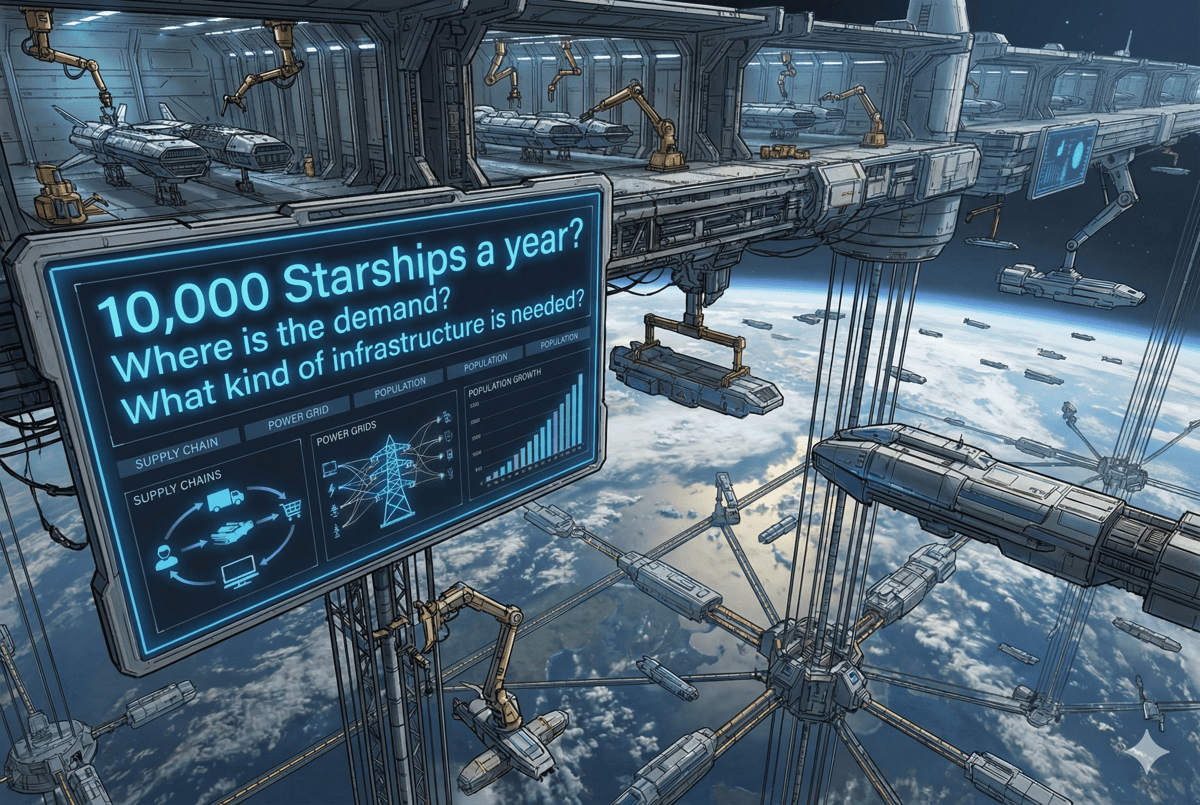
Elon Musk’s 10,000 Starship Annual Production Target: Demand Drivers and Infrastructure Imperatives
•January 7, 2026
0


Why It Matters
The ability to mass‑produce Starships could turn spaceflight into a routine commercial service, unlocking new markets and accelerating humanity’s off‑world expansion. It also forces a re‑thinking of global launch infrastructure, supply chains, and environmental governance.
Key Takeaways
- •10,000 Starships equal 27 launches daily.
- •Mars colonization drives massive cargo transport needs.
- •Point‑to‑point Earth travel could sustain high launch volume.
- •Offshore spaceports and gigawatt power required for fuel.
- •Raptor engine production must scale to hundreds of thousands yearly.
Pulse Analysis
Spaceflight has long been a low‑volume, high‑cost endeavor, but Musk’s 10,000‑a‑year goal pushes the industry toward the production dynamics of commercial aviation. Achieving a daily launch cadence demands a shift from bespoke rocket assembly to automated, assembly‑line manufacturing, similar to Tesla’s factories. This transformation would not only lower per‑flight costs through economies of scale but also create a new supply‑chain ecosystem for stainless‑steel structures, Raptor engines, and high‑throughput propellant plants, fundamentally altering aerospace economics.
The justification for such volume rests on three emerging markets. First, a sustained Mars colonization program would require moving millions of tons of cargo and personnel, translating into thousands of Starship flights per launch window. Second, point‑to‑point sub‑orbital travel promises intercontinental trips in under an hour, a service that could capture a slice of the global airline market and demand a fleet comparable to major carriers. Third, large‑scale orbital manufacturing—ranging from space‑based solar power arrays to microgravity‑produced materials—needs a constant flow of heavy lift capacity to assemble and service megastructures in low Earth orbit.
Realizing this vision compels an unprecedented expansion of ground infrastructure. Dozens of launch complexes, many on offshore platforms, would be required to disperse noise, mitigate sonic‑boom impacts, and keep launch schedules resilient to weather. Propellant production must scale to ten million tons of methane and thirty‑six million tons of liquid oxygen annually, likely through massive air‑separation units and carbon‑neutral Sabatier plants powered by gigawatt‑scale renewable grids. Finally, air‑traffic control systems would need to integrate “space lanes” and AI‑driven exclusion zones to manage thousands of daily launches, while regulators grapple with environmental footprints and liability frameworks. Together, these changes could turn space into a new logistics frontier comparable to global shipping or aviation.
Elon Musk’s 10,000 Starship Annual Production Target: Demand Drivers and Infrastructure Imperatives
0
Comments
Want to join the conversation?
Loading comments...