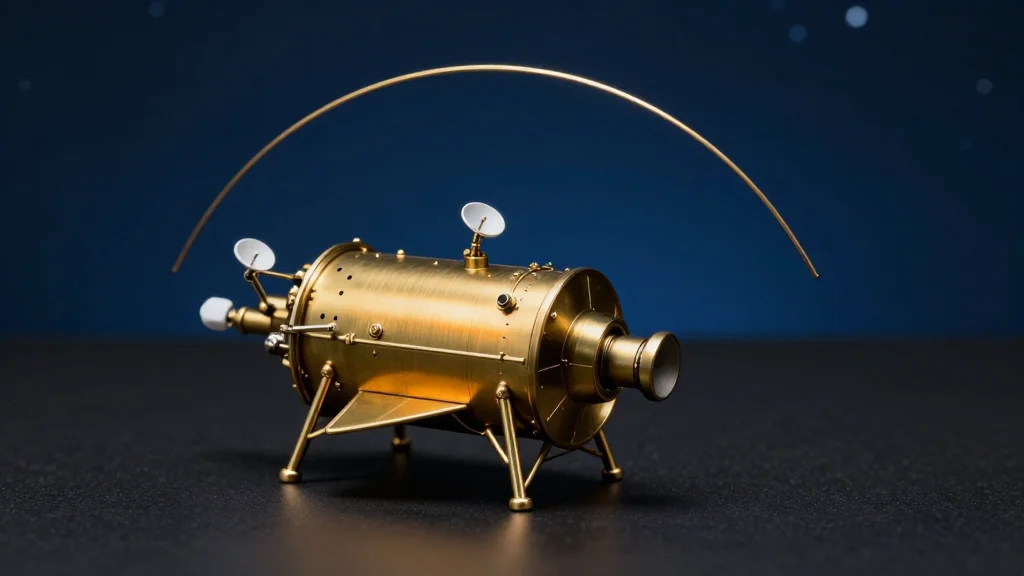
Engineers Shut Down Another Instrument on Voyager-1
Companies Mentioned

NASA

Jet Propulsion Laboratory
Why It Matters
Turning off LECP conserves precious power, extending Voyager 1’s ability to deliver unique interstellar data for several more years. The move showcases how legacy deep‑space missions can be managed to maximize scientific return despite dwindling energy supplies.
Key Takeaways
- •LECP instrument shut down after 49 years of continuous operation
- •Voyager 1 now runs only three science instruments
- •Power budget cuts aim to extend mission to 2030
- •Both Voyagers may survive until at least 2027
- •Planned late‑year reboot could improve power efficiency
Pulse Analysis
Voyager 1, launched in 1977, became humanity’s first probe to cross the heliopause and now drifts in interstellar space. Its three‑radioisotope thermoelectric generators (RTGs) have been gradually losing output, forcing engineers to ration power. On 17 April 2026 NASA’s Jet Propulsion Laboratory commanded the shutdown of the Low‑energy Charged Particles (LECP) experiment, a sensor that has operated almost uninterrupted for 49 years. The instrument measured ions, electrons and cosmic rays, providing a continuous record of the solar wind’s evolution. Its retirement marks the latest step in a pre‑planned power‑conservation sequence.
The Voyager team has long mapped a hierarchy for turning off instruments, prioritizing those with overlapping science goals. With seven of ten instrument suites already offline, Voyager 1 now runs only three scientific payloads alongside essential housekeeping systems. Engineers hope a major software reboot scheduled for later this year will recalibrate power distribution and extend usable voltage, potentially keeping the spacecraft functional until 2030, though the baseline target is 2027—the mission’s 50th anniversary. This approach mirrors the strategy used on Voyager 2, where the LECP was deactivated in March 2025, demonstrating a coordinated, long‑term stewardship of aging deep‑space assets.
Extending Voyager’s operational life offers more than nostalgic value; it preserves a unique platform for interstellar measurements that no future mission can replicate for decades. Data on low‑energy charged particles, even if sparse, continue to refine models of the heliosphere’s boundary and the galactic environment. Moreover, the power‑management lessons learned inform the design of next‑generation probes such as the Interstellar Probe concept, which will rely on advanced RTGs or alternative power sources. By squeezing every watt from Voyager, NASA not only honors a historic achievement but also extracts maximal scientific return from a multi‑decade investment.
Engineers shut down another instrument on Voyager-1
Comments
Want to join the conversation?
Loading comments...