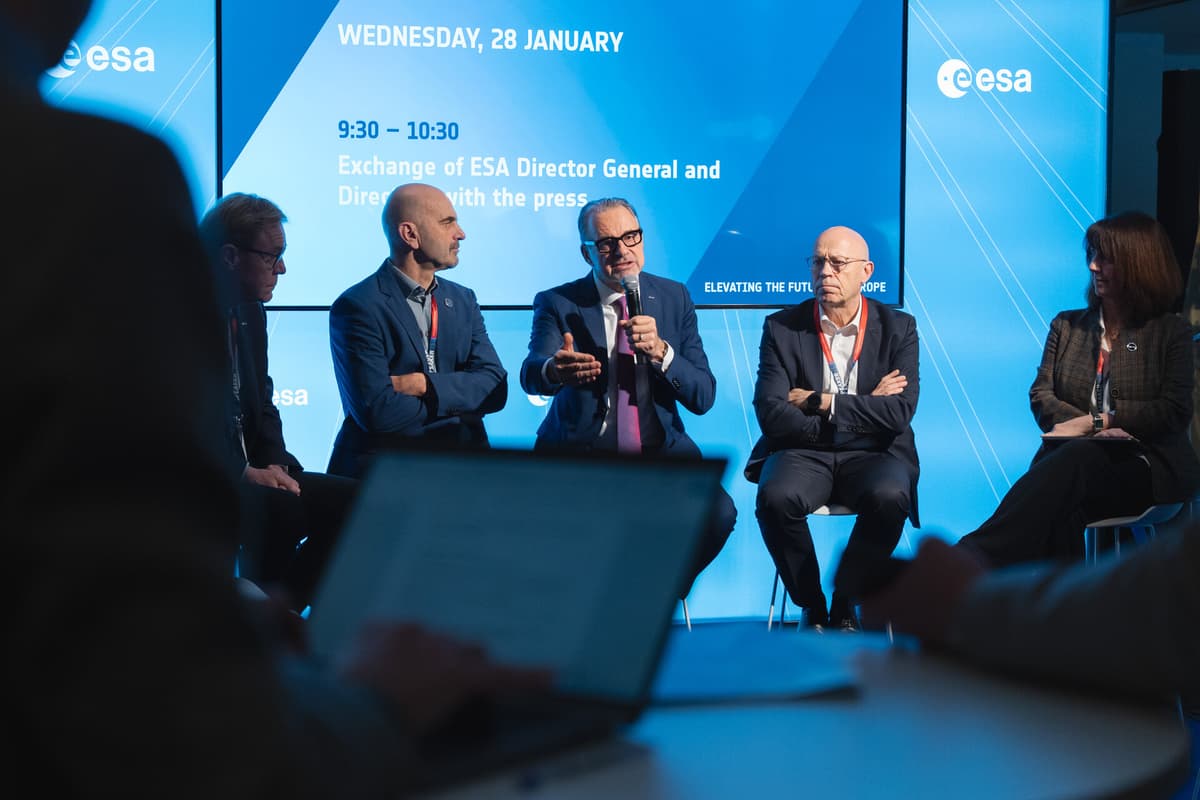
ESA at the European Space Conference - Day 2
•January 28, 2026
0
Companies Mentioned

Why It Matters
The event underscores ESA’s strategic push for secure, resilient space infrastructure while linking exploration to European industrial growth, shaping policy and investment across the continent’s space sector.
Key Takeaways
- •Aschbacher emphasized space resilience and security
- •ESA showcased Copernicus mission successes
- •Astronaut Maurer linked exploration to industry competitiveness
- •Directors engaged media, students, and stakeholders
- •ESA booth displayed satellite models for public outreach
Pulse Analysis
The 18th European Space Conference in Brussels served as a showcase for Europe’s coordinated space agenda, bringing together agencies, industry leaders, academia, and policy makers. ESA, as the continent’s primary launch and research organization, occupied a central stage with a dedicated booth featuring miniature satellite models that illustrated ongoing programmes from Earth observation to deep‑space exploration. By hosting panels, media interactions, and student meetings, the agency reinforced its commitment to transparency and to nurturing the next generation of space talent, a strategy that underpins long‑term sector growth.
In his second keynote, Director General Josef Aschbacher framed resilience and security as the twin pillars of Europe’s future space architecture. He warned that congested orbits, cyber‑threats, and geopolitical tensions demand robust satellite design, autonomous navigation, and coordinated defence mechanisms. The address echoed recent EU policy drafts that call for a shared situational‑awareness framework and increased investment in on‑orbit servicing. By positioning resilience at the top of ESA’s roadmap, the agency signals to partners and investors that safeguarding critical data streams will be a priority alongside scientific discovery.
The conference also highlighted the commercial upside of Europe’s space portfolio. Copernicus contributing missions were celebrated as a proven model of public‑private synergy, delivering climate‑grade data that fuels agriculture, insurance, and logistics markets. Astronaut Matthias Maurer’s remarks linked exploration activities directly to industrial competitiveness, arguing that technology spin‑offs from lunar and Martian missions can revitalize European manufacturing. Meanwhile, outreach efforts by directors such as Carole Mundell and Simonetta Cheli underscored ESA’s intent to align research priorities with market demand, ensuring that the continent’s space ecosystem remains both innovative and economically viable.
ESA at the European Space Conference - Day 2
0
Comments
Want to join the conversation?
Loading comments...