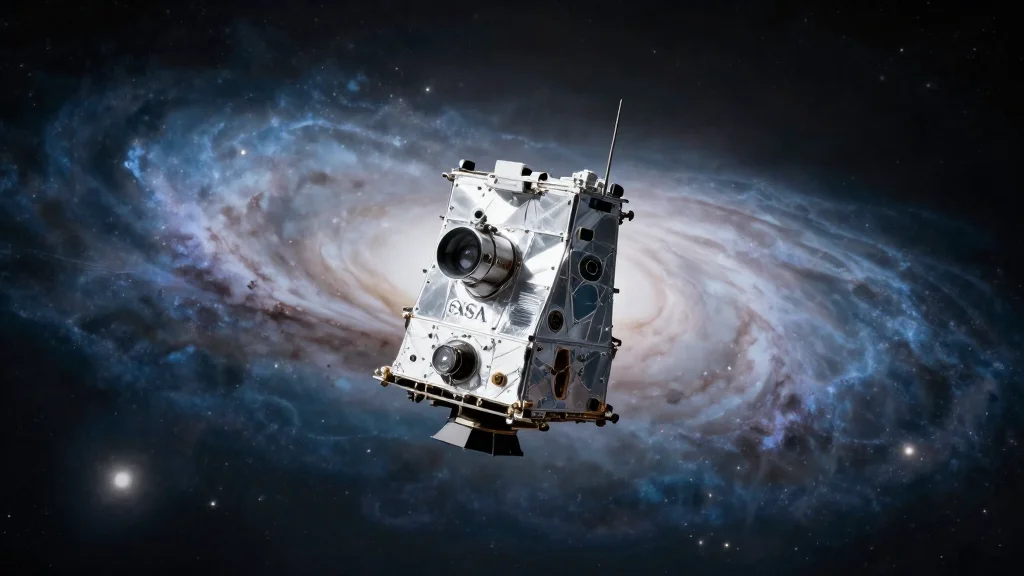
ESA Officially Adopts ARRAKIHS Mission: EU Leads the Exploration of the Low Surface Brightness Universe
Why It Matters
By opening a new observational window on the low‑surface‑brightness universe, ARRAKIHS will provide critical data to test competing dark‑matter theories and sharpen our understanding of galaxy evolution, reinforcing Europe’s leadership in frontier astrophysics.
Key Takeaways
- •ESA adopts ARRAKIHS, targeting launch in 2030
- •Mission will map faint stellar halos around nearby galaxies
- •Over 250 scientists from 7 ESA states and global partners involved
- •Data will test dark‑matter models via halo shape measurements
- •Ground demonstrator camera already operating at Javalambre Observatory
Pulse Analysis
The low‑surface‑brightness universe has long eluded astronomers because its diffuse light is easily lost against the night sky. ARRAKIHS tackles this challenge with a dedicated space‑based instrument designed to capture ultra‑deep images of galaxy halos, where ancient stars preserve the fossil record of mergers and dark‑matter interactions. By delivering high‑resolution, wide‑field observations, the mission will fill a critical gap left by ground‑based surveys, enabling scientists to quantify halo mass distributions and trace the faint outskirts of galaxies like the Milky Way.
Beyond pure discovery, ARRAKIHS serves as a decisive test‑bed for cosmological models. Competing dark‑matter scenarios predict distinct halo shapes and density profiles; the mission’s precise mapping will allow researchers to compare observed structures with state‑of‑the‑art simulations from institutions such as Leiden University. Confirming or refuting these predictions could reshape theories about the elusive dark‑matter particle, influencing both astrophysics and particle physics research agendas. The collaboration’s integration of supercomputer modeling and observational data exemplifies the interdisciplinary approach needed for next‑generation cosmology.
The project also underscores Europe’s strategic investment in space science. Coordinated by the ARRAKIHS Mission Consortium and led by Spain’s IFCA, the effort unites over 250 experts from seven ESA member states and partners across the United States, Asia, and beyond. With a ground demonstrator already operational at the Javalambre Observatory, the mission has demonstrated technical maturity, paving the way for a smooth transition to construction and launch. Successful execution will cement the EU’s role as a global leader in probing the dark universe, while delivering a rich data legacy for the broader scientific community.
ESA officially adopts ARRAKIHS mission: EU leads the exploration of the low surface brightness universe
Comments
Want to join the conversation?
Loading comments...