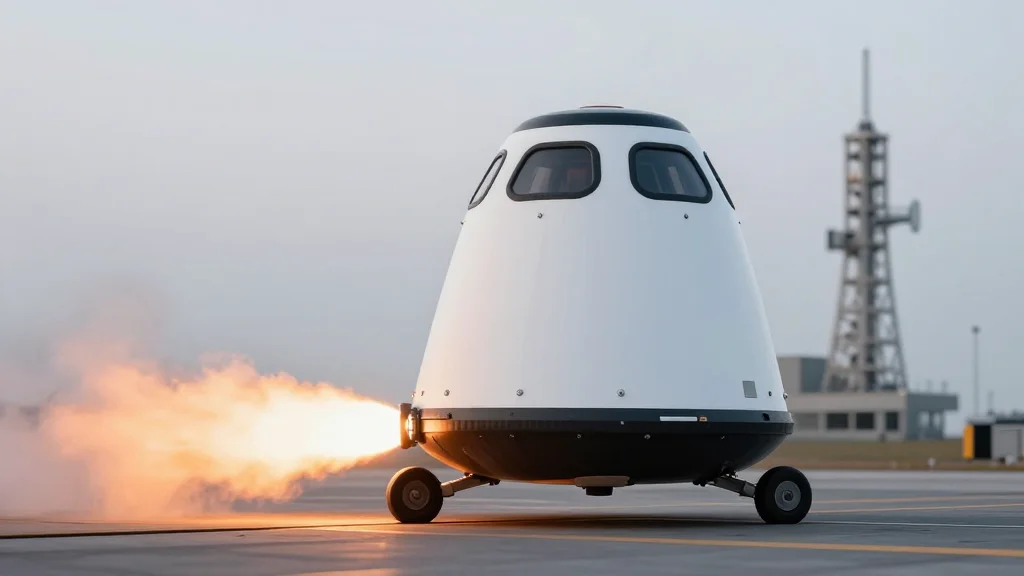
ESA Opens €1 Million Call for Crew Launch Abort Demonstrator, Targeting Ariane 6 Safety

Companies Mentioned
Why It Matters
A reliable launch abort system is a prerequisite for any crewed launch vehicle, and Europe’s lack of an indigenous solution has long been a strategic vulnerability. By funding the early modelling phase, ESA is de‑risking a critical safety component without committing to full‑scale hardware, preserving budget flexibility while still moving the needle on crewed capability. The demonstrator also dovetails with the LEO Cargo Return Service, meaning that safety investments can serve dual commercial and crewed missions, potentially unlocking new revenue streams for European launch providers. Beyond safety, the project signals Europe’s intent to compete in the emerging market for crewed and cargo services to low‑Earth orbit. A validated abort system would make an Ariane‑based crew vehicle more attractive to national space agencies and private operators, strengthening Europe’s position in a market increasingly dominated by US and Chinese launch providers.
Key Takeaways
- •ESA opened a €1 million (≈$1.1 M) call for proposals on 10 April for a crew launch abort demonstrator.
- •The System Level Definition phase will last up to 12 months and focus on modelling pad‑abort scenarios.
- •Baseline design uses an Ariane 6 launch from ELA4, Guiana, with a 5.4 m blunt‑body capsule weighing 10 000 kg.
- •The project is linked to ESA’s LEO Cargo Return Service, aiming to adapt cargo capsules for crewed use.
- •Selection of a prime contractor is expected in Q3 2026, with a detailed design review slated for early 2027.
Pulse Analysis
ESA’s decision to fund only the modelling phase of a crew launch abort system reflects a pragmatic, incremental strategy. By allocating €1 million—tiny compared with the multi‑billion budgets of full abort hardware programs—the agency can assess technical feasibility and risk without over‑committing resources. This approach mirrors the European tradition of collaborative, step‑wise development, where early‑stage studies often precede larger, multinational investments.
The abort demonstrator also serves as a strategic bridge between ESA’s cargo‑return ambitions and its longer‑term crewed launch goals. By ensuring that capsule designs are abort‑ready, ESA can attract commercial partners looking for a safety‑first solution, potentially accelerating the commercialisation of European crewed services. In a market where safety certifications can take years, an early‑stage, ESA‑validated abort system could become a differentiator for European launch providers.
However, the modest budget and reliance on modelling rather than hardware could be a double‑edged sword. While it reduces upfront risk, it also means that ESA must secure additional funding for subsequent phases, and any delays in moving from simulation to flight testing could erode Europe’s competitive edge. The upcoming contractor selection will be a litmus test: a strong consortium could leverage the study’s findings to fast‑track hardware development, while a weak proposal could stall the entire crewed launch roadmap. In short, the abort demonstrator is a pivotal, but not decisive, milestone in Europe’s quest for autonomous human‑spaceflight capability.
ESA Opens €1 Million Call for Crew Launch Abort Demonstrator, Targeting Ariane 6 Safety
Comments
Want to join the conversation?
Loading comments...