Companies Mentioned


Why It Matters
Accelerating the launch cuts storage expenses and dramatically improves the mission’s scientific return, positioning Europe at the forefront of primitive comet exploration.
Key Takeaways
- •Launch moved to 2028‑2029 via Ariane 64.
- •Co‑passenger commercial satellite reduces storage costs.
- •Delta‑v increase to ~1,000 m/s improves target odds.
- •Failure risk drops below 10% for long‑period comet.
- •JAXA probe adds multipoint observations during flyby.
Pulse Analysis
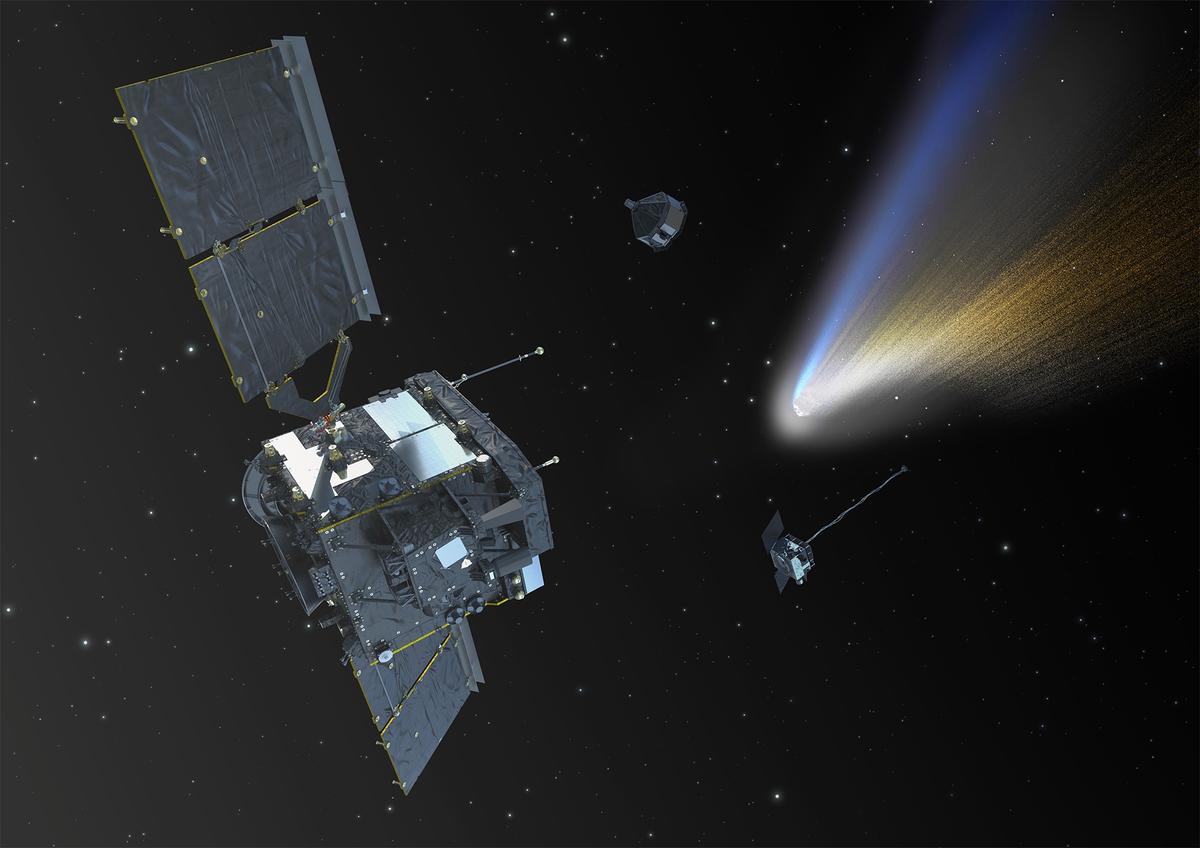
The revised launch timetable for Comet Interceptor reflects ESA’s agile response to shifting program timelines. By decoupling from the delayed Ariel mission, ESA not only sidesteps three years of idle storage but also taps into the growing commercial launch market. Partnering with a geostationary communications satellite on an Ariane 64 offers a cost‑effective ride‑share, freeing up payload capacity for additional propellant and hardware. This strategic use of commercial infrastructure underscores a broader industry trend where scientific missions increasingly rely on private sector launch services to meet budgetary and schedule constraints.
From a technical standpoint, the extra delta‑v afforded by the Ariane 64 configuration is a game‑changer for a mission that must chase a target identified only after launch. The boost to roughly 1,000 m/s expands the reachable orbital envelope, allowing the spacecraft to maneuver from the Earth‑Sun L1 point to L2 and then pursue a dynamically new comet with higher confidence. The improved maneuverability cuts the failure risk of missing a suitable long‑period comet to under 10 %, a significant upgrade that enhances the mission’s scientific payoff. Moreover, the inclusion of two JAXA‑built probes enables simultaneous measurements at different points, enriching the data set and providing a more comprehensive view of comet composition and behavior.
Beyond the immediate mission, Comet Interceptor’s launch shift signals a maturing European space ecosystem that balances governmental ambition with commercial pragmatism. The cost offsets from avoiding storage fees, combined with the potential for shared launch expenses, illustrate a sustainable model for future deep‑space probes. Successful execution will not only deliver unprecedented insights into the early solar system but also reinforce ESA’s reputation for innovative, cost‑efficient exploration, encouraging further international collaborations and private‑public partnerships in the next generation of planetary science missions.
ESA’s Comet Interceptor mission moves up launch
0
Comments
Want to join the conversation?
Loading comments...