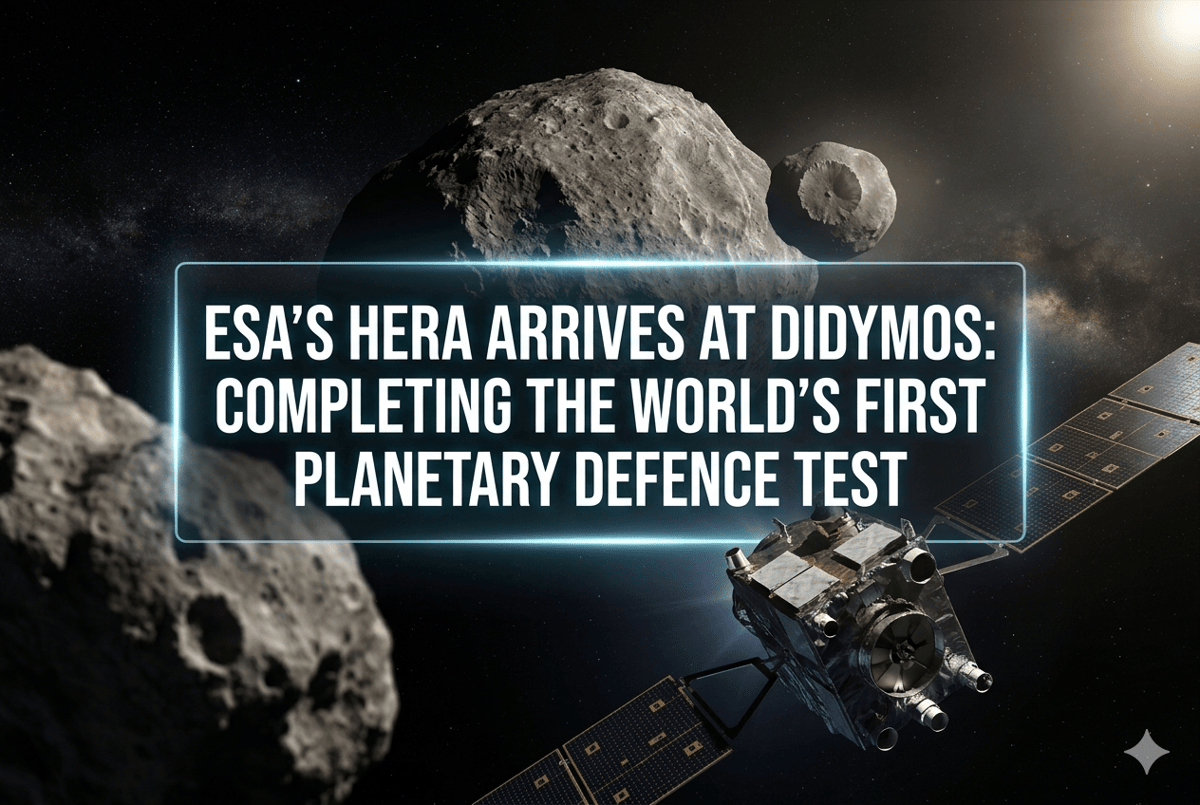
ESA’s Hera Arrives at Didymos: Completing the World’s First Planetary Defence Test
Companies Mentioned
Why It Matters
Hera provides the missing physical data needed to turn DART’s proof‑of‑concept into a predictable deflection technique, essential for future asteroid threat mitigation.
Key Takeaways
- •Hera will orbit Dimorphos to measure its mass and gravity field
- •CubeSats Milani and Juventas will map composition and probe interior structure
- •Momentum‑enhancement factor β will be quantified for the first time
- •DART’s 33‑minute orbital change proved kinetic impact deflection works
- •Data will feed ESA and NASA models for future asteroid mitigation
Pulse Analysis
The DART mission’s dramatic impact on Dimorphos captured headlines, but it left a critical knowledge gap: the physics governing how much momentum an asteroid gains from a kinetic strike. Without a precise mass measurement and an empirical β factor, planners can only estimate deflection outcomes, limiting confidence in emergency response scenarios. Hera’s arrival in 2026 bridges that gap by turning a spectacular demonstration into a rigorously quantified technique, reinforcing the scientific foundation of planetary‑defence strategies.
Hera carries a suite of high‑resolution cameras, a laser altimeter, and a radio‑science experiment designed to sense the tiny gravitational tug of Dimorphos. By orbiting the moonlet, the spacecraft will derive its mass from subtle trajectory perturbations, while imaging the impact crater to assess ejecta volume and distribution. The two companion CubeSats, Milani with a hyperspectral imager and Juventas with a low‑frequency radar, will simultaneously probe surface mineralogy and internal porosity, delivering a multidimensional portrait of the asteroid’s response to impact.
These data will flow directly into ESA’s Space‑Safety Programme and NASA’s Planetary Defense Coordination Office, sharpening impact‑modelling tools that inform mitigation plans. Coupled with the expanding near‑Earth object catalog from the Vera C. Rubin Observatory, Hera’s validated β value will enable rapid scenario analysis for 100‑to‑300‑meter asteroids—the size range most likely to cause regional devastation. In turn, governments and commercial space firms can design more reliable deflection missions, turning planetary defence from a hopeful concept into an operational capability.
ESA’s Hera Arrives at Didymos: Completing the World’s First Planetary Defence Test
Comments
Want to join the conversation?
Loading comments...