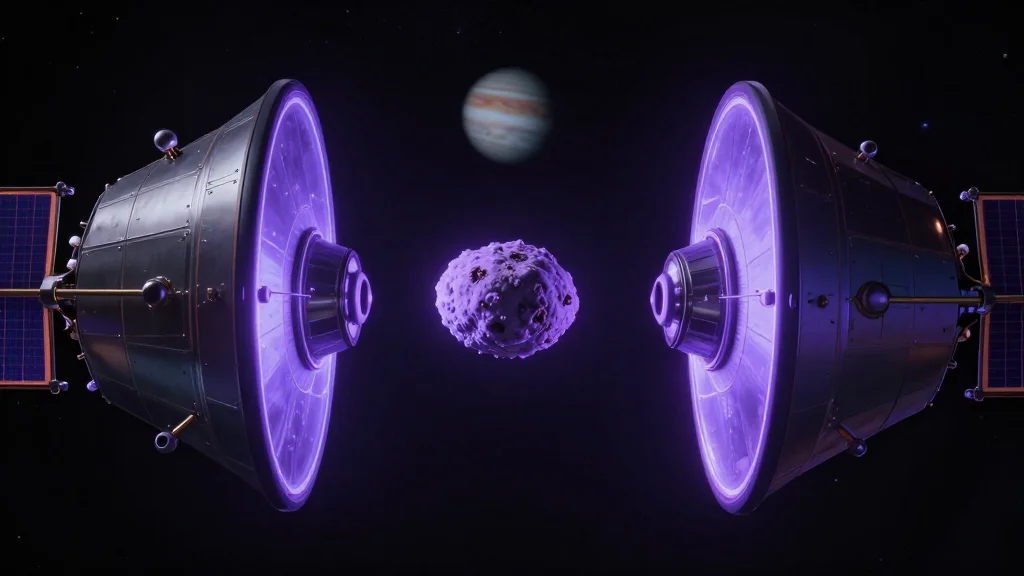
Europa Clipper and Juice Make Simultaneous UV Light Observatoins of Interstellar Comet 3I/Atlas
Companies Mentioned
Why It Matters
The coordinated UV measurements provide unprecedented three‑dimensional insight into an interstellar comet’s chemistry, sharpening models of how such bodies interact with the Sun and informing future mission designs.
Key Takeaways
- •JUICE and Europa Clipper captured simultaneous UV data of comet 3I/Atlas.
- •Observations revealed higher-than-expected carbon emissions compared to solar system comets.
- •Dual‑view dataset provided day‑side gas and night‑side dust measurements.
- •Emission ratios tracked over days showed compositional evolution during solar approach.
- •Findings confirm interstellar comet shares many traits with native solar system comets.
Pulse Analysis
Interstellar objects have surged into the scientific spotlight after the discovery of ‘Oumuamua and comet 2I/Borisov, yet detailed compositional data remain scarce. The November 2025 alignment of Europa Clipper and JUICE offered a unique chance to fill that gap, leveraging the ultraviolet spectrometers aboard both probes. By positioning the comet between the two spacecraft, researchers obtained a full 360‑degree view of its coma, capturing emissions of hydrogen, oxygen and a surprisingly rich carbon signature that challenged pre‑flight expectations.
The UV spectra revealed a dual nature: Europa Clipper’s night‑side perspective highlighted dense dust scattering, while JUICE’s day‑side view emphasized bright gas emissions. Tracking these signatures over several days allowed scientists to map how the ratios of carbon‑bearing molecules shifted as the comet approached perihelion. This temporal evolution mirrors processes observed in native comets, suggesting that the mechanisms driving outgassing and dust release are universal, regardless of a comet’s birthplace. Moreover, the heightened carbon output hints at a distinct volatile inventory that could trace back to the comet’s formation environment beyond the Solar System.
These findings have broad implications for planetary science and mission planning. Demonstrating that two distant probes can synchronize observations sets a precedent for future collaborative campaigns, especially as more interstellar visitors are anticipated. The data enrich models of cometary chemistry, aiding predictions of how such bodies might deliver organic material to planetary atmospheres. Ultimately, the success of this joint effort underscores the value of multi‑platform, multi‑wavelength strategies in unraveling the mysteries of objects that traverse interstellar space.
Europa Clipper and Juice make simultaneous UV light observatoins of interstellar comet 3I/Atlas
Comments
Want to join the conversation?
Loading comments...