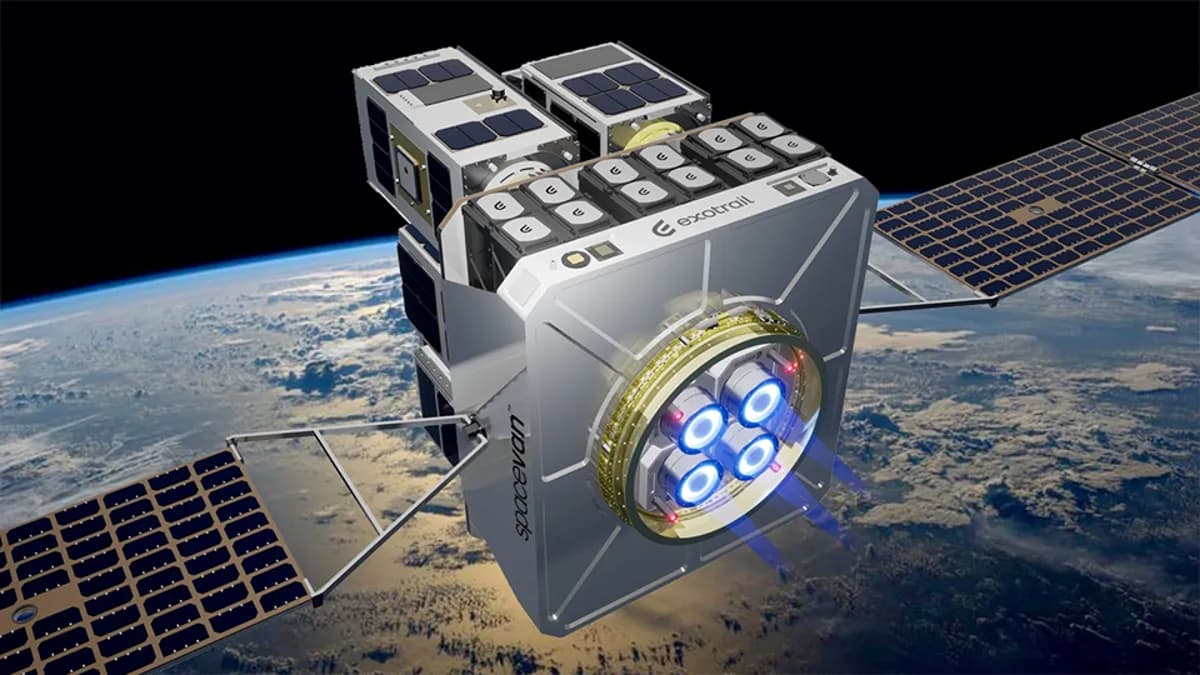
Exotrail Confirms Successful Deployment of NASA-Funded AEPEX CubeSat via Spacevan 002
Why It Matters
The precise, cost‑effective delivery of AEPEX demonstrates how commercial orbital transfer vehicles can unlock niche orbits for scientific and defense payloads, accelerating research and reducing mission risk. This validates a growing business model where OTVs provide last‑mile flexibility for both government and commercial customers.
Key Takeaways
- •Exotrail deployed NASA‑funded AEPEX CubeSat via spacevan 002.
- •Precise 500 km, >70° inclination orbit achieved, beyond standard rideshare.
- •Spacevan 002 offers multi‑payload “pick‑up and drop‑off” capability.
- •Hosted payloads tested optical links, atomic clock, solar panel, lunar robotics.
- •Exotrail plans two LEO missions per year and GEO variant by 2027.
Pulse Analysis
The AEPEX mission, led by the University of Colorado Boulder, targets a critical gap in heliophysics: quantifying how high‑energy electrons from Earth’s radiation belts precipitate into the upper atmosphere. This electron precipitation influences atmospheric chemistry and, by extension, climate models. By leveraging Exotrail’s spacevan 002, the mission achieved a 500 km, high‑inclination orbit that would have required costly on‑board propulsion if launched directly, underscoring the strategic value of dedicated orbital transfer vehicles for niche scientific objectives.
Spacevan 002, dubbed “Wings of Light,” marks Exotrail’s first fully vertically integrated OTV, combining an in‑house bus with electric propulsion. Its “pick‑up and drop‑off” architecture allowed simultaneous deployment of AEPEX and four hosted payloads, ranging from France’s Astrolight optical‑link demo to Australia’s TEMPO atomic‑clock component. This multi‑user approach not only spreads launch costs but also creates a testbed for emerging space technologies, accelerating commercialization and offering governments a reliable, precise delivery method for defense and civil satellites.
Looking ahead, Exotrail’s roadmap includes two LEO missions per year and the development of a GEO‑class spacevan slated for late 2026/early 2027. The upcoming spacevan 003 will target a 550 km Sun‑Synchronous Orbit, while the GEO variant aims to support satellite life‑extension and on‑orbit servicing. As the market embraces in‑space mobility, Exotrail’s proven capability to execute complex proximity maneuvers positions it as a key enabler of the next generation of small‑sat constellations and orbital logistics services.
Exotrail Confirms Successful Deployment of NASA-Funded AEPEX CubeSat via Spacevan 002
Comments
Want to join the conversation?
Loading comments...