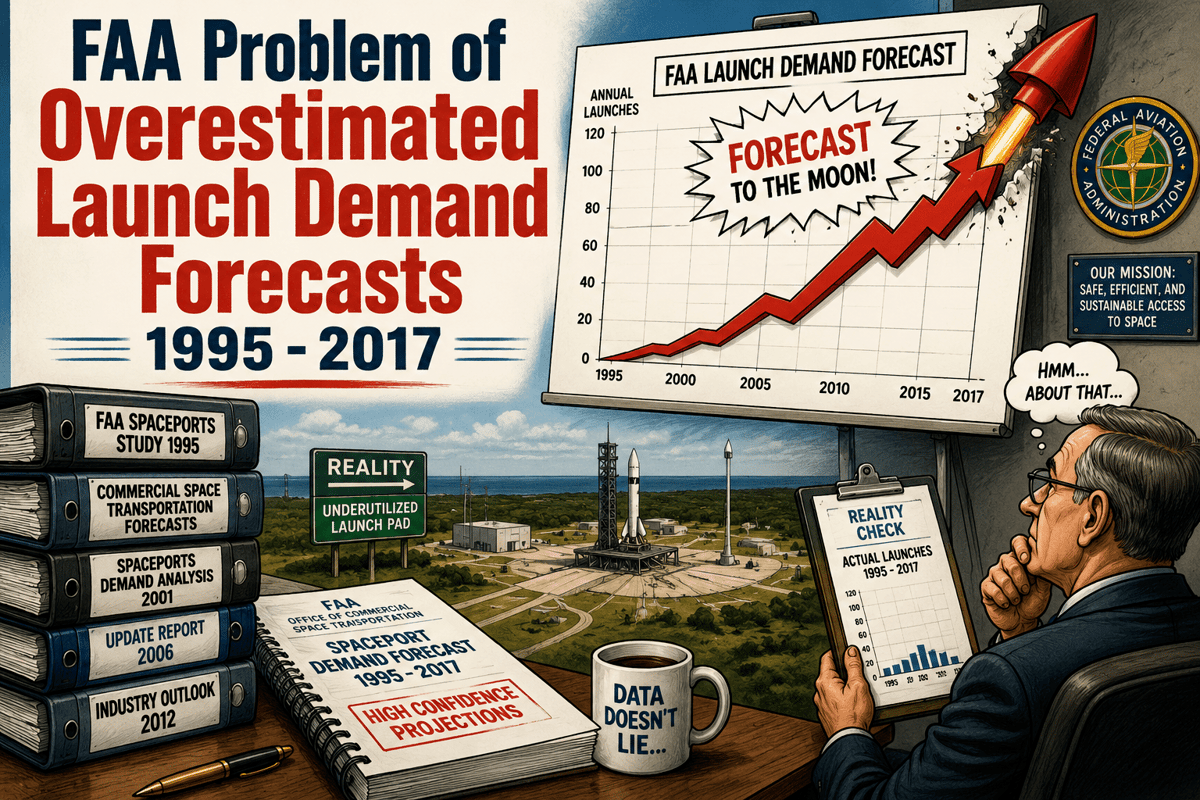
FAA Problem of Overestimated Launch Demand Forecasts 1995 – 2017
Why It Matters
Because FAA forecasts guide congressional appropriations, regulatory staffing, and private investment, systematic overestimation can misallocate resources and distort market expectations. Accurate, transparent forecasts are essential for sustainable growth of the U.S. commercial space sector.
Key Takeaways
- •FAA forecasts overestimated addressable launches by ~40% from 1998‑2015.
- •Zero‑year predictions consistently ran high despite near‑term data availability.
- •Overoptimism stems from industry self‑reporting and FAA’s dual regulator‑promoter role.
- •Proposed launch realization factor creates a 20‑27 launch range versus 40 forecast.
- •Study urges transparent methodology, confidence intervals, and annual error reporting.
Pulse Analysis
The FAA’s commercial launch forecasts have long been a cornerstone of U.S. space policy, informing everything from congressional budget requests to private sector business plans. Since the mid‑1990s the agency has issued annual projections of "commercially addressable" launches—a narrow subset of the market that assumes internationally competitive procurement. These numbers feed into range capacity planning, spaceport development, and satellite‑service revenue models, making their accuracy a matter of national economic and security interest.
A 2017 GWU study dissected three decades of FAA forecasts and uncovered a persistent optimism bias. By averaging multiple forecast vintages, comparing implied growth rates, and evaluating zero‑year versus out‑year predictions, the researchers documented an average over‑prediction of roughly 40 % for the 1998‑2015 period. The study traced the error to industry‑supplied manifest data that often overstated readiness, and to the FAA’s statutory dual role of regulator and market promoter, which can nudge projections upward. Moreover, the removal of a launch‑realization adjustment after 2015 eliminated a key corrective mechanism, amplifying the gap between forecast and reality.
The implications are clear: inflated launch expectations can lead to over‑staffed licensing offices, premature infrastructure investments, and misguided investor confidence. The authors’ proposed launch realization factor—anchoring forecasts to historical error bands—offers a pragmatic fix, converting a single optimistic point estimate into a defensible 20‑27 launch range for 2017. Adoption of such calibrated ranges, coupled with mandatory confidence intervals and yearly retrospective reporting, would enhance transparency, improve resource allocation, and bolster the credibility of U.S. commercial space planning.
FAA Problem of Overestimated Launch Demand Forecasts 1995 – 2017
Comments
Want to join the conversation?
Loading comments...