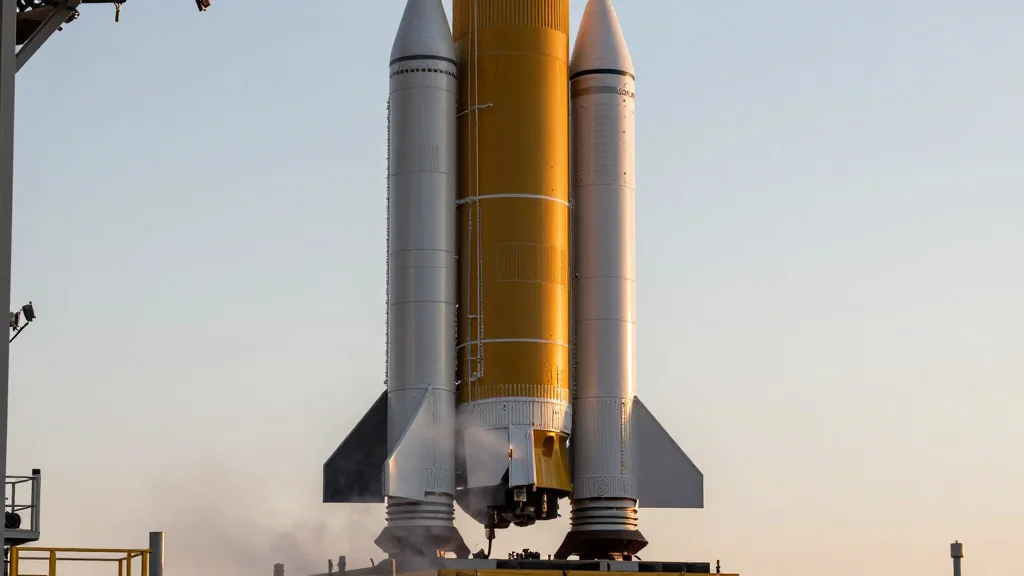
Falcon Heavy Returns to Flight as Russia Announces Soyuz‑5 Heavy‑Lift Rocket

Companies Mentioned
Why It Matters
Falcon Heavy’s return demonstrates that reusable heavy‑lift rockets can be operated with a cadence that supports both commercial broadband constellations and high‑value government missions, reinforcing SpaceX’s dominance in the sector. At the same time, Russia’s Soyuz‑5 announcement signals a strategic effort to re‑enter the heavy‑lift market, offering customers an alternative to U.S. launch providers and potentially reshaping the competitive dynamics of orbital access. Together, these developments could drive down launch costs, spur innovation in payload design, and accelerate the deployment of next‑generation satellite services worldwide. The juxtaposition of a proven, revenue‑generating heavy‑lift system with a nascent, state‑backed contender also highlights the broader geopolitical stakes of space infrastructure. Nations and commercial operators will weigh reliability, cost, and political considerations when selecting launch partners, making the performance and schedule of both Falcon Heavy and Soyuz‑5 critical factors in future satellite constellations and deep‑space missions.
Key Takeaways
- •Falcon Heavy lifted the 6.6‑ton ViaSat‑3 F3 satellite on April 30, 2026, its first flight since Oct 2024.
- •Both side boosters landed safely at Cape Canaveral’s Landing Zones 2 and 40, confirming reusable operations.
- •SpaceX has invested over $15 billion in Starship development, dwarfing the $400 million spent on Falcon 9.
- •Russia announced its Soyuz‑5 heavy‑lift launch vehicle, but technical details and launch dates were not disclosed.
- •Industry analysts see the dual announcements as a catalyst for price competition and faster cadence in heavy‑lift services.
Pulse Analysis
SpaceX’s Falcon Heavy comeback is more than a headline; it is a proof point that the company can sustain a mixed‑fleet strategy while its next‑generation Starship matures. The dual‑booster recovery reduces per‑launch costs and shortens turnaround, a competitive edge that will become increasingly important as satellite operators demand higher throughput and lower latency. The $15 billion Starship spend signals a long‑term bet on airline‑like launch cadence, but the technology still faces infrastructure bottlenecks—fuel logistics, water‑suppression capacity, and in‑orbit refueling—that could delay its commercial rollout.
Russia’s Soyuz‑5, though shrouded in secrecy, reflects a strategic pivot toward heavy‑lift capability that can support both national security payloads and commercial customers seeking alternatives to Western launch services. If Russia can deliver a reliable, cost‑effective vehicle, it could erode SpaceX’s market share in regions where geopolitical considerations dominate procurement decisions. The lack of disclosed performance metrics, however, makes it difficult to assess whether Soyuz‑5 will truly compete on payload capacity or price.
The immediate market impact will likely be felt in the broadband satellite arena. ViaSat’s mini‑constellation, now complete with F3, showcases how a single heavy‑lift launch can provision an entire regional network, a model that other operators will try to emulate. As demand for high‑throughput, low‑latency connectivity surges—driven by AI workloads, remote work, and emerging markets—launch providers that can reliably deliver large payloads at reduced cost will command premium contracts. Falcon Heavy’s proven reliability, combined with the promise of Starship’s massive lift, positions SpaceX to dominate this niche, provided it can overcome the remaining technical hurdles.
In the broader geopolitical context, the Soyuz‑5 announcement may force the United States and its allies to reconsider launch‑service diversification strategies. A credible Russian heavy‑lift option could incentivize joint‑venture launches, shared ground‑segment infrastructure, and even cross‑licensing agreements, potentially reshaping the global launch ecosystem. The next six months will be critical: SpaceX’s ability to schedule additional Falcon Heavy flights and demonstrate rapid booster refurbishment will test its operational resilience, while Russia’s forthcoming technical disclosures on Soyuz‑5 will reveal whether it can truly challenge the status quo.
Falcon Heavy Returns to Flight as Russia Announces Soyuz‑5 Heavy‑Lift Rocket
Comments
Want to join the conversation?
Loading comments...