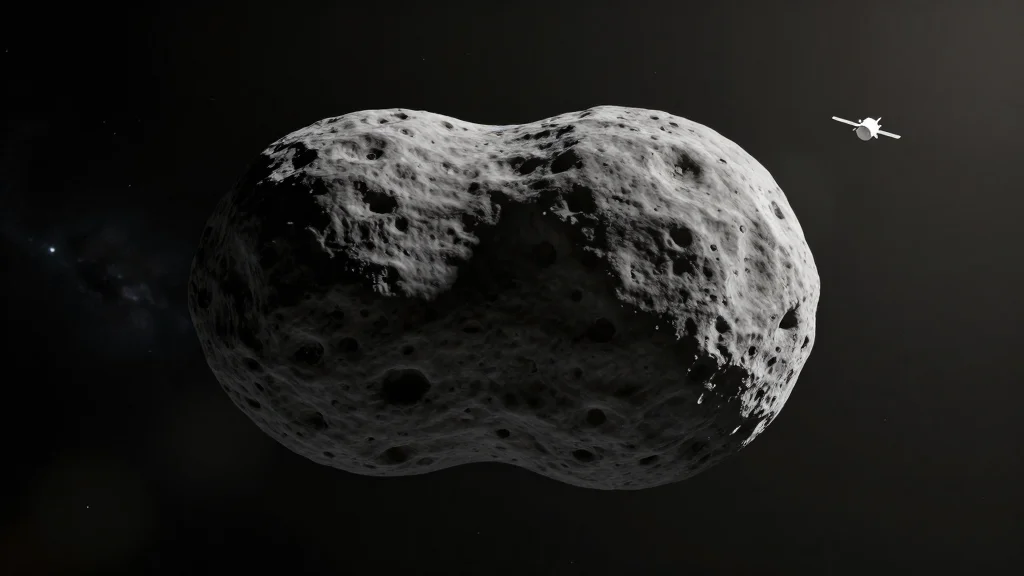
Final Results From Lucy’s 2025 Fly-By of Asteroid Donaldjohanson: A Tumbling Peanut!
Why It Matters
Understanding Donaldjohanson’s evolution provides a rare window into how small bodies reshape after catastrophic collisions, informing models of asteroid dynamics and planetary‑defense strategies. Lucy’s continued journey to the Trojans will extend these insights to a distinct population of primitive objects.
Key Takeaways
- •Donaldjohanson formed from 80 km parent body breakup 155 Myr ago.
- •YORP effect slowed spin, causing neck collapse and ridge formation.
- •Current tumbling state has 100–200 hour rotation period.
- •Small craters <0.4 km erased by seismic shaking.
- •Lucy will next visit Jupiter Trojans, starting with Eurybates 2027.
Pulse Analysis
Lucy’s fly‑by of Donaldjohanson marks a milestone for deep‑space small‑body exploration, delivering high‑resolution gravity and topography data that few missions have captured. By mapping the asteroid’s surface slopes and gravitational gradients, scientists could reconstruct its internal structure and pinpoint the precise moment its two lobes fused. This level of detail not only validates the mission’s imaging suite but also sets a benchmark for future probes targeting similarly complex objects.
The study’s core revelation is a multi‑stage evolutionary pathway: an 80‑kilometer progenitor shattered by a 20‑kilometer impactor 155 million years ago, followed by rapid re‑accretion that left Donaldjohanson spinning faster than ten hours. Over tens of millions of years, the YORP effect—solar‑radiation torque—gradually slowed the spin, destabilizing the neck region and prompting mass movement that forged a central ridge. Subsequent seismic shaking erased sub‑kilometer craters, and the asteroid ultimately entered a non‑principal‑axis (tumbling) state with a 100‑to‑200‑hour period, a rare dynamical condition for bodies of its size.
These findings have broader implications for planetary‑defense planning and asteroid mining prospects. A tumbling asteroid presents challenges for deflection missions, requiring precise modeling of its irregular rotation to predict impact outcomes. Moreover, Lucy’s upcoming Trojan encounters will allow scientists to compare a main‑belt relic with primordial bodies that have lingered near Jupiter since the solar system’s formation, refining theories of planetary migration and small‑body composition. The mission’s sequential observations thus weave a continuous narrative from violent birth to present‑day dynamics, enriching our strategic understanding of near‑Earth and distant asteroids alike.
Final results from Lucy’s 2025 fly-by of asteroid Donaldjohanson: A tumbling peanut!
Comments
Want to join the conversation?
Loading comments...