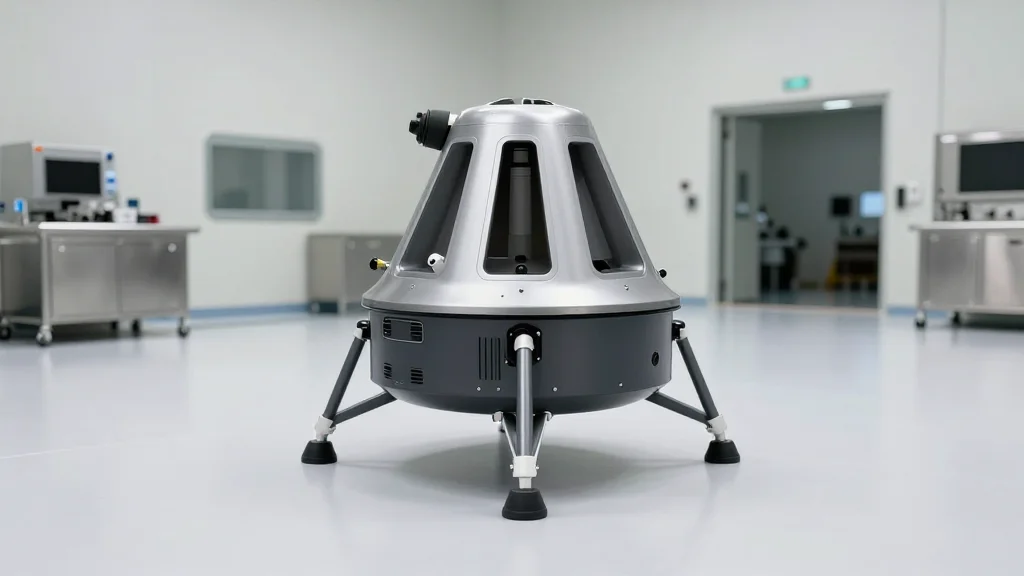
Firefly Aerospace Doubles Texas Campus to Accelerate Lunar Landers and Orbital Vehicles

Companies Mentioned
Why It Matters
Firefly Aerospace’s Texas campus expansion marks a pivotal shift from bespoke spacecraft builds to a scalable production model, a capability that has been a bottleneck for many emerging space firms. By establishing a repeatable line for lunar landers and orbital vehicles, Firefly can lower unit costs, shorten delivery timelines and take on larger contract volumes from both government and commercial customers. This move also deepens the United States’ domestic supply chain for lunar logistics, reducing reliance on foreign manufacturers and supporting NASA’s Artemis objectives. The broader SpaceTech ecosystem stands to benefit from increased competition in the small‑sat launch and lunar‑service markets. Firefly’s ability to offer integrated launch‑and‑delivery services could pressure rivals to accelerate their own manufacturing upgrades, potentially driving down prices across the sector. Moreover, the expansion reinforces Texas’s growing reputation as a hub for aerospace manufacturing, attracting talent, investment and ancillary suppliers to the region.
Key Takeaways
- •Firefly’s Cedar Park campus now totals ~144,000 sq ft, nearly double its previous size
- •New cleanroom is four times larger than the prior facility, funded partly by the Texas Space Commission
- •Expansion enables a repeatable production line for Blue Ghost lunar lander and Elytra orbital vehicle
- •Positioned to support multiple Moon missions per year and increase market share in small‑sat launches
- •Serial production of Blue Ghost targeted for late 2024, with first flight on Alpha launch vehicle in 2027
Pulse Analysis
Firefly’s decision to double its manufacturing footprint reflects a broader industry trend: the transition from low‑volume, custom spacecraft to high‑throughput, assembly‑line production. Historically, companies like SpaceX have demonstrated the cost advantages of repeatable manufacturing, and Firefly appears to be applying the same logic to its lunar and orbital offerings. The timing is strategic; NASA’s Artemis program is entering its procurement phase, and defense agencies are seeking rapid, low‑cost access to space. By aligning its capacity expansion with these demand drivers, Firefly can lock in contracts that would otherwise go to more established players.
However, scaling production is not without risk. The capital outlay for cleanrooms, tooling and workforce training can strain cash flow, especially for a company that has yet to achieve profitability on a large scale. Firefly’s reliance on state funding underscores the importance of public‑private partnerships in de‑risking such investments. If the company can deliver on its promise of multiple lunar landers per year, it will not only validate its manufacturing model but also set a new benchmark for commercial lunar logistics.
Looking forward, the success of Firefly’s expansion will hinge on three factors: the ability to secure a pipeline of launch contracts, the speed at which it can certify its spacecraft for flight, and its capacity to maintain quality at scale. Competitors are also accelerating their own production capabilities, meaning Firefly must differentiate through cost, schedule and reliability. If it can meet these challenges, the company could become a cornerstone of the emerging lunar economy and a key player in the next wave of satellite servicing and small‑sat launch services.
Firefly Aerospace Doubles Texas Campus to Accelerate Lunar Landers and Orbital Vehicles
Comments
Want to join the conversation?
Loading comments...