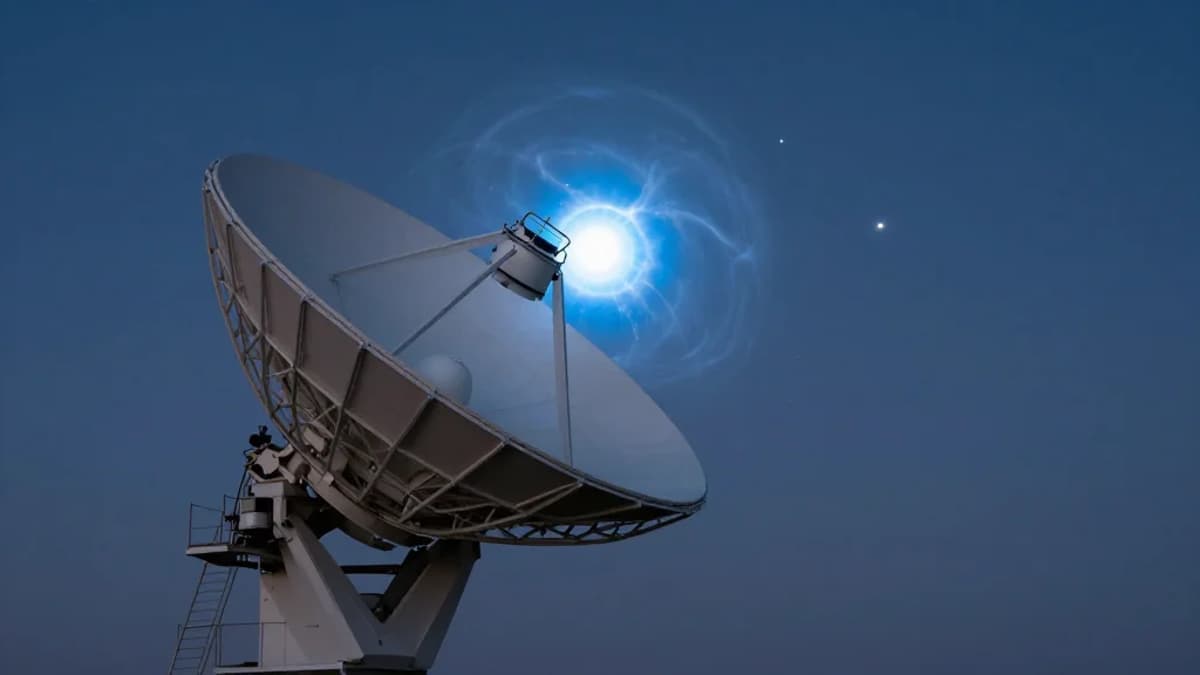
First Radio Signals From Rare Supernova Reveal Star's Final Years
•January 27, 2026
0
Why It Matters
Radio detection provides a direct window into the final years of massive stars, reshaping models of stellar evolution and supernova mechanisms. This breakthrough expands observational tools, influencing research priorities and funding for next‑generation radio facilities.
Key Takeaways
- •First radio detection of a Type Ibn supernova
- •Radio traces decade‑long mass loss before explosion
- •Binary companion likely drove intense mass shedding
- •Radio adds new dimension beyond optical observations
- •Future surveys will target early radio emission
Pulse Analysis
The breakthrough radio detection of SN 2023fyq marks a paradigm shift in how astronomers study the end stages of massive stars. While optical telescopes have long been the workhorse for supernova discovery, they capture only the immediate flash of the explosion. Radio waves, however, linger as the shockwave collides with circumstellar material, encoding a timeline of the star’s final decade of activity. By exploiting the Very Large Array’s sensitivity across 3–35 GHz, researchers reconstructed a detailed mass‑loss profile that optical data alone could never reveal.
Understanding the mechanisms behind pre‑supernova mass loss is critical for refining theoretical models of stellar evolution. The evidence of a binary companion influencing the progenitor’s behavior aligns with emerging theories that many massive stars exchange material before death, altering their fate and the resulting supernova type. This insight not only clarifies the origins of the rare Type Ibn class but also informs predictions of gravitational‑wave sources, as binary interactions can lead to compact object mergers. Consequently, funding agencies are likely to prioritize multi‑wavelength campaigns that integrate radio, optical, and X‑ray observations to capture the full lifecycle of massive stars.
The practical implications extend to the design of next‑generation radio facilities such as the Square Kilometre Array (SKA). Early‑time radio monitoring will become a standard component of supernova follow‑up, driving demand for rapid response capabilities and high‑throughput data pipelines. For the broader scientific community, this development promises richer datasets, more accurate supernova rate estimates, and deeper insight into the chemical enrichment of galaxies. As radio astronomy proves its value in unveiling hidden stellar histories, it solidifies its role as an essential pillar of modern astrophysical research.
First radio signals from rare supernova reveal star's final years
0
Comments
Want to join the conversation?
Loading comments...