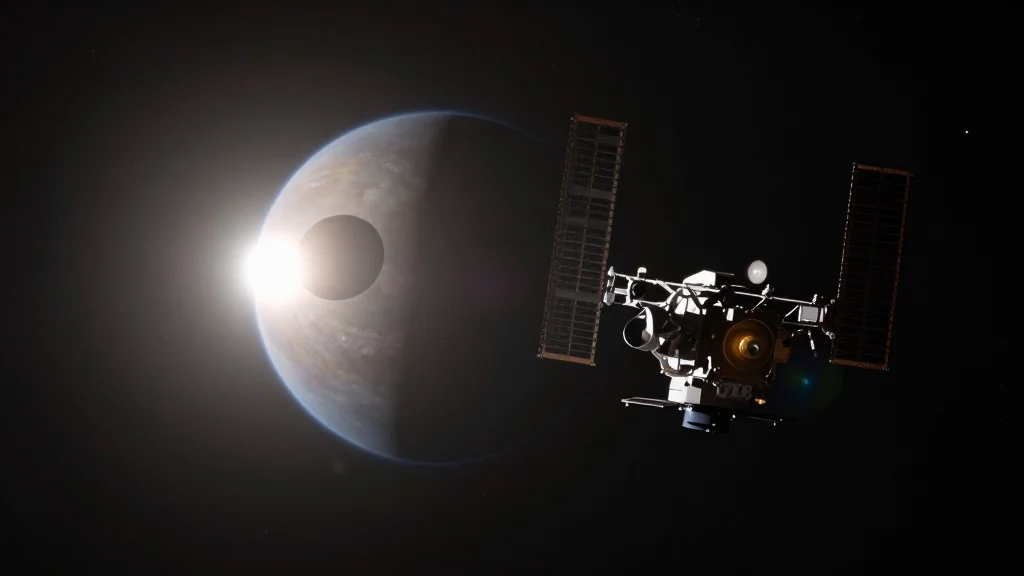
For NASA’s TESS, Stellar Eclipses Shed Light on Possible New Worlds
Why It Matters
Stellar‑eclipse analysis sharpens TESS’s ability to spot small, potentially habitable planets, accelerating the search for life‑supporting worlds and informing future space‑telescope designs.
Key Takeaways
- •Eclipse timing variations reveal hidden exoplanet signals
- •TESS now detects planets around binary star systems
- •Method increases discovery of Earth‑size planets in habitable zones
- •Findings guide design of next‑generation space telescopes
Pulse Analysis
The Transiting Exoplanet Survey Satellite, launched in 2018, has traditionally identified planets by spotting the brief dip in starlight as a planet crosses its host star. Recent research, however, exploits a complementary phenomenon: stellar eclipses in binary systems. When two stars orbit each other, their mutual eclipses produce predictable brightness patterns. By measuring subtle shifts in eclipse timing—known as eclipse timing variations—scientists can infer the gravitational tug of an unseen third body, often a planet. This technique allows TESS to extract planetary signals that would otherwise be lost in the complex light curves of binary stars, effectively turning a challenge into a discovery engine.
Applying eclipse analysis, the TESS team has uncovered several candidate worlds orbiting eclipsing binaries, including at least two Earth‑size planets situated within their stars’ habitable zones. These discoveries demonstrate that planets can form and remain stable in the dynamic environments of close‑in binary systems, expanding theoretical models of planetary formation. Moreover, the method improves the precision of planetary radius and orbital period estimates, providing richer datasets for atmospheric characterization with upcoming observatories like the James Webb Space Telescope.
The broader impact reaches beyond academia. Enhanced detection capabilities increase the catalog of potentially habitable worlds, fueling commercial interest in exoplanet data services, satellite instrumentation, and private‑sector space exploration. Investors and technology firms watch these breakthroughs closely, as they inform the next wave of space telescopes and deep‑space missions. By turning stellar eclipses into a powerful exoplanet probe, TESS not only advances scientific knowledge but also strengthens the economic ecosystem surrounding space science.
For NASA’s TESS, Stellar Eclipses Shed Light on Possible New Worlds
Comments
Want to join the conversation?
Loading comments...