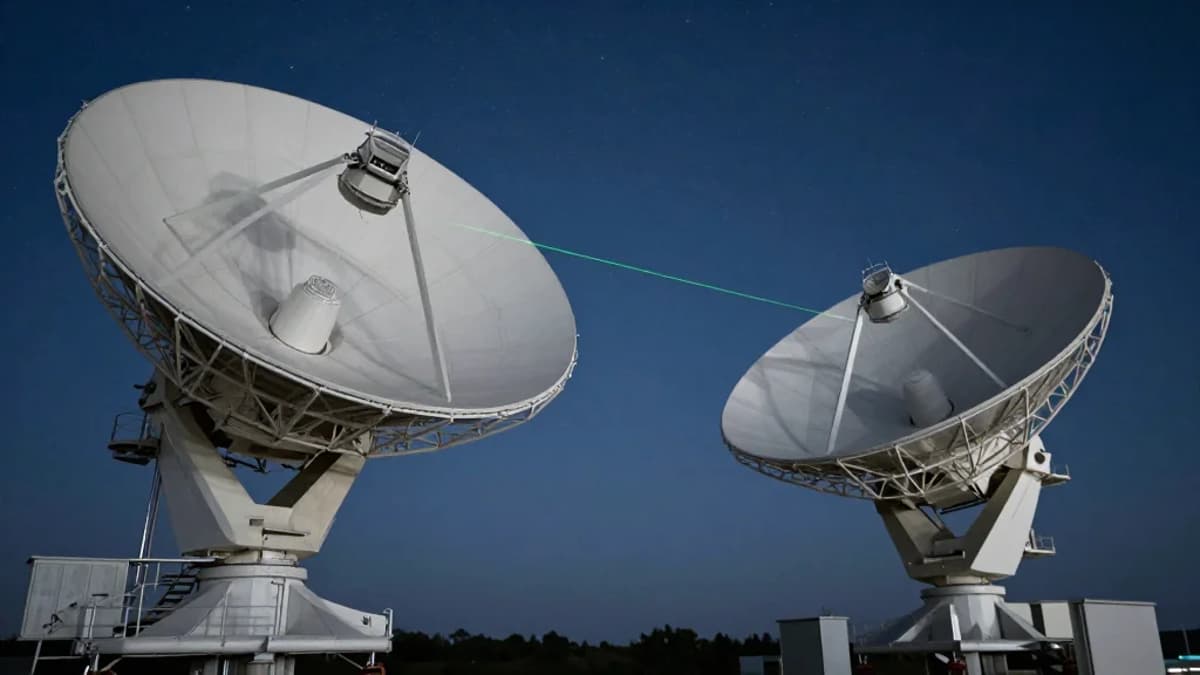
Frequency Comb Lasers Enable Clearer Observation of Black Holes
•January 15, 2026
0
Why It Matters
The technology dramatically boosts VLBI resolution and reliability, accelerating black‑hole science while enabling ultra‑precise time‑keeping and geodetic applications worldwide.
Key Takeaways
- •First optical frequency comb applied to VLBI telescopes
- •Laser reference eliminates phase‑delay errors at high frequencies
- •Enables sharper black‑hole images for Event Horizon studies
- •Supports ultra‑precise clock comparisons across continents
- •Potential for space geodesy and deep‑space probe tracking
Pulse Analysis
Very Long Baseline Interferometry (VLBI) has long been the cornerstone of high‑resolution radio astronomy, stitching together signals from geographically dispersed dishes to simulate a telescope the size of Earth. The technique’s power hinges on synchronizing the phase of each incoming wavefront, a task traditionally handled by electronic reference signals. As observation frequencies climb, these electronic references suffer minute vibrations that corrupt phase alignment, limiting image fidelity and constraining the study of compact objects like black holes.
Enter the optical frequency‑comb laser, a light source that emits thousands of evenly spaced, ultra‑stable frequencies—effectively a ruler of light calibrated to atomic‑clock precision. By feeding this comb directly into VLBI receivers, the KAIST team replaced shaky electronic markers with a steadfast optical benchmark. The result is a dramatic reduction in phase‑delay errors, as demonstrated by stable fringe detection across Korea’s VLBI Network telescopes. This laser‑based approach not only sharpens black‑hole silhouettes but also simplifies the reference‑signal architecture, merging generation and calibration into a single, highly reliable system.
Beyond astronomy, the ripple effects are profound. Precise phase control is essential for intercontinental clock comparisons, where nanosecond‑level synchronization underpins financial markets, navigation, and scientific experiments. Space geodesy—measuring Earth’s shape and tectonic movements—will gain accuracy, while deep‑space probe tracking can achieve tighter navigation margins. As the technology scales to global arrays, it promises a new era of ultra‑high‑resolution imaging and cross‑disciplinary precision, positioning optical frequency‑comb lasers as a pivotal tool in both scientific discovery and high‑tech infrastructure.
Frequency comb lasers enable clearer observation of black holes
0
Comments
Want to join the conversation?
Loading comments...