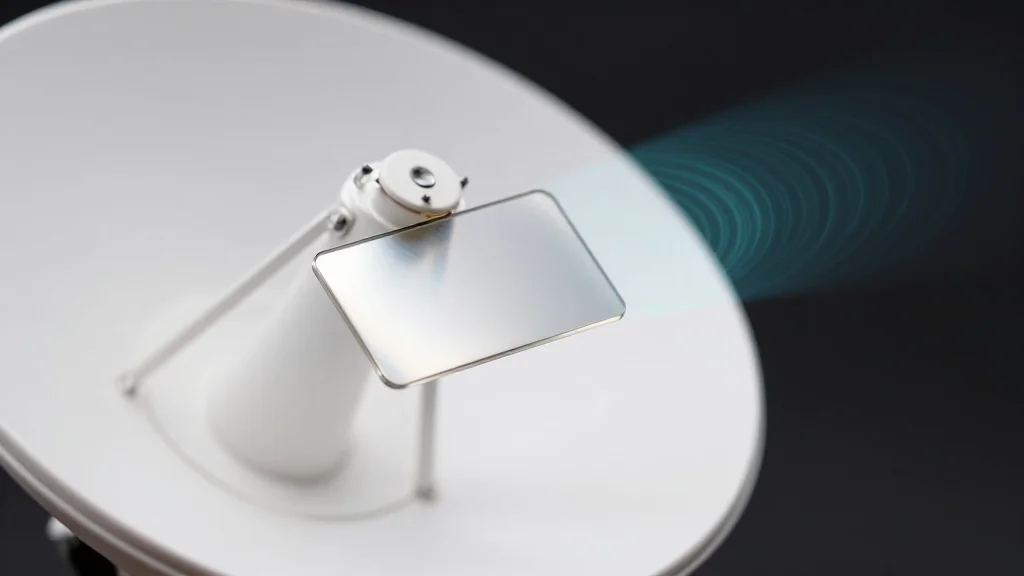
German Spin‑off Lepto Unveils 1‑µm Terahertz Filters to Lighten Satellite Payloads

Why It Matters
Lepto’s breakthrough addresses two persistent bottlenecks in space communications: payload mass and bandwidth scarcity. By delivering a filter that is both ultra‑light and capable of handling terahertz frequencies, the company offers a tangible solution to the cost pressures of launching larger constellations. The technology also dovetails with the broader push toward 6G, where terahertz bands are expected to carry the bulk of data traffic, making the spin‑off’s timing strategically significant. Beyond satellites, the filters could accelerate research in astrophysics, quantum computing, and medical diagnostics, where terahertz spectroscopy provides unique material insights. If Lepto can transition from bespoke research orders to volume manufacturing, it may catalyze a new supply chain for high‑frequency components, reshaping both the space and terrestrial communications markets.
Key Takeaways
- •Lepto unveiled a 1‑µm‑thick terahertz filter, roughly the thickness of a virus.
- •The filter’s thinness and 3D‑printed frames enable lightweight, custom satellite components.
- •Terahertz frequencies promise faster data rates and enhanced security for satellite links.
- •Lepto is seeking pre‑seed funding; financial details were not disclosed.
- •A field‑trial on a low‑Earth‑orbit platform is planned for early 2027.
Pulse Analysis
Lepto’s entry into the terahertz market arrives at a moment when satellite operators are scrambling to reduce launch expenses while expanding bandwidth. Historically, the terahertz band has been underutilized because of material and fabrication challenges; Lepto’s sub‑micron foil sidesteps many of those hurdles by marrying nanomaterials with additive manufacturing. This hybrid approach could lower the barrier to entry for other firms, potentially spawning a niche ecosystem of ultra‑light, high‑frequency components.
From a competitive standpoint, Lepto faces established RF component manufacturers that dominate the microwave and millimeter‑wave segments. However, those incumbents lack a proven pathway to terahertz production at scale. If Lepto can secure the needed capital and demonstrate reliability in orbit, it could carve out a first‑mover advantage, especially in the emerging 6G satellite backhaul market where terahertz links are projected to become the norm. The company’s focus on custom, on‑demand frames also positions it to serve a fragmented market of research institutions and niche satellite missions, a strategy that mitigates the risk of over‑reliance on a single large customer.
Looking ahead, the success of Lepto’s field trial will be the litmus test for commercial viability. A positive outcome could attract venture capital eager to back hardware that directly reduces launch costs—a metric that investors can quantify. Conversely, technical setbacks in the harsh space environment could stall adoption, pushing the technology back into the laboratory. Either way, Lepto’s announcement signals that the terahertz frontier is moving from theory to hardware, and the space industry will be watching closely.
German Spin‑off Lepto Unveils 1‑µm Terahertz Filters to Lighten Satellite Payloads
Comments
Want to join the conversation?
Loading comments...