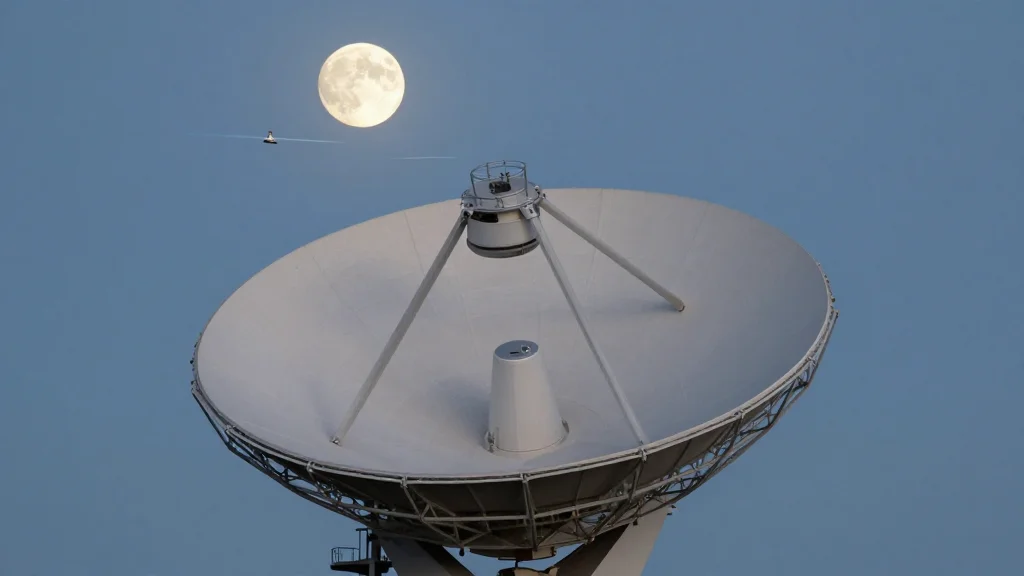
Green Bank Telescope Captures First Radio Image of Artemis 2 Crew Around the Moon

Why It Matters
The Green Bank Telescope’s ability to capture a radio image of a crewed spacecraft validates a low‑cost, high‑precision tracking method that could become a staple for future deep‑space missions. By providing an independent verification of Orion’s trajectory, the observation enhances mission safety and offers a new data source for navigation engineers. For the broader SpaceTech ecosystem, the demonstration opens a commercial market for radio‑based tracking services. Companies developing lunar orbiters, asteroid probes, or even interplanetary cargo can leverage existing radio infrastructure, reducing the need for dedicated space‑borne telemetry hardware and lowering overall mission budgets.
Key Takeaways
- •Green Bank Telescope tracked Artemis 2 for five days, producing the first radio image of a crewed lunar mission.
- •Observations confirmed Orion’s position within 0.2 mm/s of NASA’s projected trajectory.
- •GBT’s 100‑meter dish, weighing 17 million pounds, captured the spacecraft from 213,000 miles away.
- •The achievement showcases a cost‑effective, ground‑based alternative to traditional space‑borne telemetry.
- •Future Artemis missions may integrate radio‑tracking data to improve navigation and safety.
Pulse Analysis
The GBT’s success marks a turning point in how space agencies and commercial operators think about mission tracking. Historically, deep‑space navigation has relied on a constellation of space‑based assets—NASA’s Deep Space Network, ESA’s ESTRACK, and private relay satellites. Those systems are expensive to launch, maintain, and operate. By proving that a terrestrial radio telescope can deliver sub‑millimeter precision, the industry now has a viable, scalable alternative that can be deployed quickly and at a fraction of the cost.
From a market perspective, the data opens a niche for firms that specialize in radio‑frequency signal processing and data analytics. Companies that can ingest raw Doppler data, filter out noise, and generate actionable navigation insights could sell services to both government and private missions. This could spur a wave of startups focused on “radio‑track as a service,” similar to how satellite imagery has become a commodity.
Strategically, NASA’s Artemis program benefits from diversified tracking sources. Redundancy is critical for crew safety, especially as missions become more ambitious—lunar landings, Mars flybys, and beyond. The GBT’s involvement also strengthens the partnership between the agency and the National Science Foundation, aligning scientific research with operational needs. As Artemis 3 prepares for a lunar landing, integrating radio‑based telemetry could reduce the risk profile and free up bandwidth for scientific payloads, accelerating the overall timeline for sustainable lunar exploration.
Green Bank Telescope Captures First Radio Image of Artemis 2 Crew Around the Moon
Comments
Want to join the conversation?
Loading comments...