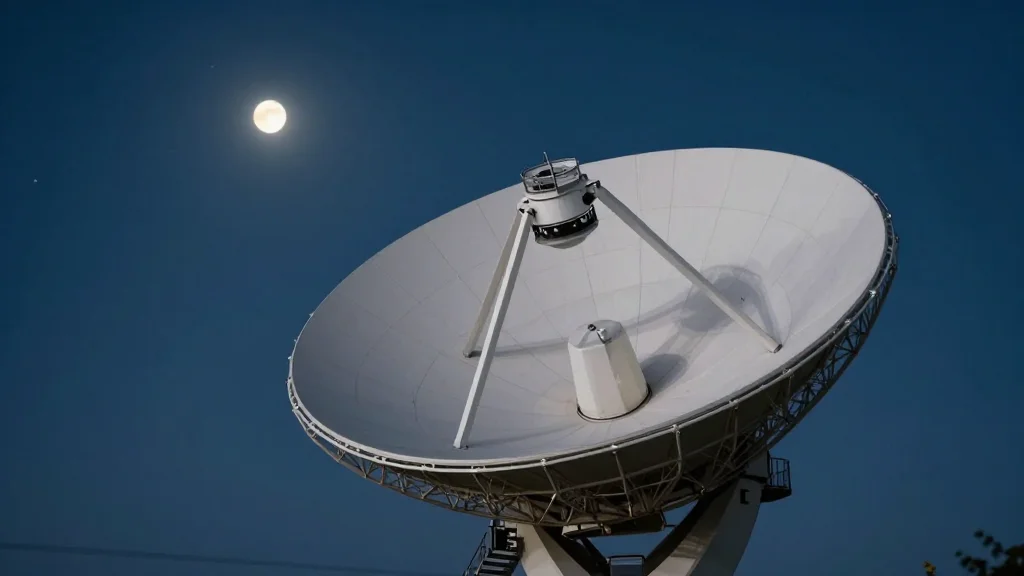
Ground‑Based Telescope Snaps Pixel‑Size Image of Artemis II Crew Orbiting Moon

Why It Matters
The GBT image demonstrates that ground‑based radio telescopes can deliver unprecedented tracking precision for crewed deep‑space missions, reducing reliance on costly space‑borne assets. This capability not only enhances mission safety but also opens avenues for international collaboration, as institutions worldwide can contribute data without launching additional hardware. Moreover, the visual confirmation—however pixelated—captures public imagination, reinforcing support for NASA’s Artemis program and the broader goal of a sustainable lunar economy. By proving that Earth‑based facilities can monitor spacecraft at lunar distances, the observation paves the way for more resilient, redundant navigation networks essential for future Mars expeditions.
Key Takeaways
- •Green Bank Telescope captured a pixel‑size image of Artemis II on April 6 at ~213,000 miles distance.
- •Image is the longest‑distance photograph of humans taken from Earth.
- •GBT tracked Orion’s movement within 0.2 mm per second of NASA’s projected trajectory.
- •Four crew members—Wiseman, Glover, Koch, Hansen—were represented in the pixel image.
- •Ground‑based tracking will support Artemis III lunar landing and future cislunar operations.
Pulse Analysis
The Green Bank Telescope’s successful capture of Artemis II illustrates a pivotal evolution in how space agencies will monitor crewed missions. Historically, visual confirmation has relied on onboard cameras or satellite imaging, both of which entail significant expense and limited coverage. By harnessing the GBT’s radio‑frequency sensitivity, NASA gains a low‑cost, high‑precision tool that can operate continuously, weather‑independent, and from any location with a suitable dish. This shift mirrors trends in commercial aviation, where ground‑based radar and ADS‑B networks have supplanted many satellite‑only tracking solutions.
From a strategic perspective, the GBT’s performance validates a hybrid tracking architecture that blends space‑based telemetry with terrestrial radio observations. Such redundancy is crucial as Artemis missions become more complex, involving lunar orbiters, the Gateway station, and surface habitats. The sub‑millimeter accuracy reported by Anthony Remijan translates into tighter navigation windows, potentially shaving minutes off transfer burns and conserving propellant—an economic benefit that compounds over multiple missions.
Looking ahead, the public’s reaction to the pixel image—viral on social media despite its simplicity—highlights the power of visual storytelling in sustaining funding and political support. As NASA and its partners push toward a lunar base and eventually Mars, the ability to produce tangible, relatable imagery from Earth will be a valuable outreach asset. The GBT’s role may expand beyond tracking, serving as a testbed for interferometric techniques that could one day image spacecraft surfaces or even detect subtle structural changes in orbiting hardware, further integrating scientific research with mission operations.
Ground‑Based Telescope Snaps Pixel‑Size Image of Artemis II Crew Orbiting Moon
Comments
Want to join the conversation?
Loading comments...