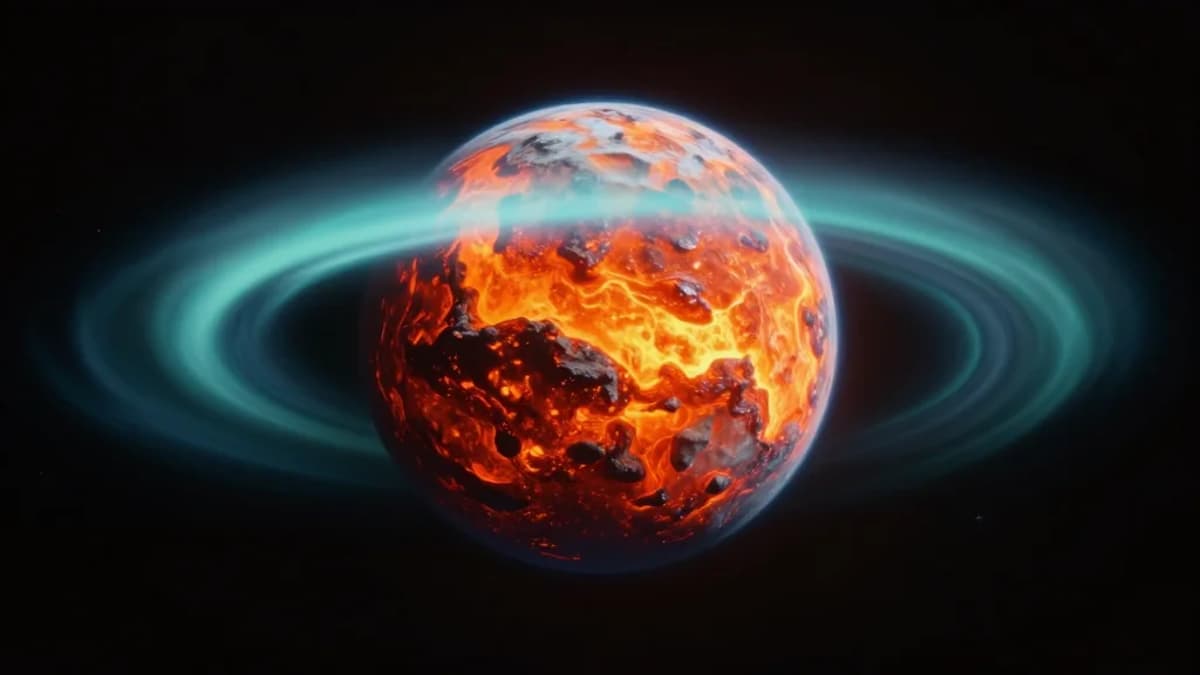
Hidden Magma Oceans Could Shield Rocky Exoplanets From Harmful Radiation
•January 15, 2026
0
Why It Matters
A magnetic shield generated by a magma ocean could make many super‑Earths viable targets in the search for life, influencing future exoplanet observation strategies.
Key Takeaways
- •Basal magma oceans can act as planetary dynamos
- •Conductive molten rock yields magnetic fields billions of years long
- •Super‑Earths 3‑6× Earth size may have stronger fields
- •Magnetic shielding boosts potential habitability
- •Experiments combined laser shocks, quantum simulations, planetary models
Pulse Analysis
The discovery that molten rock layers can power planetary dynamos adds a new dimension to our understanding of magnetic field generation beyond the traditional iron‑core model. While Earth’s magnetosphere arises from fluid motion in its liquid outer core, super‑Earths—due to their greater mass and internal pressure—may host extensive basal magma oceans that become electrically conductive. This conductivity enables the movement of charged particles to create magnetic fields that can persist for billions of years, fundamentally altering the thermal and chemical evolution of these worlds.
In the recent Nature Astronomy paper, Nakajima’s team replicated the extreme conditions of super‑Earth interiors using laser‑shock compression at the University of Rochester’s Laboratory for Laser Energetics. Coupled with quantum‑mechanical calculations of (Mg,Fe)O conductivity, the experiments revealed that pressures exceeding several hundred gigapascals turn mantle‑level magma into a metallic‑like fluid. Planetary‑evolution models then demonstrated that such a BMO dynamo could generate magnetic fields stronger than Earth’s, especially on planets three to six times Earth’s size. This mechanism offers a plausible explanation for why many super‑Earths might retain protective magnetospheres despite lacking a conventional iron core.
The broader implications are significant for astrobiology and exoplanet surveys. A robust magnetic field mitigates atmospheric erosion and shields surface environments from high‑energy particles, both critical factors for sustaining life. As next‑generation telescopes aim to characterize exoplanet atmospheres, magnetic field detection—via auroral emissions or star‑planet interaction signatures—could become a key habitability metric. The BMO hypothesis thus expands the catalog of potentially life‑supporting worlds and guides future observational priorities in the quest to find Earth‑like conditions beyond our solar system.
Hidden magma oceans could shield rocky exoplanets from harmful radiation
0
Comments
Want to join the conversation?
Loading comments...