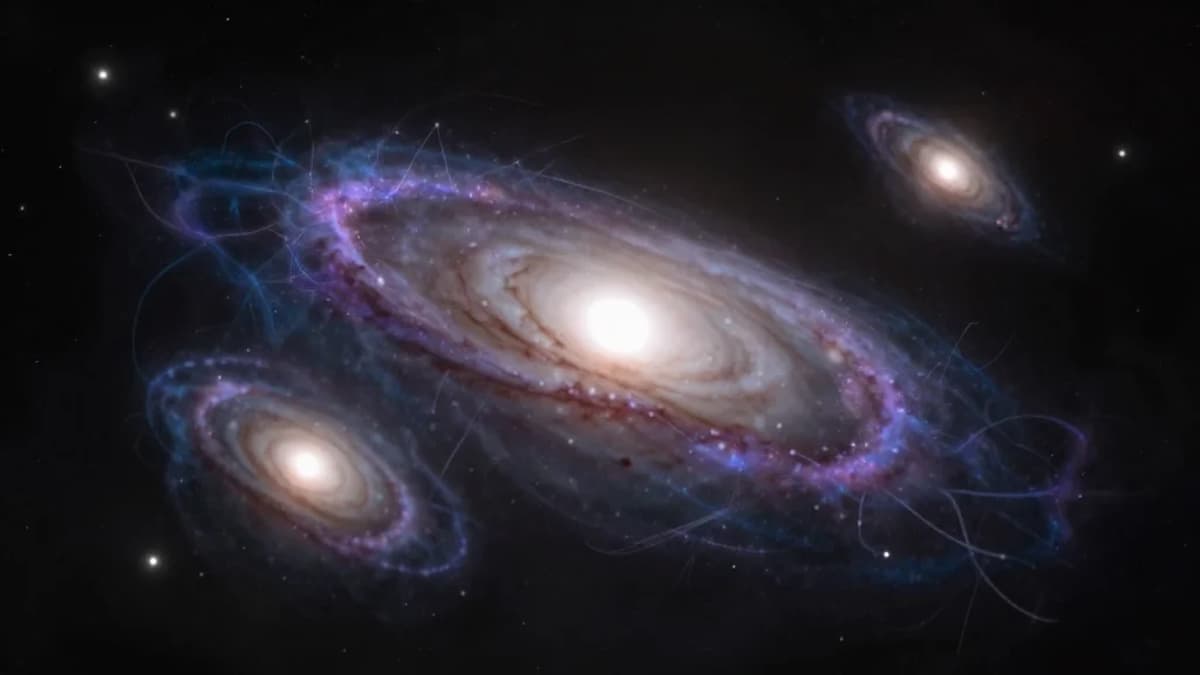
High-Resolution Map Shows Dark Matter's Gravity Pulled Normal Matter Into Galaxies
•January 26, 2026
0
Why It Matters
The map quantifies dark matter’s gravitational influence, a cornerstone for models of galaxy evolution and large‑scale structure, sharpening predictions for cosmology and future surveys. Understanding this hidden framework is essential for interpreting observations and probing dark matter’s fundamental properties.
Key Takeaways
- •Webb mapped dark matter with unprecedented resolution.
- •Map covers 2.5 Moon-sized area, 800k galaxies.
- •Reveals dark matter’s role in galaxy and planet formation.
- •Future surveys will expand mapping to whole universe.
Pulse Analysis
The new dark‑matter map leverages James Webb’s infrared sensitivity and exquisite angular resolution to overcome the blur that limited earlier surveys. By exploiting gravitational lensing of nearly a million background galaxies, researchers derived density contours with ten‑fold higher galaxy counts than ground‑based projects and twice the fidelity of Hubble’s maps. This leap in precision not only validates theoretical predictions about dark matter’s early clumping but also refines the mass distribution inputs used in cosmological simulations, tightening constraints on the Universe’s expansion history.
Beyond a technical triumph, the map illuminates how dark matter’s invisible scaffolding orchestrated the birth of stars, galaxies, and eventually planetary systems. The alignment of dark‑matter peaks with luminous structures confirms that gravity from unseen particles pulled ordinary matter into dense regions, accelerating star formation and enriching the interstellar medium with heavy elements essential for life. By visualizing this relationship, the study bridges the gap between abstract particle physics and the observable cosmos, offering a tangible illustration of why dark matter is indispensable for the cosmic web we inhabit.
Looking ahead, the research sets a benchmark for upcoming missions such as ESA’s Euclid and NASA’s Nancy Grace Roman Space Telescope, which will expand dark‑matter cartography across the entire sky. These next‑generation surveys will integrate Webb’s high‑resolution patch as a calibration reference, enabling astronomers to trace dark‑matter evolution over billions of years. For the broader scientific and commercial sectors—ranging from astrophysics research to satellite navigation—the refined mass‑distribution models promise more accurate predictions of gravitational lensing effects, improving everything from deep‑field imaging strategies to the planning of future space infrastructure.
High-resolution map shows dark matter's gravity pulled normal matter into galaxies
0
Comments
Want to join the conversation?
Loading comments...