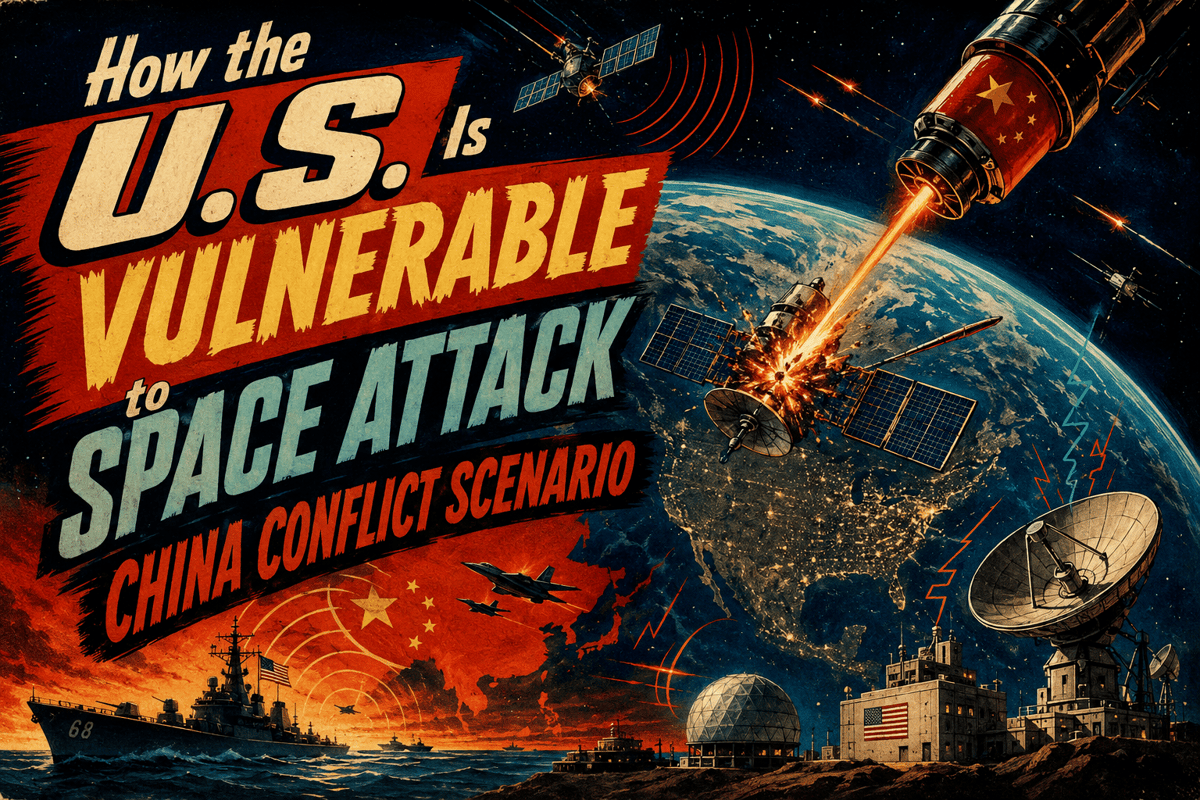
How the U.S. Is Vulnerable to Space Attack in a China Conflict Scenario
Companies Mentioned
Why It Matters
A sudden, partial loss of space‑based services could slow U.S. response, shift strategic initiative to China, and ripple through the global economy, highlighting urgent gaps in defense and policy readiness.
Key Takeaways
- •US military depends on satellites for warning, navigation, communications, ISR
- •China could disrupt satellites and undersea cables, creating early conflict ambiguity
- •Resilience needs diversified constellations, launch capacity, and redundant ground networks
- •Commercial space offers backup services but increases orbital congestion risk
- •Lack of space‑conflict norms leaves escalation rules undefined
Pulse Analysis
The Bruno scenario underscores how modern warfare has become inseparable from space. Satellite‑based warning, positioning, and communications compress decision cycles for forces spread across the Indo‑Pacific, so any simultaneous outage—whether from jamming, cyber intrusion, or kinetic attack—creates a fog of uncertainty that can be exploited by an adversary. By linking orbital disruption to undersea‑cable cuts, the analysis highlights a dual‑layer vulnerability: while satellites provide global reach, fiber‑optic cables deliver the bulk of high‑capacity data. Losing both at once would force military and civilian networks onto strained backups, amplifying delays and mis‑attribution risks during the crucial opening hours of a crisis.
China’s counter‑space portfolio, now encompassing electronic attack, cyber operations, directed‑energy tools, and both direct‑ascent and co‑orbital anti‑satellite weapons, makes the threat credible. Recent assessments show a rapid increase in Chinese ISR‑capable satellites—over 500 by the end of 2025—allowing precise targeting of U.S. assets. At the same time, commercial constellations such as low‑Earth‑orbit imaging and communications networks have proliferated, offering redundancy but also adding congestion and collision hazards. The intertwining of government and commercial space services means that a disruption reverberates through finance, logistics, weather forecasting, and emergency response, turning a military setback into a whole‑of‑society crisis.
Addressing the gap requires more than hardware. Policy makers must establish clear escalation norms for space engagements, akin to nuclear or maritime signaling, to deter ambiguous attacks. Technically, a resilient architecture should distribute capability across multiple orbits, increase launch cadence, and integrate secure commercial backups while hardening ground stations against cyber and kinetic threats. Allied coordination—sharing sensor data, joint repair assets, and interoperable communication protocols—will further dilute the value of any single target. Together, these steps can preserve the informational edge that underpins U.S. strategic advantage in a contested Pacific environment.
How the U.S. Is Vulnerable to Space Attack in a China Conflict Scenario
Comments
Want to join the conversation?
Loading comments...