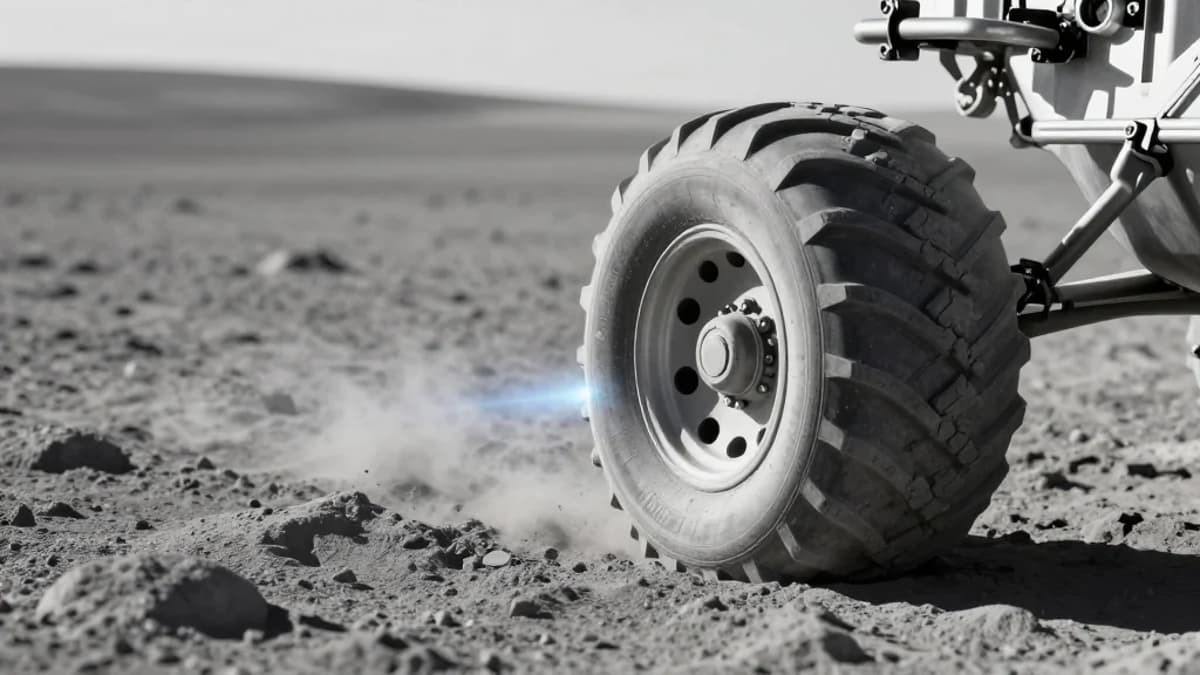
How to Prevent Charge Buildup in a Lunar Rover
•January 18, 2026
0
Why It Matters
Unmitigated electrostatic charge can damage rover electronics, jeopardizing mission objectives and increasing costs. Implementing the recommended controls safeguards hardware and enables reliable exploration of shadowed lunar regions.
Key Takeaways
- •Triboelectric charge builds on wheels in lunar regolith.
- •Solar wind plasma dissipates charge, but wakes reduce flux.
- •Rover speed must stay below 0.2 cm/s to avoid buildup.
- •Entering craters downwind of Sun maintains higher plasma density.
- •Wheels should stay electrically connected to rover body for discharge.
Pulse Analysis
The Moon’s surface is covered by a dry, insulating regolith that readily generates triboelectric charge when disturbed. As a rover’s wheels roll over this granular material, electrons are transferred, creating a static buildup that can reach voltages capable of arcing into delicate electronics. While the ambient solar‑wind plasma normally offers a conductive path for excess charge, the Moon’s lack of atmosphere means that any interruption of this plasma flow can leave the rover electrically isolated. Understanding this electrostatic environment is therefore a prerequisite for any surface‑based mission.
Farrell and Zimmerman’s recent simulations reveal that charge dissipation hinges on the local plasma density, which drops dramatically in the lunar night‑side wake and within permanently shadowed polar craters. In those plasma‑starved zones, the tribocharging current of a moving wheel can outpace the available plasma current, leading to rapid voltage accumulation. Their models identify a practical speed ceiling of roughly 0.2 cm s⁻¹; slower traversal allows the ambient plasma to neutralize the wheel before dangerous levels develop. This speed constraint directly influences mission timelines and rover navigation strategies.
The authors also advise keeping the wheels electrically tied to the rover chassis rather than isolating them, because a conductive path enables the vehicle body to act as a larger antenna for plasma currents. Additionally, approaching a crater from the sun‑facing, downwind side maximizes exposure to the solar‑wind stream, further aiding charge removal. Implementing these measures during the design phase reduces the risk of electrostatic discharge, protecting scientific payloads and extending operational life. As lunar exploration intensifies, such electro‑static safeguards will become standard engineering practice for future surface assets.
How to prevent charge buildup in a lunar rover
0
Comments
Want to join the conversation?
Loading comments...