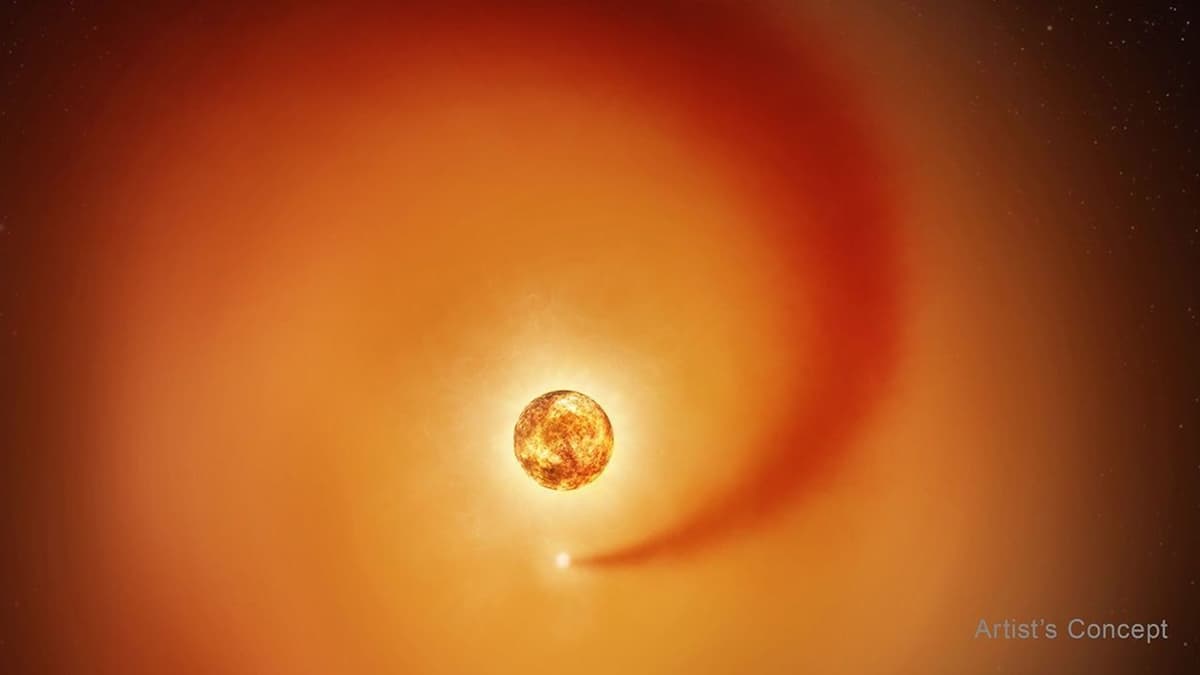
Hubble Telescope Spies 'Wake' Of Supergiant Beutelgeuse's Hidden Companion Star
•January 6, 2026
0
Companies Mentioned

NASA

ESA
Why It Matters
Confirming Siwarha reshapes our understanding of Betelgeuse’s erratic brightness and mass‑loss processes, informing models of red supergiant evolution and supernova precursors.
Key Takeaways
- •Hubble images reveal dense gas wake around Betelgeuse
- •Companion Siwarha confirmed after July 2025 detection
- •Wake appears every six years during alignment
- •Upcoming 2027 observation will test models
- •Findings refine red supergiant evolution theories
Pulse Analysis
The detection of Siwarha’s wake marks a milestone in stellar astrophysics, providing the first direct visual evidence of a companion influencing a red supergiant’s outer layers. By combining Hubble’s ultraviolet sensitivity with high‑resolution spectroscopy from the Fred Lawrence Whipple and Roque de Los Muchachos observatories, researchers mapped subtle density variations that trace the companion’s orbital path. This multi‑instrument approach underscores how space‑based and ground‑based assets can synergize to reveal phenomena otherwise invisible to single telescopes.
Understanding Betelgeuse’s variability has long challenged astronomers, as its irregular dimming events sparked speculation about internal convection, dust formation, or external perturbations. The newly confirmed wake offers a concrete mechanism: as Siwarha orbits, it compresses surrounding gas, creating a denser trail that modulates spectral lines and brightness when it crosses our line of sight. This insight refines mass‑loss estimates for red supergiants, a critical factor in predicting when such stars will explode as supernovae and how they enrich the interstellar medium.
Looking ahead, the 2027 alignment presents a rare observational window to test theoretical models of binary interaction in massive stars. Planned campaigns will leverage next‑generation instruments, including the James Webb Space Telescope’s infrared capabilities, to probe the wake’s composition and temperature structure. These data will not only validate current simulations but also improve forecasts of stellar end‑states, influencing fields from galactic chemical evolution to supernova early‑warning systems. The Betelgeuse‑Siwarha system thus becomes a natural laboratory for studying how hidden companions shape the life cycles of the universe’s most massive stars.
Hubble Telescope spies 'wake' of supergiant Beutelgeuse's hidden companion star
0
Comments
Want to join the conversation?
Loading comments...