Spacetech News and Headlines
  • All Technology
  • AI
  • Autonomy
  • B2B Growth
  • Big Data
  • BioTech
  • ClimateTech
  • Consumer Tech
  • Crypto
  • Cybersecurity
  • DevOps
  • Digital Marketing
  • Ecommerce
  • EdTech
  • Enterprise
  • FinTech
  • GovTech
  • Hardware
  • HealthTech
  • HRTech
  • LegalTech
  • Nanotech
  • PropTech
  • Quantum
  • Robotics
  • SaaS
  • SpaceTech
AllNewsDealsSocialBlogsVideosPodcastsDigests
NewsDealsSocialBlogsVideosPodcasts
SpacetechNewsHunting Cosmic Ghosts From the Edge of Space
Hunting Cosmic Ghosts From the Edge of Space
SpaceTechAerospace

Hunting Cosmic Ghosts From the Edge of Space

•February 17, 2026
0
New Space Economy
New Space Economy•Feb 17, 2026

Why It Matters

Detecting ultra‑high‑energy neutrinos would open a new window on the universe’s most violent astrophysical events, informing models of black holes and neutron‑star collisions. The mission also demonstrates a scalable, cost‑effective method for high‑energy particle astronomy.

Key Takeaways

  • •PUEO flew 23 days at 120,000 ft over Antarctica
  • •96 antennas detect radio signals from ultra‑high‑energy neutrinos
  • •Ice acts as a radio‑transparent detector for neutrino interactions
  • •Data payload holds 50–60 TB, analysis to start next year
  • •Mission builds on ANITA, improving sensitivity with real‑time beamforming

Pulse Analysis

Neutrino astronomy has long been hampered by the particles’ ghost‑like nature; they pass through matter virtually unnoticed, making detection a formidable engineering challenge. Ultra‑high‑energy neutrinos, however, carry clues about the most extreme cosmic phenomena—gamma‑ray bursts, supermassive black‑hole jets, and neutron‑star mergers. By exploiting the radio‑transparent properties of Antarctic ice, scientists can convert a rare neutrino interaction into a detectable radio pulse, turning the continent itself into a gigantic, natural detector.

The Payload for Ultrahigh Energy Observations (PUEO) builds on the legacy of the ANITA missions but introduces a denser array of 96 antennas and real‑time beamforming electronics that dramatically boost signal‑to‑noise performance. Housed in a 700‑foot balloon platform, the system operates autonomously at stratospheric altitudes, drawing power from solar panels and using sophisticated thermal management to survive the vacuum of near‑space. During its 23‑day flight, PUEO recorded 50–60 terabytes of raw data, a trove that will require months of calibration and machine‑learning‑driven analysis to isolate genuine neutrino events from background noise.

If PUEO identifies even a handful of ultra‑high‑energy neutrinos, it will validate a cost‑effective, reusable architecture for next‑generation particle observatories, potentially accelerating commercial interest in high‑altitude platforms for scientific payloads. Moreover, the findings could reshape astrophysical models of particle acceleration, offering direct insight into the mechanisms powering the universe’s most energetic explosions. The collaboration’s multinational component also showcases how shared expertise and logistics can overcome the logistical hurdles of Antarctic research, setting a precedent for future large‑scale, low‑budget space‑science initiatives.

Hunting Cosmic Ghosts from the Edge of Space

In Antarctica, balloon lands after 23‑day search for particles from outer space · University of Chicago News

Picture this… you’ve spent five years building an exquisitely sensitive scientific instrument. You’ve tested it, shipped it halfway around the world, reassembled it in Antarctica, and now you’re watching it disappear into the blue sky aboard a giant balloon. For the next three weeks, all you can do is monitor it from the ground and hope everything works.

That’s exactly what happened to a team of University of Chicago scientists who launched the PUEO experiment on December 20, 2024. PUEO (Payload for Ultrahigh Energy Observations) spent 23 days floating at 120,000 feet above Antarctica, searching for particles that have never been detected before. The quarry? Ultra‑high‑energy neutrinos, some of the most elusive and energetic particles in the universe.

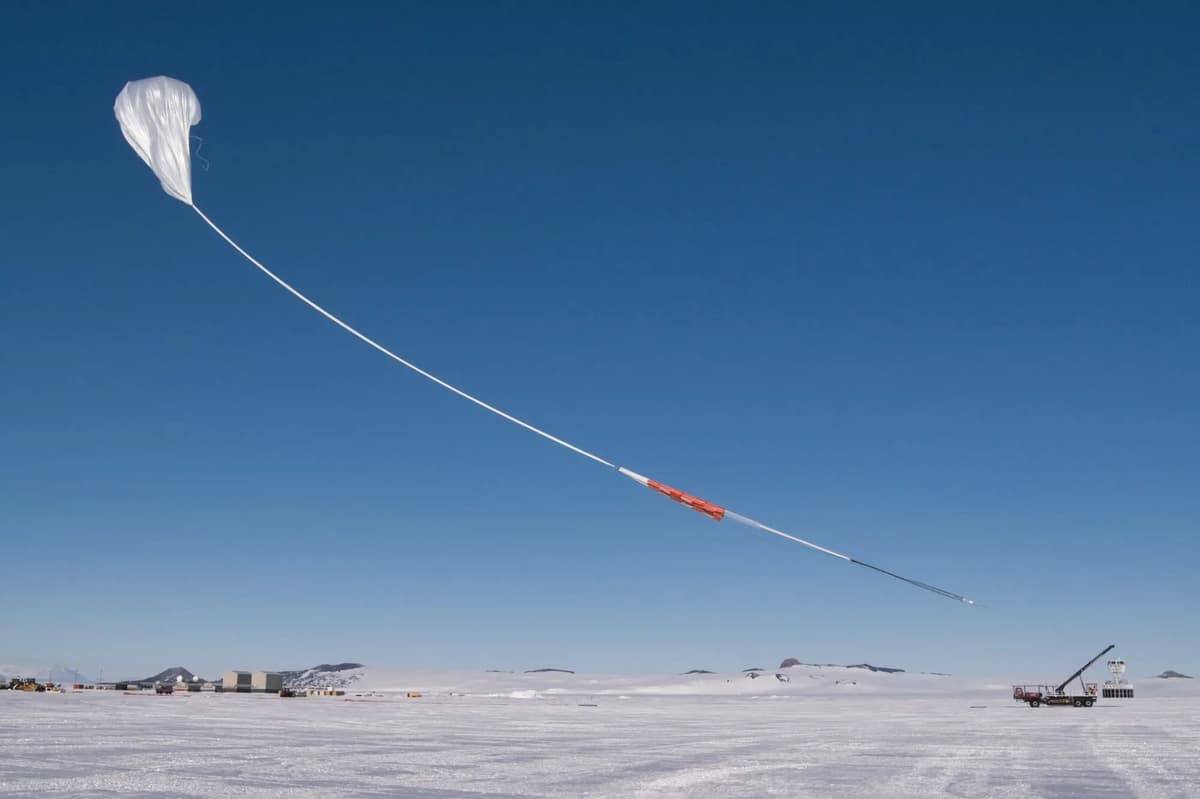
Image caption: The Payload for Ultrahigh Energy Observations (Credit: NASA / Scott Battaion).

Neutrinos are fascinating things. They’re constantly raining down on Earth from outer space, passing through matter as if it barely exists. Most of the time we don’t notice them at all; they interact so weakly with ordinary matter that they can sail right through the entire planet without touching anything.

Scientists believe there’s a rare subset of neutrinos that are extraordinarily energetic—carrying more energy than even the particles being smashed together at the Large Hadron Collider. Finding them would give us a window into the universe’s most violent events, such as the vicinity of supermassive black holes or collisions between ultra‑dense neutron stars. The challenge is actually catching one, and to do that the PUEO team came up with an ingenious solution: use the entire continent of Antarctica as a detector.

Image caption: Superconducting quadrupole electromagnets are used to direct the beams in the Large Hadron Collider (Credit: Gamsiz).

The idea works because ice conducts radio waves extremely well. If an ultra‑high‑energy neutrino collides with an atom in Antarctica’s enormous ice sheet, the impact produces radio waves that travel through the ice and into the air above. PUEO was designed to catch those faint signals from its vantage point at the edge of space.

The instrument itself is remarkable: 96 ultra‑sensitive radio antennas arranged in concentric circles surround a “brain” that constantly sifts through incoming signals to identify which might be neutrinos. It’s powered by solar panels and built to be significantly more sensitive than its predecessor, ANITA, thanks to advances in electronics and a clever design that combines signals from multiple antennas in real time.

Building PUEO was a global effort. Over five years, labs around the world built components and shipped them to Chicago for assembly. The testing phase included a trip to Texas to make sure the electronics would function in the near‑vacuum conditions of the stratosphere, where there’s no air for cooling fans.

“The big challenge is that without air, you can’t use fans to cool down the electronics if they get too hot,” – Cosmin Deaconu, research professor at UChicago who wrote the flight software.

After passing its tests, PUEO had to be taken apart again for an epic journey: by road to California, by ship to Christchurch, New Zealand, and finally by air to NASA’s balloon station in Antarctica. There, scientists worked quickly to reassemble it before the launch window opened. The weather needed to be not just clear but stable all the way up through the atmosphere, and the launch window could open at any time of day or night, so the team had to be constantly ready.

PUEO launched successfully on its first attempt in the early morning of December 20. The balloon rose, lifting the instrument until the entire 700‑foot‑long assembly was airborne. As it climbed to 120,000 feet, the solar panels extended and additional antennas deployed below the main instrument to boost sensitivity.

But the launch was just the beginning. For the next three weeks the team took shifts monitoring PUEO around the clock. The instrument was designed to function independently, but adjustments were still required; at one point the payload was rotating more slowly than expected, causing one side to receive too much sun and overheat.

Image caption: PUEO is hunting for high‑energy particles such as those emitted by gamma‑ray bursters. This animation shows GRB 211106A, one of the most energetic short GRBs ever registered, as seen by the Atacama Large Millimetre/sub‑millimetre Array (Credit: ALMA/ESO/NAOJ/NRAO).

After 23 days aloft, with weather predictions suggesting the winds would change, the team decided to bring PUEO back down. NASA cut the line to the balloon and deployed a parachute. The instrument drifted gently back to Earth about 200 miles north of the South Pole.

A retrieval crew traveled to the landing site to recover the “black box” containing 50–60 terabytes of data collected during the mission. That precious cargo will be flown back to Chicago, where the real work begins: sorting, calibrating, and analysing the data to see if PUEO caught any of these extraordinary particles.

The scientists expect it will take about a month just to process all the data, with first results available in roughly a year. They might discover the highest‑energy particles ever detected, or they might not find any at all—but either way, they’ll learn something valuable about the most extreme environments in our universe.

Read Original Article
0

Comments

Want to join the conversation?

Loading comments...