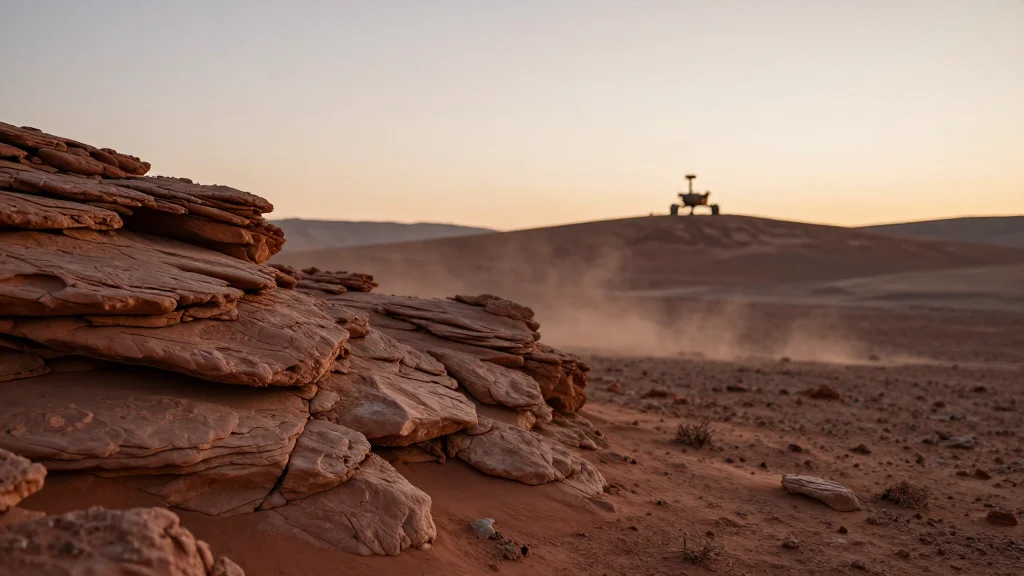
Images: NASA's Perseverance Captures Panorama at 'Arbot'
Why It Matters
The high‑resolution view expands understanding of Martian sedimentology and informs future sample‑return site selection, underscoring Perseverance’s continued capability to deliver valuable data.
Key Takeaways
- •46‑image panorama captured at ‘Arbot’ on sol 1882 (April 5, 2026).
- •Enhanced‑color processing highlights subtle mineralogical differences across the terrain.
- •3‑D anaglyph composed of 92 images enables stereoscopic geological analysis.
- •Panorama supports scouting for future Mars sample‑return and human‑exploration sites.
Pulse Analysis
Perseverance’s latest achievement comes as the rover extends its western traverse beyond the rim of Jezero Crater, a region scientists have long eyed for its potential to preserve ancient Martian environments. The newly named “Arbot” sector, reached on sol 1882, offers a broad, winds‑carved vista that contrasts sharply with the crater’s more sheltered basins. By stitching together 46 high‑resolution Mastcam‑Z frames, engineers produced an enhanced‑color mosaic that accentuates subtle hue variations, a technique that helps differentiate mineral deposits and weathering patterns.
The scientific payoff of the Arbot panorama is immediate. Enhanced‑color processing brings out faint spectral signatures that can indicate the presence of clays, sulfates, or basaltic fragments, each hinting at past water activity or volcanic processes. The accompanying 3‑D anaglyph, built from 92 overlapping images, lets geologists examine stratigraphic relationships in stereoscopic view, improving assessments of sedimentary layering and erosion dynamics. Such detailed visual data are crucial for refining the shortlist of sites where Perseverance’s drill may retrieve samples for the upcoming Mars Sample Return campaign.
Beyond pure research, the Arbot images serve strategic planning for humanity’s next steps on the Red Planet. High‑resolution, color‑accurate mosaics help mission architects evaluate terrain safety for future landers and habitats, while public‑facing releases boost outreach and sustain funding momentum. As NASA and international partners gear up for crewed missions in the 2030s, every new vista like Arbot adds a layer of confidence that the Martian surface can be navigated, studied, and eventually inhabited.
Images: NASA's Perseverance captures panorama at 'Arbot'
Comments
Want to join the conversation?
Loading comments...