Infrared Running of Gravity Offers a Field-Theoretic Route to Dark Matter Phenomena
•February 2, 2026
0
Why It Matters
If gravity’s coupling varies on large scales, it offers a particle‑free explanation for galactic dynamics, challenging the dominant cold dark‑matter paradigm and reshaping cosmological model building.
Key Takeaways
- •Gravity’s constant may run in infrared regime
- •Infrared running yields logarithmic correction to potential
- •Model reproduces flat galaxy rotation curves
- •Fits data with single crossover parameter
- •Preserves early‑universe constraints while altering large scales
Pulse Analysis
Renormalisation‑group techniques, a staple of quantum field theory, traditionally describe how couplings evolve at high energies. Applying the same logic in reverse, researchers have explored the possibility that Newton’s constant is not immutable but drifts at ultra‑large wavelengths. This infrared running introduces a subtle logarithmic term to the gravitational potential, effectively shifting the force law from 1/r² to a hybrid that includes a 1/r component. Such a modification emerges directly from scaling arguments, sidestepping ad‑hoc additions common in many modified‑gravity proposals.
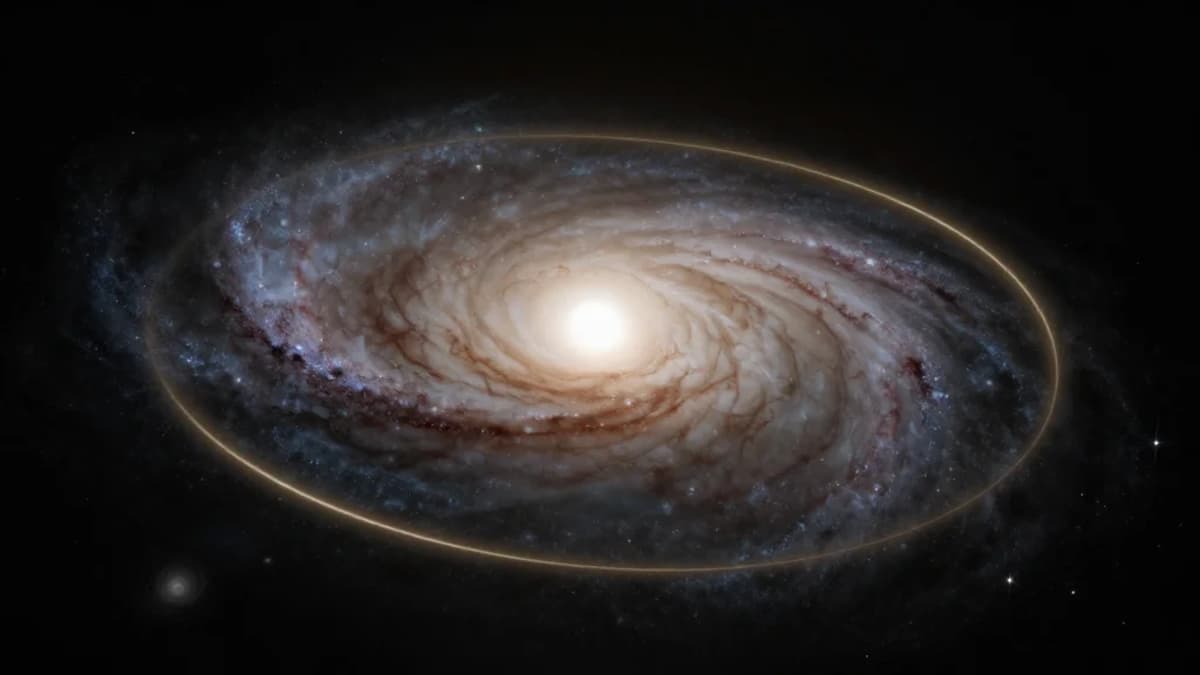
When the revised potential is confronted with rotation‑curve measurements, the results are striking. By inputting only the observed distribution of stars and gas, and adjusting a single crossover‑scale parameter, the model reproduces the characteristic flatness of spiral‑galaxy rotation curves across a broad radial range. This parsimonious fit challenges the necessity of massive, unseen dark‑matter halos in explaining galactic dynamics, offering a field‑theoretic alternative that aligns with existing baryonic data.
Beyond individual galaxies, the infrared‑running scenario must coexist with precision cosmology. Because the correction grows slowly with distance and cosmic time, it leaves the early‑universe physics—such as the cosmic microwave background and primordial nucleosynthesis—largely untouched, while becoming relevant at later epochs. Future surveys targeting gravitational lensing, cluster velocity dispersions, and large‑scale structure will be crucial to differentiate this approach from particle‑dark‑matter models. If confirmed, scale‑dependent gravity could redefine our understanding of the universe’s missing mass problem.
Infrared running of gravity offers a field-theoretic route to dark matter phenomena
0
Comments
Want to join the conversation?
Loading comments...