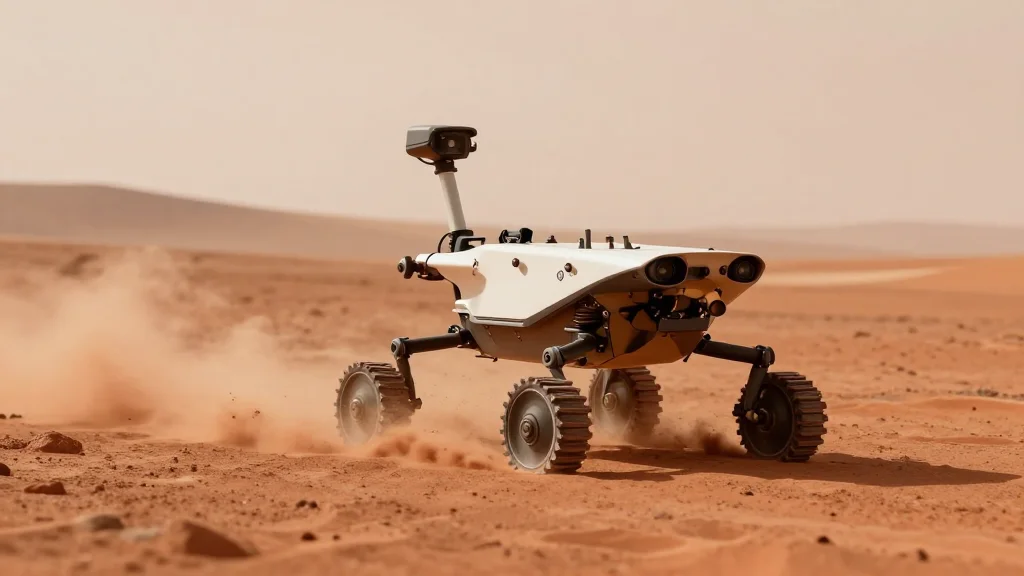
Innovative Mars Rovers “Swim” Through the Sand
Why It Matters
Enabling rovers to traverse soft, shifting terrain expands the scientific reach of Mars missions, allowing access to previously unreachable sites rich in geological and possibly biosignature information. The technology also reduces mission risk and cost by minimizing the need for complex wheel‑based suspension systems.
Key Takeaways
- •Sandfish mimics lizard locomotion to move through granular sand
- •Prototype reaches 1.5 m/s in simulated Martian conditions
- •Handles slopes up to 30° without losing traction
- •Reduces reliance on heavy wheel‑suspension designs
- •Potential to unlock dune‑filled regions for scientific study
Pulse Analysis
The Sandfish rover represents a paradigm shift in planetary mobility, borrowing biomechanics from desert fauna to solve a long‑standing engineering challenge. Traditional wheeled rovers, such as NASA’s Curiosity and Perseverance, excel on firm ground but struggle in loose regolith where wheels can sink or slip. By employing rapid lateral undulations, Sandfish generates thrust within the sand itself, effectively "swimming" through the granular medium. This approach not only improves speed—up to 1.5 meters per second in laboratory tests—but also enhances stability on steep, uneven dunes, a terrain type that covers a significant portion of the Martian surface.
Beyond the immediate performance gains, the swimming‑style locomotion offers strategic advantages for mission planners. Reducing the mechanical complexity of wheel assemblies translates into lower mass, fewer moving parts, and decreased wear, which can extend mission lifespans and lower launch costs. Moreover, the ability to navigate soft sand opens up high‑value scientific targets, such as ancient sedimentary layers that may preserve clues about Mars’ climate history and potential past life. By accessing these regions, future missions could gather samples that are currently out of reach, enriching our understanding of planetary evolution.
The broader implications extend to other planetary bodies with granular surfaces, including the Moon’s regolith and asteroid surfaces. Engineers are already exploring adaptations of the Sandfish concept for lunar exploration, where dust mitigation is a critical concern. As the space industry pushes toward more ambitious, cost‑effective missions, bio‑inspired mobility solutions like Sandfish are poised to become a cornerstone of next‑generation rover design, marrying scientific ambition with engineering efficiency.
Innovative Mars Rovers “Swim” Through the Sand
Comments
Want to join the conversation?
Loading comments...