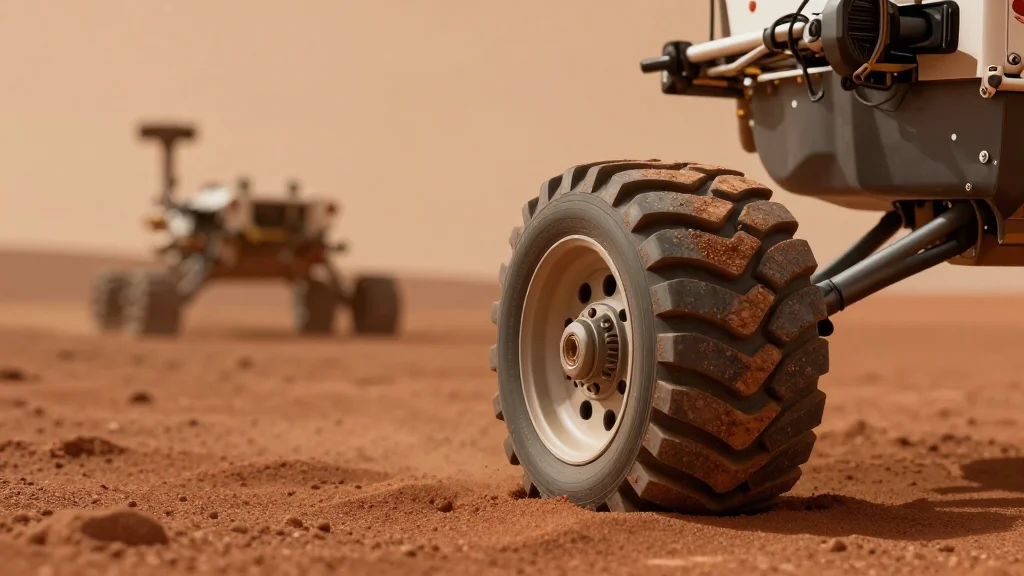
Innovative Mars Rovers 'Swim' Through the Sand
Why It Matters
The breakthrough could dramatically extend the operational range of future Mars rovers, reducing mission risk and cost associated with getting stuck in soft soils. It also showcases how biological inspiration can solve longstanding engineering challenges in planetary exploration.
Key Takeaways
- •Würzburg team created wheels that “swim” through sand, mimicking sandfish lizard
- •Initial prototypes were heavy and narrow, causing sinking and slippage
- •Wider, lighter wheels reduced ground pressure and improved rover stability
- •Future work adds AI-driven control to adapt to granular terrain
Pulse Analysis
Mars exploration has long been hampered by the planet’s pervasive fine‑grained regolith, which can immobilize even the most robust rovers. Traditional wheels, optimized for firm ground, often lose traction on dunes, forcing mission planners to chart conservative routes or risk costly rescue operations. Biomimicry offers a compelling alternative: by studying organisms like the sandfish lizard that glide beneath sand, engineers can extract principles of distributed force generation and low‑pressure locomotion. This approach aligns with a broader trend in aerospace where nature‑inspired designs reduce mechanical complexity while enhancing performance.
The Würzburg prototype translates these biological insights into a set of non‑rolling, sinusoidal wheels that produce both forward thrust and lateral stability. Early field trials in German sand pits demonstrated the concept’s viability, but the first generation suffered from high ground pressure due to narrow, heavy wheels, leading to slippage and sinking. Iterative redesigns widened the wheel footprint and trimmed mass, cutting pressure by roughly 30 percent and delivering smoother, more controllable motion. These hardware refinements were validated through collaborative testing with DFKI and the University of Bremen, confirming that the rover can maintain traction on loose substrates without sacrificing speed.
Looking ahead, the project’s ambition extends beyond mechanical innovation. By embedding sensor‑rich feedback loops and AI‑driven control strategies, the rover could dynamically adjust wheel kinematics in response to real‑time terrain assessments, effectively “learning” how to swim through varying granular conditions. Such adaptive mobility would empower future missions to venture into previously inaccessible regions, from deep dune fields to crater walls, expanding scientific return while mitigating the risk of immobilization. The convergence of biomimetic hardware and intelligent software thus positions this technology as a potential game‑changer for planetary surface exploration.
Innovative Mars rovers 'swim' through the sand
Comments
Want to join the conversation?
Loading comments...