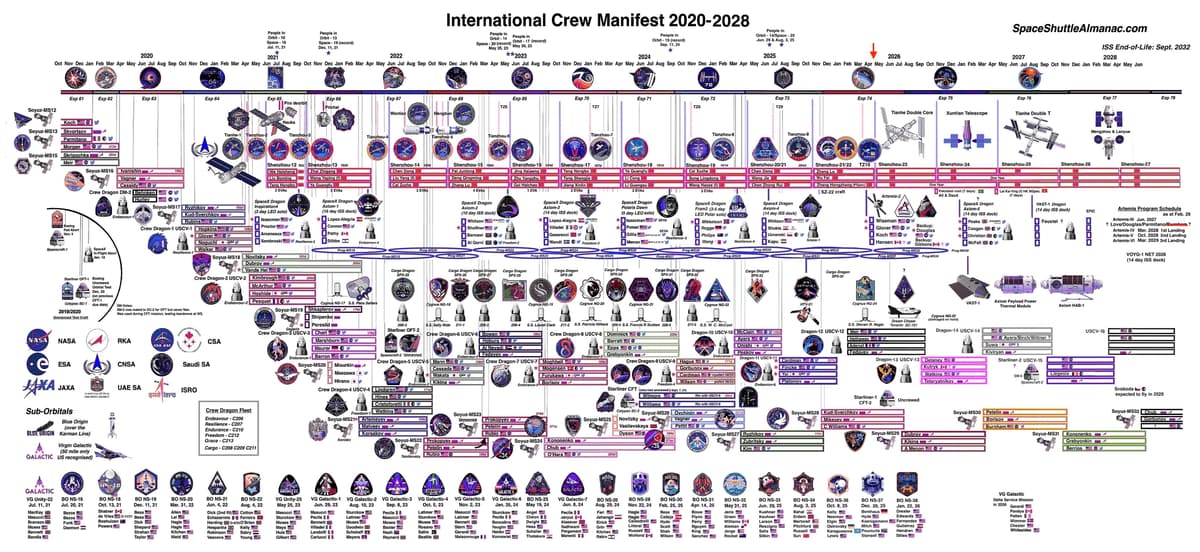
International Crew Manifest 2020-2028: The Human Spaceflight Traffic Map of a Crowded Decade
Why It Matters
The manifest proves that human spaceflight is now a commercial‑driven logistics network, making schedule resilience and multi‑vehicle redundancy critical for continued research, revenue, and international cooperation.
Key Takeaways
- •Crew Dragon performed 13 ISS rotations by 2026
- •Soyuz remained core Russian crew transport through 2028
- •Axiom private missions added commercial astronaut slots
- •Tiangong established a parallel six‑month crew schedule
Pulse Analysis
The past decade has reshaped low‑Earth‑orbit operations from a handful of government‑run expeditions into a continuous, multi‑vehicle service model. SpaceX’s Crew Dragon, after Demo‑2 in 2020, quickly transitioned to a routine rotation, delivering more than a dozen crews and supporting partner agencies such as ESA, JAXA, and CSA. This commercial cadence lowered launch costs, introduced a service‑based procurement approach, and created a reliable backbone that can absorb disruptions, as demonstrated when Starliner’s 2024 test failure forced a rapid crew return on Dragon. The resulting redundancy is now a strategic asset for NASA and its international partners, ensuring station staffing and research continuity.
Simultaneously, China’s Tiangong program has cemented a second long‑duration platform, mirroring the ISS’s six‑month crew turnover but operating independently of the Western partnership. The parallel schedules highlight a shift toward a multi‑destination architecture, where future missions will need to coordinate docking ports, life‑support resources, and crew handovers across distinct stations. Artemis lunar flights add a new orbital regime, stretching logistics planning beyond low‑Earth‑orbit and demanding integrated launch‑window management between NASA, commercial providers, and international agencies.
The influx of private astronaut missions, exemplified by Axiom’s Ax‑4 and other commercial flights, introduces short‑duration traffic that competes for limited docking slots, crew time, and cargo support. This commercial layer fuels a growing market for astronaut training, payload integration, and media services, while also serving as a proving ground for future private stations. As the manifest illustrates, the emerging human‑spaceflight ecosystem hinges on coordinated scheduling, diversified transport providers, and adaptable infrastructure—factors that will define the industry’s profitability and resilience in the coming decade.
International Crew Manifest 2020-2028: The Human Spaceflight Traffic Map of a Crowded Decade
Comments
Want to join the conversation?
Loading comments...