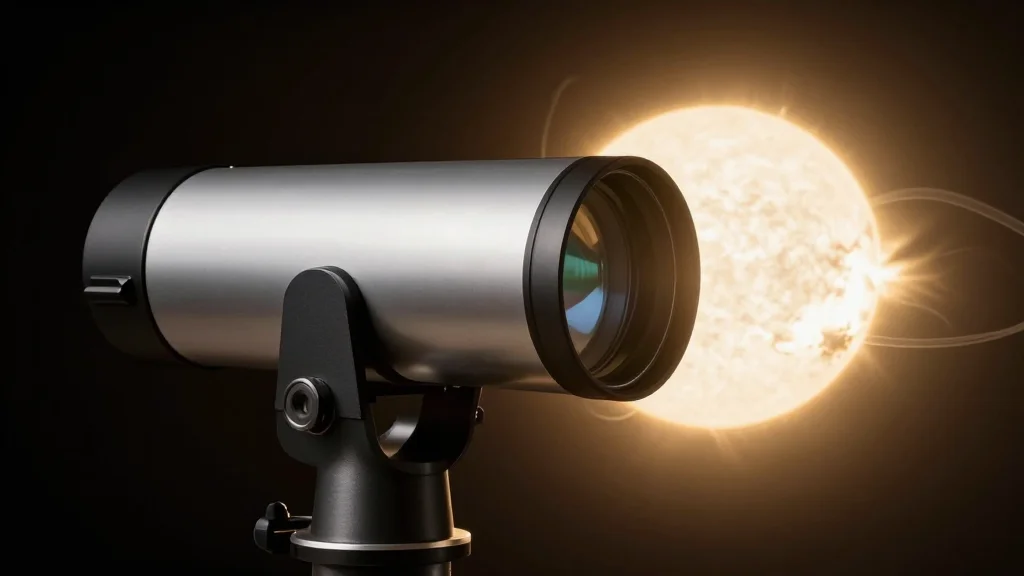
IRSOL Unveils Ultra‑Precise Polarimeter to Map Sun's Magnetic Field

Why It Matters
Understanding the Sun’s magnetic field is essential for predicting space‑weather events that threaten satellite operations, navigation systems, and power grids. The unprecedented precision of IRSOL’s ZIMPOL polarimeter promises to close gaps in current solar models, leading to more accurate forecasts of solar storms. Moreover, the techniques pioneered here will cascade into stellar astrophysics, enhancing our grasp of magnetic processes across the cosmos. The collaboration also showcases how European research infrastructures—IRSOL, GREGOR, and the SOLARNET network—can deliver cutting‑edge instrumentation that competes globally. By strengthening Europe’s role in heliophysics, the project supports strategic goals for scientific leadership and technological resilience against solar‑induced disruptions.
Key Takeaways
- •IRSOL unveiled an upgraded ZIMPOL polarimeter with 0.001% fractional polarisation precision.
- •The instrument will operate on the Gregory Coudé Telescope in Locarno and the GREGOR telescope in Tenerife.
- •A new slow‑and‑fast modulation technique reduces systematic errors, enhancing absolute polarisation accuracy.
- •Joint observations are planned with Solar Orbiter’s STIX X‑ray imager for solar flare studies.
- •Improved magnetic field mapping aims to boost space‑weather forecasting and inform stellar physics research.
Pulse Analysis
The launch of IRSOL’s ultra‑precise ZIMPOL polarimeter arrives at a critical juncture for heliophysics. Historically, solar magnetic field measurements have been limited by instrumental noise and calibration uncertainties, leaving key questions about the solar dynamo unresolved. By slashing systematic errors through the novel modulation scheme, IRSOL not only narrows the error bars on magnetic field vectors but also sets a new benchmark for ground‑based solar polarimetry.
From a market perspective, the ability to predict solar storms with higher confidence has tangible economic value. Power utilities, satellite operators, and aviation companies all rely on space‑weather alerts; even modest improvements in forecast lead time can translate into millions of dollars saved in avoided outages and hardware damage. IRSOL’s data, once integrated into operational models, could become a commodity for commercial forecasting services, creating a new revenue stream for European research institutions.
Looking forward, the real test will be how quickly the community can translate these high‑precision observations into actionable models. The collaboration with SOLARNET and the planned data pipelines suggest a pathway toward near‑real‑time delivery, but scaling that capability will require sustained funding and cross‑disciplinary expertise. If successful, IRSOL’s approach could become the template for future solar observatories, reinforcing Europe’s strategic position in space‑weather resilience and deepening our scientific understanding of magnetic phenomena across the universe.
IRSOL Unveils Ultra‑Precise Polarimeter to Map Sun's Magnetic Field
Comments
Want to join the conversation?
Loading comments...