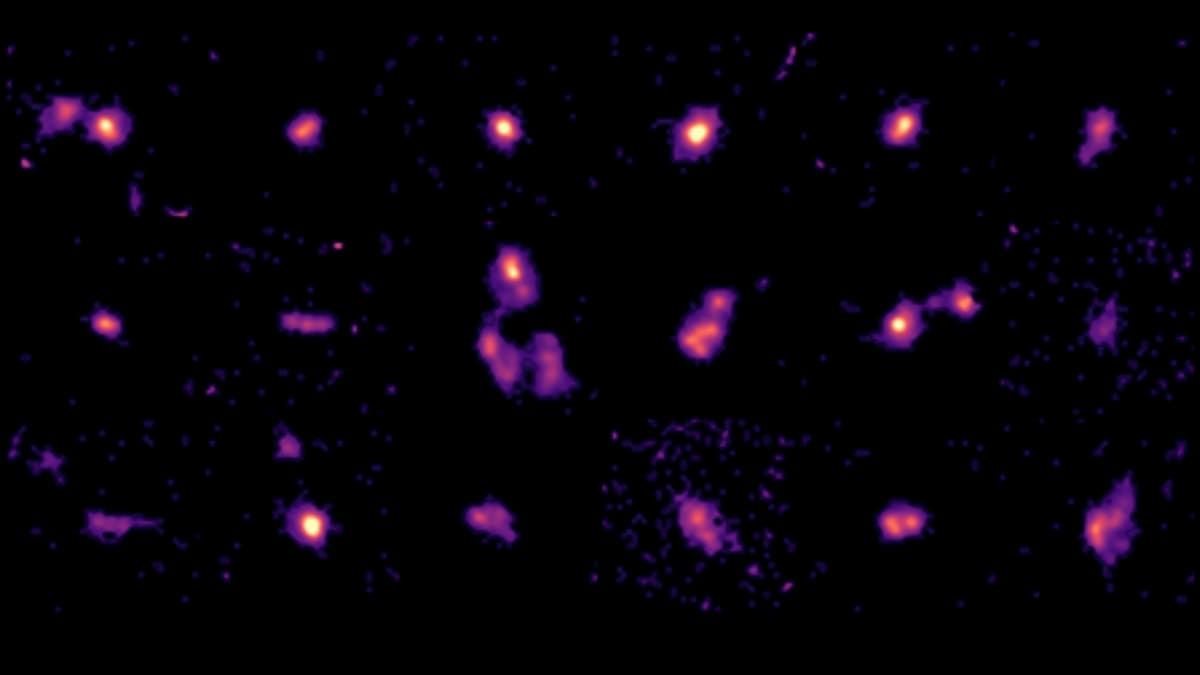
James Webb Space Telescope Discovers Young Galaxies Age Rapidly: 'It's Like Seeing 2-Year-Old Children Act Like Teenagers'
•January 20, 2026
0
Companies Mentioned

X (formerly Twitter)

Elsevier
Why It Matters
The discovery reshapes our understanding of how quickly galaxies can enrich themselves and form complex structures, impacting models of early star and planet formation. It also informs predictions for the evolution of the Milky Way’s ancestors.
Key Takeaways
- •18 early galaxies observed 12.5 billion light‑years away
- •Galaxies show unexpectedly high metal (carbon, oxygen) abundances
- •Rapid black‑hole accretion drives fast growth and enrichment
- •Rotating stellar disks appear earlier than models predicted
- •Metal‑rich circumgalactic medium shows flat abundance gradients
Pulse Analysis
The James Webb Space Telescope, working in concert with Hubble and the Atacama Large Millimeter/submillimeter Array, has finally opened a clear window onto the universe’s first billion years. By targeting a sample of 18 galaxies at a redshift corresponding to roughly 12.5 billion light‑years, astronomers can directly observe star‑forming regions as they existed when the cosmos was still in its infancy. This multi‑instrument approach provides unprecedented spatial resolution and spectral coverage, allowing scientists to dissect the physical conditions that governed early galaxy assembly.
The observations revealed a suite of unexpected properties. Despite their youth, the galaxies are already enriched with heavy elements such as carbon and oxygen, suggesting that massive stars and supernovae cycled material far more efficiently than models anticipated. Many of the systems host rapidly accreting supermassive black holes, and their stellar components are organized into rotating disks reminiscent of mature spirals. Even the surrounding circumgalactic medium displays flat metal gradients extending tens of thousands of light‑years, indicating widespread, early chemical mixing.
These results force a reassessment of galaxy‑formation simulations, which must now account for accelerated metal production, early disk stabilization, and swift black‑hole growth within the first billion years. By feeding the empirical data back into cosmological models, researchers hope to refine predictions for the birth of the first stars, the emergence of planetary systems, and the evolutionary path that led to our own Milky Way. The study also underscores JWST’s role as a transformative tool for probing the formative epochs of the universe.
James Webb Space Telescope discovers young galaxies age rapidly: 'It's like seeing 2-year-old children act like teenagers'
0
Comments
Want to join the conversation?
Loading comments...