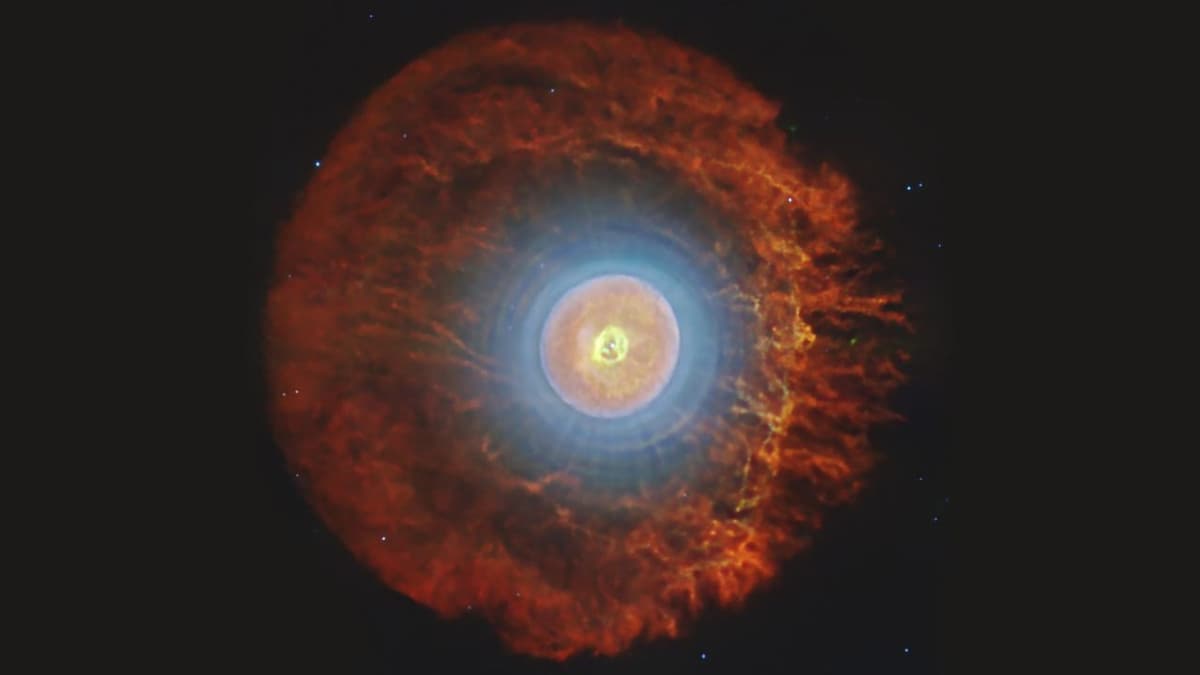
James Webb Space Telescope Peers Into a Dying Star Surrounded by Mysterious Buckyballs: 'The Structures We're Seeing Now Are Breathtaking'
Companies Mentioned
Why It Matters
By pinpointing where buckyballs form and how they emit infrared radiation, the study links stellar death to the chemistry that seeds future planetary systems, advancing astrochemical models and the search for life's building blocks.
Key Takeaways
- •JWST imaged planetary nebula Tc 1 10,000 light‑years away.
- •Buckyballs detected in distinct shell surrounding the white dwarf.
- •Infrared spectra reveal emission processes beyond current models.
- •Study will inform how organic molecules form in dying stars.
Pulse Analysis
The James Webb Space Telescope’s mid‑infrared instrument (MIRI) is delivering a level of detail that far exceeds its predecessor, the Spitzer Space Telescope, which first identified cosmic buckyballs in 2010. By targeting the planetary nebula Tc 1, JWST not only confirms the presence of buckminsterfullerene but also maps its spatial relationship to the white dwarf core, exposing intricate filamentary structures that were previously invisible. This leap in resolution opens a new window into the photochemical environments of dying stars, where intense radiation fields reshape carbon chemistry.
Astrochemists are particularly intrigued by the unexpected infrared signatures emerging from the buckyball‑rich shell. Existing laboratory models struggle to reproduce the observed emission lines, suggesting that additional processes—perhaps involving high‑energy photons or shock‑driven chemistry—play a role. Understanding these mechanisms is critical because polycyclic aromatic hydrocarbons (PAHs) and fullerenes are considered fundamental organic precursors that can survive the harsh conditions of interstellar space and later seed nascent planetary systems.
The broader implications extend beyond pure science. Accurate models of carbon molecule formation inform the design of future space‑based observatories and guide the search for biosignatures on exoplanets. JWST’s upcoming spectroscopic campaigns on two additional nebulae will test how varying radiation fields influence fullerene production, potentially establishing a universal framework for organic synthesis in the cosmos. As the data mature, the findings are poised to influence both academic research agendas and the strategic priorities of agencies investing in next‑generation infrared astronomy.
James Webb Space Telescope peers into a dying star surrounded by mysterious buckyballs: 'The structures we're seeing now are breathtaking'
Comments
Want to join the conversation?
Loading comments...