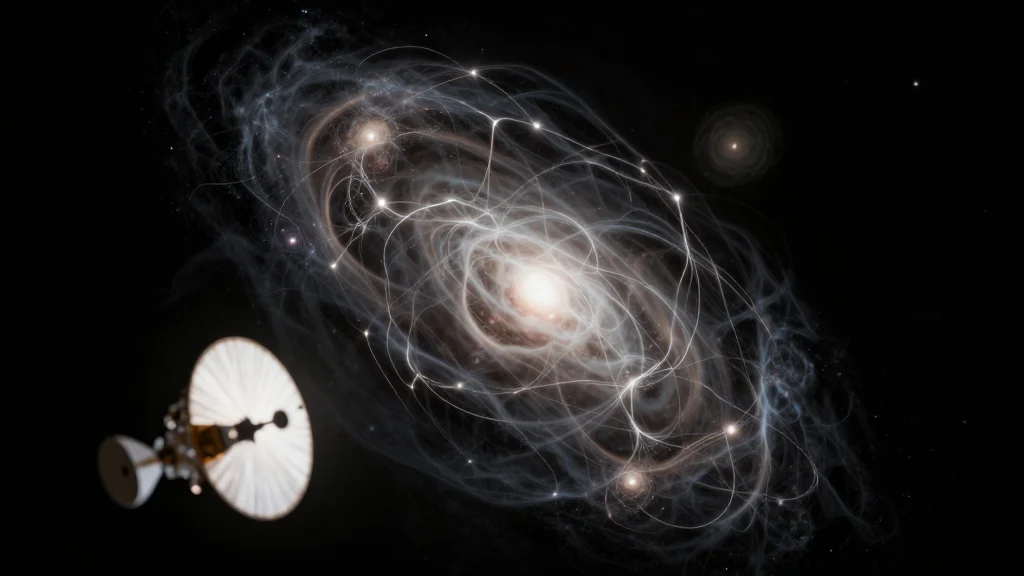
JWST Maps Cosmic Web in Record Detail Back to Universe's First Billion Years
Companies Mentioned
Why It Matters
The breakthrough provides the most complete view of large‑scale structure formation, informing models of galaxy evolution and dark‑matter distribution. Open access accelerates research and enables cross‑disciplinary studies in cosmology and astrophysics.
Key Takeaways
- •JWST's COSMOS-Web surveyed area size of three full moons.
- •Map includes 164,000 galaxies spanning 13.7 billion years.
- •Resolution surpasses Hubble, revealing structures from <1 billion‑year epoch.
- •Public release provides data pipeline, catalog, and interactive video.
- •Study traces cosmic web to redshift ~7 (≈800 million years after Big Bang).
Pulse Analysis
The James Webb Space Telescope, launched in 2021, has quickly become the premier observatory for probing the early universe. Its suite of infrared instruments can detect faint, redshifted galaxies that vanished from view after the Hubble era, allowing astronomers to peer through cosmic dust and capture light emitted less than a billion years after the Big Bang. This capability is crucial for constructing a three‑dimensional map of the cosmic web—the vast network of dark‑matter filaments that scaffolds galaxy formation. By extending observations to redshift ≈ 7, JWST fills a long‑standing gap in our understanding of how the universe’s large‑scale structure emerged.
The COSMOS‑Web program, the largest General Observer allocation ever granted to JWST, surveyed a sky patch roughly the size of three full moons. The team identified 164,000 galaxies and measured their distances with unprecedented precision, producing a high‑resolution density field that distinguishes individual filaments, sheets, and voids. Compared with Hubble’s earlier maps, the JWST data resolve structures that previously appeared as amorphous blobs, revealing the intricate branching of the web when the cosmos was only a few hundred million years old. This level of detail sharpens constraints on dark‑matter models and galaxy‑assembly timelines.
Beyond its scientific merit, the public release of the COSMOS‑Web catalog, processing pipeline, and an animated visualization democratizes access to frontier data. Researchers worldwide can now test cosmological simulations against an empirical benchmark that spans most of cosmic history. The open‑science approach also invites interdisciplinary collaborations, from machine‑learning experts refining structure‑finding algorithms to educators illustrating the universe’s evolution in classrooms. As JWST continues to deliver deep‑field observations, the COSMOS‑Web map sets a new standard for future missions such as the Nancy Grace Roman Space Telescope and the Euclid survey.
JWST maps cosmic web in record detail back to universe's first billion years
Comments
Want to join the conversation?
Loading comments...