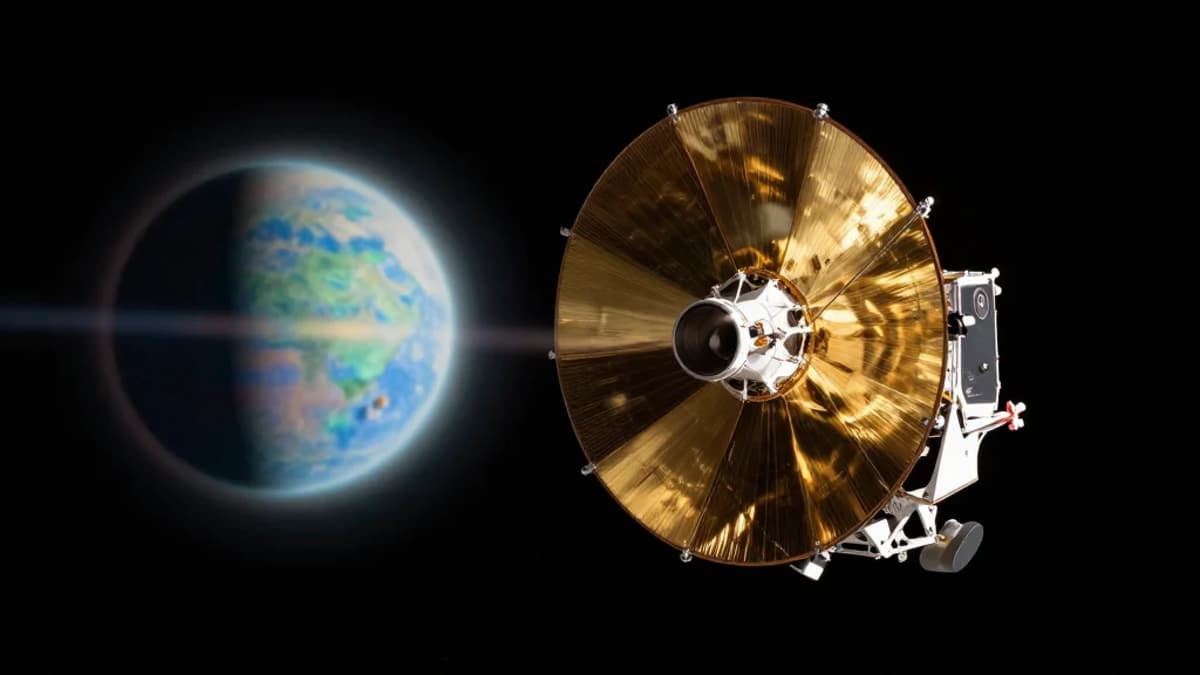
JWST Study Links Sulfur Rich Gas Giants to Core Growth in Distant HR 8799 System
•February 10, 2026
0
Why It Matters
The findings confirm that even super‑Jovian planets can arise via core accretion, reshaping giant‑planet formation theory and informing future exoplanet surveys.
Key Takeaways
- •JWST detects sulfur in HR 8799 c.
- •Sulfur enrichment supports core‑accretion formation.
- •Massive giants show uniform metal enrichment like Jupiter.
- •New data processing extracted faint planetary spectra.
- •Findings extend core‑accretion to wide, massive orbits.
Pulse Analysis
The debate over how giant planets form has long centered on two competing mechanisms: core accretion, where a solid core gathers gas, and gravitational instability, where disk fragments collapse directly into massive objects. Traditional core‑accretion models struggled to explain planets as large and distant as those orbiting HR 8799, leading many to favor the instability scenario for such systems. By placing the HR 8799 planets in the broader context of planetary formation, researchers can test the limits of existing theories and refine the conditions under which each pathway dominates.
James Webb’s unprecedented infrared sensitivity allowed the team to target refractory elements, especially sulfur, which remains locked in solid grains during the early disk phase. Detecting hydrogen sulfide and other sulfur‑bearing species in the atmospheres of HR 8799 c and its siblings provides a direct chemical fingerprint of solid‑core growth. Coupled with elevated carbon and oxygen abundances relative to the host star, the data paint a consistent picture of pebble‑driven core buildup followed by rapid gas capture, extending core‑accretion viability to orbital distances beyond 50 AU.
These results compel a revision of planet‑formation models to incorporate efficient pebble accretion and sustained solid delivery in the outer disk. The novel data‑processing pipeline demonstrated here also opens the door for similar high‑contrast spectroscopy of fainter, more distant exoplanets. As astronomers apply sulfur‑tracing techniques across a wider sample, the field will gain a clearer map of where the planetary‑brown‑dwarf boundary lies, ultimately sharpening predictions for upcoming missions and guiding target selection for direct‑imaging surveys.
JWST study links sulfur rich gas giants to core growth in distant HR 8799 system
0
Comments
Want to join the conversation?
Loading comments...