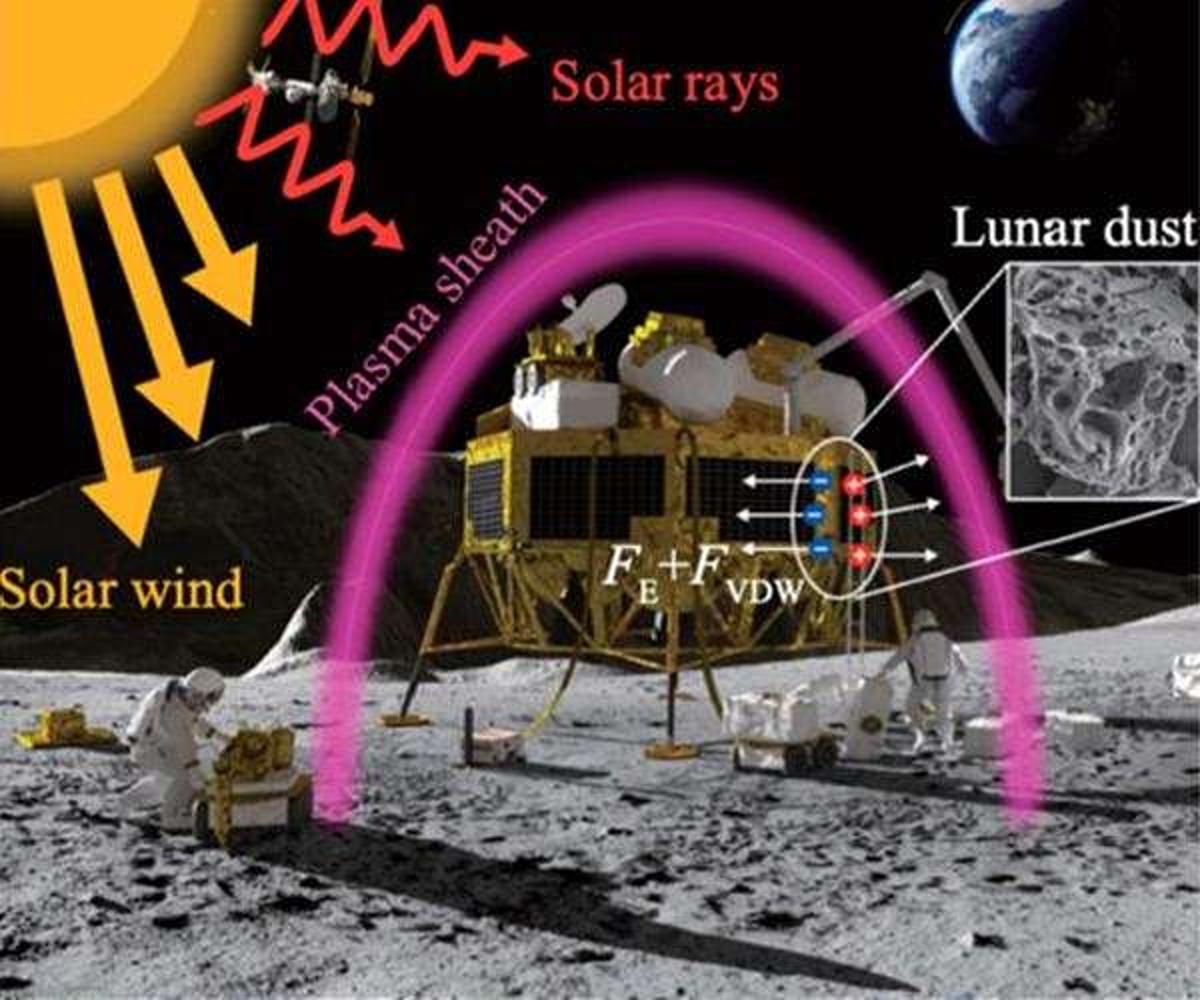
Lunar Dust Model Maps How Charged Grains Stick to Spacecraft
•March 5, 2026
0
Why It Matters
Dust adhesion threatens the reliability of lunar habitats, suits and long‑duration missions; the new model provides quantitative guidance for coating design and operational planning to limit buildup.
Key Takeaways
- •Dielectric coating thickness lowers electrostatic pull on dust
- •Surface charge density outweighs spacecraft potential in adhesion
- •Van der Waals dominate when charge <0.1 mC/m²
- •Larger grains exhibit higher restitution coefficients
- •Framework applicable to precipitators and powder mixers
Pulse Analysis
Lunar dust has long been recognized as a critical engineering challenge for sustained surface operations, eroding optics, degrading thermal control surfaces and compromising astronaut mobility. Traditional mitigation has relied on empirical testing or separate analyses of electrostatic charging and mechanical impact, leaving a gap in predictive capability. By integrating plasma sheath physics with a comprehensive contact‑mechanics formulation, the new model bridges that gap, offering a unified description of how charged grains interact with spacecraft materials under realistic lunar conditions.
The core of the framework combines three electrostatic force components—direct field, dielectrophoretic, and multipole image forces—with the Johnson‑Kendall‑Roberts (JKR) adhesive‑elastic‑plastic collision theory adapted for a Kapton dielectric coating. Simulations reveal that increasing coating thickness and selecting materials with lower permittivity markedly diminish the net attractive force, while the particle’s surface charge density exerts a stronger influence than the overall spacecraft potential. When charge densities drop below 0.1 mC m⁻², van der Waals adhesion overtakes electrostatic pull, suggesting that low‑surface‑energy, roughened coatings could simplify dust removal procedures.
Beyond the Moon, the authors argue that the same principles apply to any dusty plasma environment, from industrial electrostatic precipitators to high‑energy powder mixers. Extending the model to irregular grain shapes, dynamic plasma variations and solar‑radiation effects will sharpen its predictive power, directly informing material selection for upcoming lunar bases and informing dust‑control technologies across sectors. By quantifying the balance between electrostatic attraction and mechanical adhesion, the research equips engineers with actionable metrics to design more resilient spacecraft and infrastructure in the dusty frontier.
Lunar dust model maps how charged grains stick to spacecraft
0
Comments
Want to join the conversation?
Loading comments...