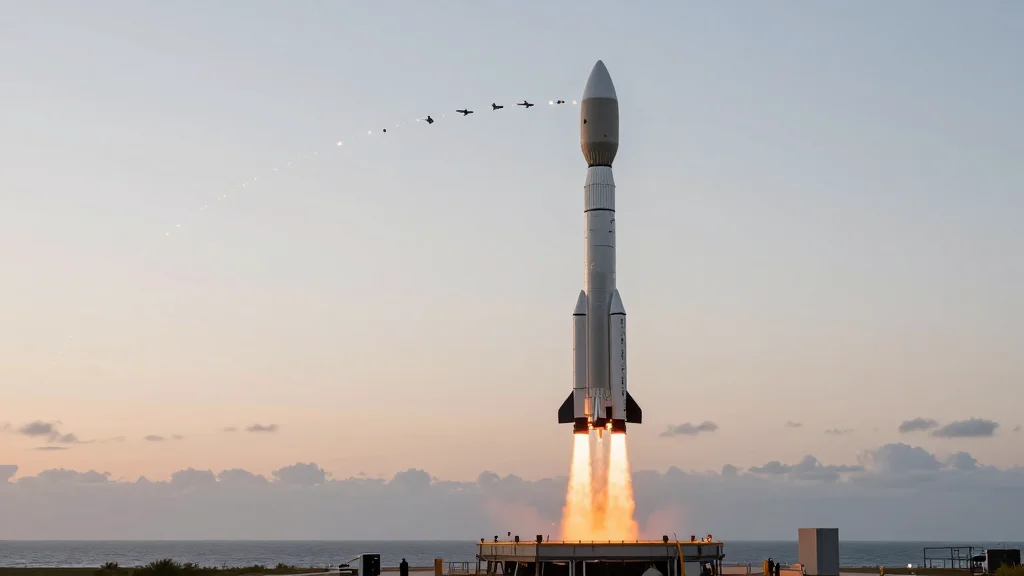
Lynk, EarthDaily, True Anomaly Launch Satellites on Weekend SpaceX Rideshare Mission
Companies Mentioned
Why It Matters
The launch demonstrates how rideshare lowers entry barriers, enabling rapid deployment of connectivity, Earth‑observation and on‑orbit servicing assets that will fuel new data‑driven markets. It also reinforces SpaceX’s dominance as the go‑to carrier for the fast‑growing small‑sat ecosystem.
Key Takeaways
- •SpaceX deployed 45 payloads on a single Falcon 9 rideshare launch
- •Lynk Global added two direct‑to‑device satellites, targeting 2027 connectivity rollout
- •EarthDaily Analytics launched six EO satellites to begin commercial services this year
- •True Anomaly’s Jackal autonomous vehicle flew after a $650 million funding round
- •Exolaunch delivered 39 customer satellites, including Europe’s IRIDE and Polish SAR missions
Pulse Analysis
SpaceX’s rideshare model continues to reshape the low‑Earth‑orbit market by offering a single Falcon 9 launch that can accommodate dozens of small‑satellite customers. The May 3 launch from Vandenberg carried 45 payloads, demonstrating the company’s operational cadence and its ability to reliably deploy heterogeneous constellations in a single mission. This efficiency reduces launch costs for emerging operators and accelerates the timeline for getting data and connectivity services into orbit, reinforcing SpaceX’s position as the de‑facto carrier for the burgeoning small‑sat ecosystem.
The payload manifest highlighted several strategic moves. Lynk Global’s two direct‑to‑device satellites, Tower 7 and Tower 8, are stepping stones toward a 2027 global connectivity service that bypasses traditional ground infrastructure. EarthDaily Analytics’ six Earth‑observation satellites will enable near‑real‑time change‑detection, positioning the firm to capture commercial contracts in agriculture, climate monitoring, and disaster response. True Anomaly’s Jackal autonomous spacecraft, funded by a $650 million round, showcases the growing demand for on‑orbit servicing and inspection capabilities, a niche that could become a revenue engine as satellite constellations mature.
The broader launch also underscored the diversification of the small‑sat market. Exolaunch’s 39 customer satellites, ranging from Iceye’s SAR units to Poland’s first synthetic‑aperture‑radar platform, illustrate how regional players are leveraging rideshare to enter space without building dedicated launch capability. Europe’s IRIDE program and Canada’s EarthDaily further signal governmental and commercial alignment on data‑driven applications. As launch capacity expands and component costs decline, the barrier to entry lowers, prompting intensified competition and rapid innovation across connectivity, Earth observation, and on‑orbit servicing sectors.
Lynk, EarthDaily, True Anomaly Launch Satellites on Weekend SpaceX Rideshare Mission
Comments
Want to join the conversation?
Loading comments...