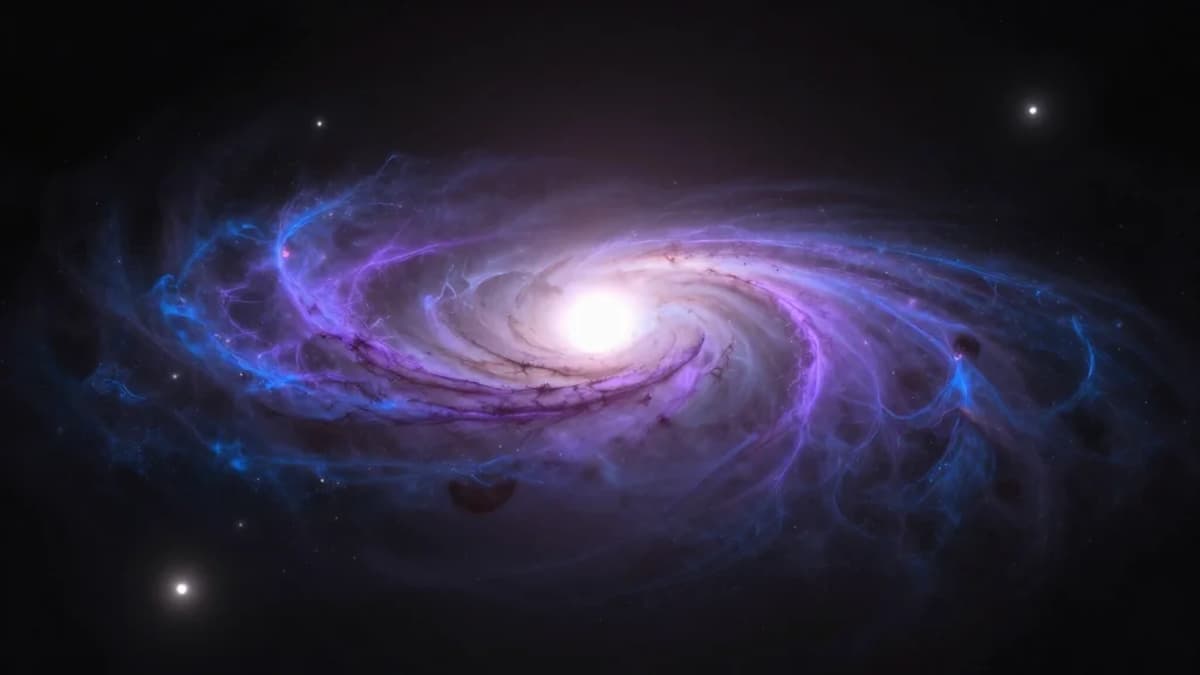
Magnetic Superhighways Discovered in a Starburst Galaxy's Winds
•January 27, 2026
0
Why It Matters
The discovery positions magnetic pressure as a critical feedback mechanism that can regulate star formation and gas removal in merging galaxies, reshaping models of galaxy evolution especially for high‑redshift dusty starbursts.
Key Takeaways
- •ALMA detected polarized CO(3‑2) emission in Arp 220
- •Outflow magnetic fields reach 1–10 mG, far above Milky Way
- •Magnetized winds can regulate star formation in merging galaxies
- •Findings suggest early‑universe starbursts host strong magnetic fields
- •Magnetic highways channel metals and dust into circumgalactic medium
Pulse Analysis
Magnetic fields have long been recognized as a subtle ingredient in galaxy evolution, yet direct measurements in the most extreme star‑forming systems remain scarce. The nearby ultraluminous infrared galaxy Arp 220, a pair of spirals in the final throes of merging, offers a rare laboratory where dense dust, intense starbursts, and active nuclei coexist. By exploiting ALMA’s full‑polarization capability at 870 µm, astronomers obtained sub‑arcsecond maps of both dust‑continuum and CO(3‑2) line polarization, delivering the first three‑dimensional view of magnetic geometry inside a buried starburst core.
The observations revealed a well‑ordered magnetic field threading the western nucleus and aligning with a bipolar molecular outflow that reaches speeds of roughly 500 km s⁻¹. Using the Davis–Chandrasekhar–Fermi technique, the team inferred field strengths of 1–10 mG within the outflow lobes—orders of magnitude stronger than the Milky Way’s disk field. This magnetization not only provides the “guardrails” that channel dust, metals and cosmic rays into the circumgalactic medium, but also contributes directly to the wind’s momentum, suggesting magnetic pressure is a missing driver in feedback models.
Because Arp 220 is the closest analog of the dusty, massive starbursts that dominated the universe ten billion years ago, the discovery implies that strong, coherent magnetic fields may have been common in early galaxies. If magnetic superhighways routinely accompany powerful outflows, they could reshape the efficiency of gas removal, the enrichment of the intergalactic medium, and the timing of quenching across cosmic history. Future ALMA surveys and next‑generation facilities such as the ngVLA will test whether these magnetic feedback channels are universal, potentially prompting a revision of galaxy‑formation simulations.
Magnetic superhighways discovered in a starburst galaxy's winds
0
Comments
Want to join the conversation?
Loading comments...