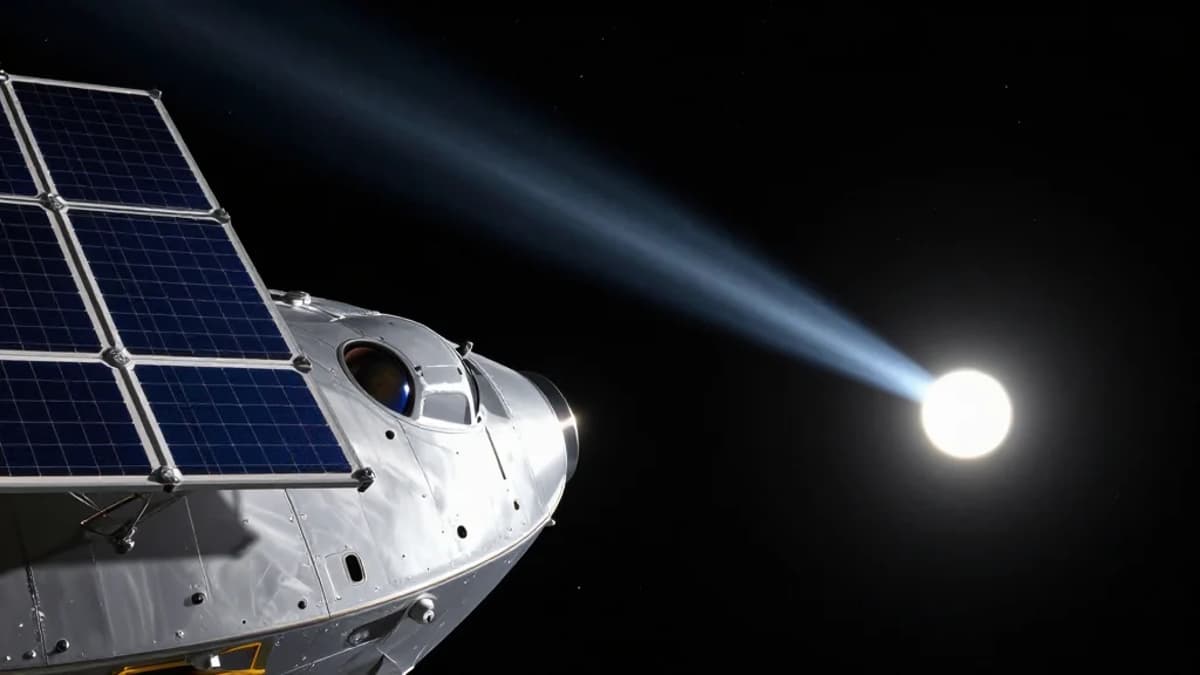
March 8, 1986: The Second of Five Probes Flies by Halley’s Comet
•March 8, 2026
0
Why It Matters
The coordinated multi‑national mission delivered unprecedented data on comet composition and structure, reshaping planetary science and informing later missions such as Rosetta. It also proved that rival space agencies can collaborate effectively on complex deep‑space objectives.
Key Takeaways
- •Vega 1 flew past Halley on March 6, 1986.
- •Japan’s Suisei probe passed on March 8, 1986.
- •Soviet Vega 2 and Japan’s Sakigake followed March 9‑11.
- •ESA’s Giotto achieved closest flyby on March 14.
- •2061 perihelion predicted brighter than 1986 by factor twelve.
Pulse Analysis
The 1986 apparition of 1P/Halley marked the first time humanity could study a periodic comet up close with a fleet of spacecraft. Although the comet reached perihelion on February 9, it was positioned behind the Sun from Earth's perspective, limiting ground‑based observations. To compensate, the Soviet Union, Japan, and the European Space Agency launched an unprecedented ‘Halley Armada’ of five probes between March 6 and March 14. This coordinated effort demonstrated that geopolitical rivals could share a common scientific goal, setting a template for future joint deep‑space endeavors.
The data returned by Vega 1, Vega 2, Suisei, Sakigake and Giotto transformed cometary science. High‑resolution images revealed a dark, peanut‑shaped nucleus roughly eight kilometers long, covered by a thin layer of volatile ices that sublimated under solar heating. Spectrometers detected water, carbon monoxide, and complex organic molecules, confirming comets as primordial reservoirs of the early solar system. Dust analyzers measured particle size distributions that informed models of comet tail formation. These findings directly influenced the design of ESA’s Rosetta mission, which later landed on comet 67P/Churyumov‑Gerasimenko.
Looking ahead, Halley's next perihelion in July 2061 promises a visual spectacle brighter than its 1986 counterpart, offering another chance for remote sensing and perhaps a new generation of probes. The 1986 armada demonstrated the scientific payoff of simultaneous multi‑point observations, a strategy now standard in planetary defense and asteroid characterization missions. Moreover, the public fascination sparked by Halley's return reinforced the value of high‑profile celestial events for science outreach and funding. As agencies plan the 2061 encounter, the lessons of 1986 will shape mission architecture, international partnerships, and data‑sharing protocols.
March 8, 1986: The second of five probes flies by Halley’s Comet
0
Comments
Want to join the conversation?
Loading comments...