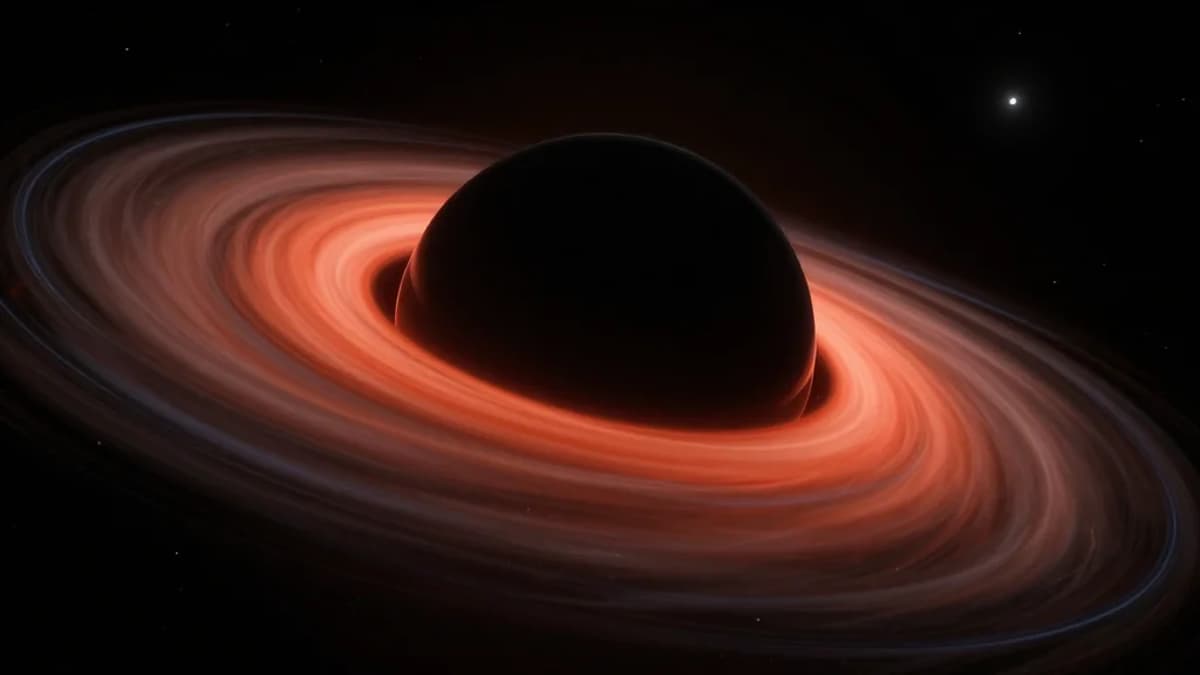
Massive Black Hole Mystery Unlocked by Researchers
•January 21, 2026
0
Companies Mentioned


Why It Matters
The study reshapes black‑hole seed theory, influencing how astronomers interpret early‑universe observations and plan future gravitational‑wave experiments.
Key Takeaways
- •Light‑seed black holes can grow via super‑Eddington accretion.
- •Simulations show chaotic early galaxies enable rapid black‑hole growth.
- •Findings reduce need for exotic heavy‑seed formation scenarios.
- •Results guide expectations for LISA gravitational‑wave detections.
- •Study highlights high‑resolution simulations as essential research tool.
Pulse Analysis
The origin of super‑massive black holes has haunted astronomers since the first James Webb Space Telescope images revealed massive quasars less than a billion years after the Big Bang. Traditional models required either improbably massive "heavy" seeds or prolonged steady growth, both at odds with observed timelines. Maynooth University’s new simulations inject fresh perspective by demonstrating that ordinary stellar‑mass black holes, born from the first stars, can experience short, intense periods of super‑Eddington accretion. This rapid feeding, driven by the dense, turbulent gas clouds of early galaxies, allows them to balloon to millions of solar masses within a few hundred million years.
The research distinguishes two seed pathways—light and heavy—but shows the former can dominate under realistic early‑universe conditions. By reproducing the chaotic dynamics of primordial galactic cores, the models reveal that the universe’s infancy was far more violent and conducive to black‑hole growth than previously assumed. This challenges the prevailing belief that heavy seeds, requiring rare direct‑collapse events, were essential for explaining the earliest quasars. Consequently, theoretical frameworks are shifting toward a hybrid view where light seeds, given the right environment, can achieve super‑massive status without exotic mechanisms.
Beyond theory, the findings have practical implications for the upcoming Laser Interferometer Space Antenna (LISA) mission. LISA aims to detect gravitational waves from merging black holes across cosmic history; the newly identified population of rapidly growing light seeds could produce a richer signal landscape than anticipated. Anticipating these events will refine detection strategies and data interpretation, enhancing our ability to map black‑hole evolution. Moreover, the study underscores the critical role of high‑resolution simulations in astrophysics, setting a benchmark for future investigations into the universe’s most extreme phenomena.
Massive black hole mystery unlocked by researchers
0
Comments
Want to join the conversation?
Loading comments...