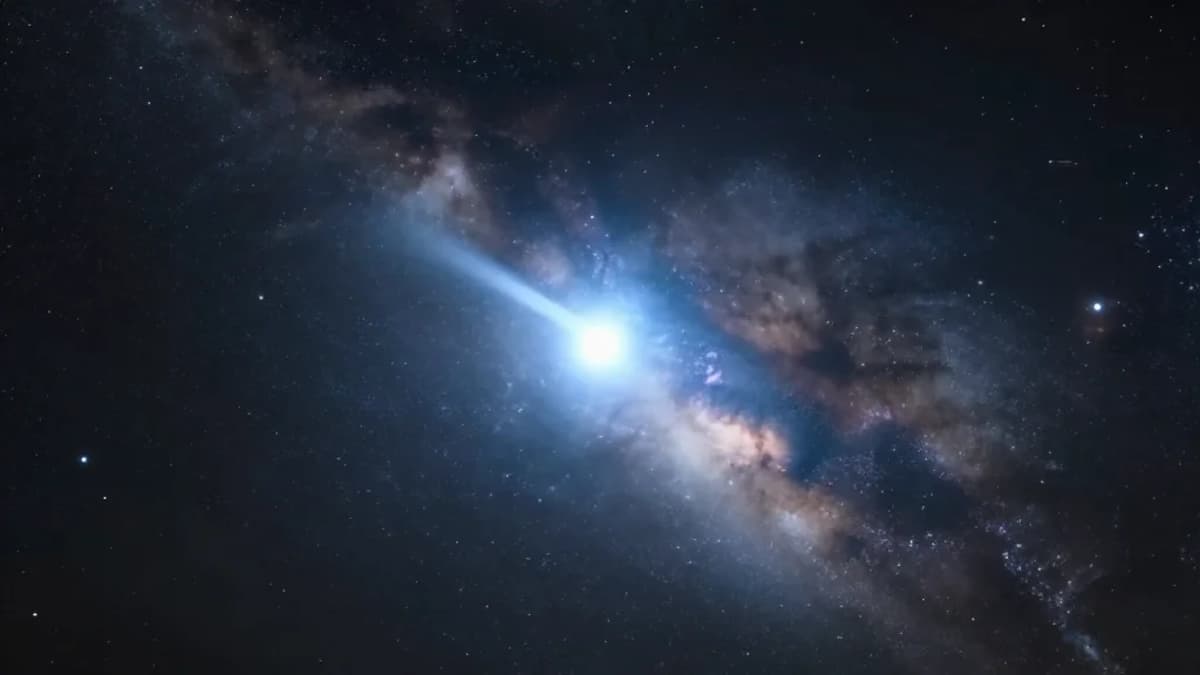
Massive Runaway Stars in the Milky Way: Observational Study Explores Origins and Ejection Process
•January 28, 2026
0
Why It Matters
Understanding the origins of massive runaway stars refines models of stellar evolution, supernova mechanisms, and the distribution of heavy elements, impacting predictions for gravitational‑wave progenitors and galactic chemical enrichment. It also provides a new observational benchmark for simulations of star‑cluster dynamics.
Key Takeaways
- •Study analyzed 214 Galactic O‑type runaway stars.
- •Fast rotators linked to supernova binary ejections.
- •Highest velocities correspond to single stars from cluster dynamics.
- •Identified 12 runaway binary systems, three likely black‑hole hosts.
- •Runaways disperse heavy elements, influencing galactic evolution.
Pulse Analysis
Runaway massive stars have long fascinated astronomers because their high velocities betray violent birth histories. Prior to this work, the relative importance of two classic ejection mechanisms—binary supernova kicks and dynamical interactions in young clusters—remained uncertain, largely due to limited samples and incomplete stellar parameters. The new study leverages the unprecedented astrometric precision of ESA’s Gaia mission together with high‑resolution spectra from the IACOB project, assembling the largest catalog of Galactic O‑type runaways ever compiled. This data set enables a statistically robust dissection of rotation rates, binarity, and space motions.
The authors find a clear dichotomy: most runaway O‑type stars rotate slowly, suggesting a dynamical origin, while the minority that spin rapidly are preferentially found in binary systems, consistent with a supernova‑driven kick. Moreover, the fastest moving objects are almost exclusively single, reinforcing the idea that close‑encounter ejections dominate at the highest velocities. Among the 214 stars, twelve are identified as runaway binaries, three of which are known high‑mass X‑ray binaries and three additional systems are strong black‑hole candidates. These results place tight observational constraints on theoretical models of massive binary evolution.
Beyond the immediate classification of ejection channels, the findings have ripple effects across several research fronts. Runaway massive stars act as mobile sources of ionizing radiation and nucleosynthetic products, seeding the interstellar medium far from their natal clusters and influencing subsequent star formation. Accurate origin tracing also improves predictions for the birth sites of compact‑object mergers that generate gravitational waves. As Gaia releases more precise proper motions and parallaxes, and as spectroscopic surveys expand, the community can refine trajectory reconstructions, uncover rarer exotic binaries, and further calibrate simulations of cluster dynamics and supernova physics.
Massive runaway stars in the Milky Way: Observational study explores origins and ejection process
0
Comments
Want to join the conversation?
Loading comments...