Massive Star WOH G64 Is Still a Red Supergiant—For Now
•January 27, 2026
0
Why It Matters
The result clarifies massive‑star evolutionary pathways and refines predictions of which stars will explode as core‑collapse supernovae. It also highlights binary dynamics as a key factor in interpreting variable red supergiant observations.
Key Takeaways
- •SALT spectra detect TiO absorption confirming red supergiant status
- •Binary companion stretches atmosphere, causing dust and emission lines
- •Fading linked to new dust cloud, not phase change
- •Study refutes transition to yellow hypergiant, revises models
- •WOH G64 remains among LMC's most luminous red supergiants
Pulse Analysis
Red supergiants sit at the upper end of the Hertzsprung‑Russell diagram, representing a brief but critical phase for stars above 15 solar masses. Their cool, extended envelopes and prodigious mass‑loss rates set the stage for core‑collapse supernovae, yet the exact timing of the transition from red supergiant to hotter evolutionary states remains uncertain. WOH G64, located in the Large Magellanic Cloud, has long been a benchmark object because of its extreme luminosity, low temperature, and thick circumstellar dust. Recent anomalies—dramatic dimming and altered spectra—prompted speculation that the star might have already entered the elusive yellow hypergiant stage.
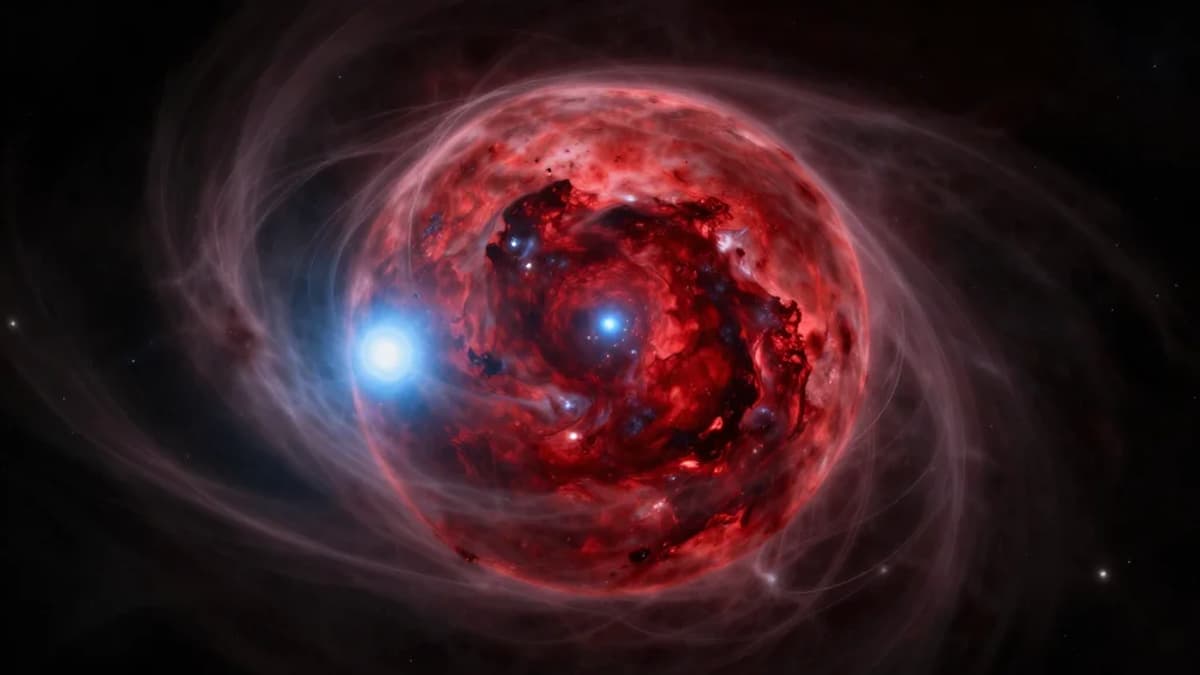
The international team led by Dr. Jacco van Loon turned to the Southern African Large Telescope to settle the debate. High‑resolution optical spectra obtained between late 2024 and 2025 revealed unmistakable titanium‑oxide (TiO) molecular bands, the hallmark of a cool photosphere. Simultaneously, emission lines from ionized gas indicated the presence of a hotter companion shaping the surrounding material. The researchers propose that binary interaction is pulling the red supergiant’s outer layers outward, creating a transient dust veil and feeding a circumstellar disk around the secondary star. This mechanism explains the observed fading without invoking a full evolutionary shift.
Confirming that WOH G64 remains a red supergiant reshapes expectations for its ultimate fate. If binary dynamics, rather than intrinsic stellar evolution, can masquerade as a phase change, astronomers must reassess supernova progenitor catalogs that rely on photometric variability alone. The finding also underscores the need for multi‑epoch spectroscopy in monitoring massive stars, especially in nearby galaxies where dust obscuration is common. Future observations with next‑generation facilities such as the James Webb Space Telescope and the Extremely Large Telescope will test whether similar binary‑driven phenomena are widespread among the most massive red supergiants.
Massive star WOH G64 is still a red supergiant—for now
0
Comments
Want to join the conversation?
Loading comments...